Joseph Pilates did not start by teaching exercises. He started with breathing. In his own words: “Above all, learn how to breathe correctly.” It is not a random motivational quote: it is the key to why Pilates works, and also the reason many people arrive at their first class feeling clumsy even when they are in good shape.
Breathing in Reformer Pilates is not what you are used to doing at the gym or in yoga. It is a specific technique that, once mastered, transforms every exercise. This article explains how it works, why it matters and how you can start practising it even before you get on the reformer.
Why breathing is the foundation of Pilates
In most physical activities, breathing is something that simply happens. In Pilates, it is an active instrument. Every movement pattern in the method is designed around a specific breathing cycle, and that is not arbitrary.
Breathing performs three functions at once in Pilates:
- It activates the deep musculoskeletal system. The diaphragm, the pelvic floor and the core muscles form an internal pressure system that coordinates with every breathing cycle. When you exhale in a controlled way, those deep muscles contract naturally.
- It facilitates mobility. A well-directed inhale creates space in the ribcage and the spine. That allows certain extension or rotation movements to be performed with greater range and without tension.
- It keeps the nervous system calm. Conscious, rhythmic breathing activates the vagus nerve and reduces activation of the sympathetic system. That is not a pleasant side effect: it is part of the method.
Lateral or intercostal breathing: what it is and how to do it
The technique of lateral breathing in Pilates is what sets the method apart from other disciplines. It is also called intercostal or three-dimensional breathing.
Unlike the usual abdominal breathing, where the belly rises as you inhale, in Pilates the instruction is different: you direct the air towards the sides and the back of the ribcage. The abdomen stays active and contained. The ribs expand sideways, like an accordion opening outwards.
How to practise lateral breathing in three steps
Step 1: Find the starting position.
Place your hands on either side of your lower ribs, thumbs towards the back and fingers towards the front. Sit or lie down in a neutral position.
Step 2: Inhale into your hands.
Breathe in through the nose and try to make the ribs push your hands outwards. The chest should not rise excessively and the belly should not swell. If it does, it is a sign that the air is going down to the abdominal area instead of expanding the ribcage.
Step 3: Exhale with control.
Let the air out through the mouth, with the lips slightly pursed, as if blowing through a straw. As you exhale, feel the ribs close and the pelvic floor and abdomen gently draw in and up.
Practise this cycle ten times before bed or when you get up. Within a week you will notice the difference when you get on the reformer.
How breathing connects with core activation
This is the point that most surprises those who come to Pilates from conventional fitness. In Pilates it is not about forcibly “sucking in your stomach”. Core activation happens as a direct consequence of a well-executed exhale.
When you exhale fully, the transversus abdominis, the deepest muscle of the abdomen, contracts reflexively. At the same time, the pelvic floor lifts slightly and the diaphragm rises. Those three elements working together form what Pilates calls the “centre” or powerhouse.
This has a very concrete practical implication: in most reformer exercises, the main effort or the moment of greatest load happens during the exhale. Not because a rule says so, but because that is when your body has the most stable internal support.
To go deeper into how the reformer works the core progressively, read our article on Reformer Pilates for core and abs.
Coordination: when to inhale and when to exhale
The question students ask most in the first classes is: “When do I breathe?”. The honest answer is that at first it is the hardest part, and nobody gets it perfect from day one.
There are general patterns that guide coordination:
- You inhale in the preparation or in the phase of least effort. For example, as you slowly lower to the starting position before pushing the carriage.
- You exhale on the effort, the drive or the phase of greatest demand. As you extend the legs, as you flex the spine, as you push the footbar.
- You inhale to lengthen, exhale to contract. In spinal extensions you inhale; in forward flexions, you exhale.
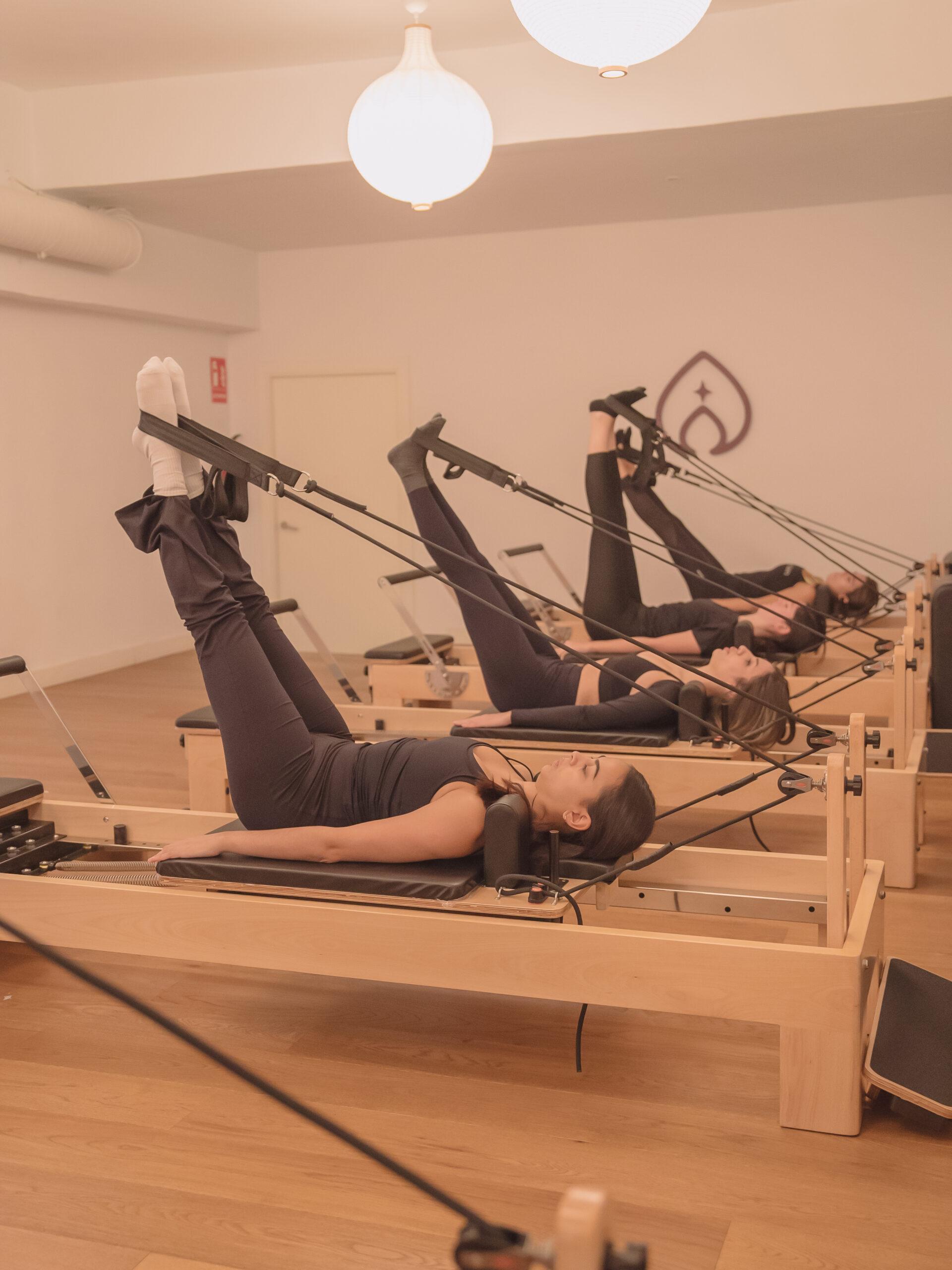
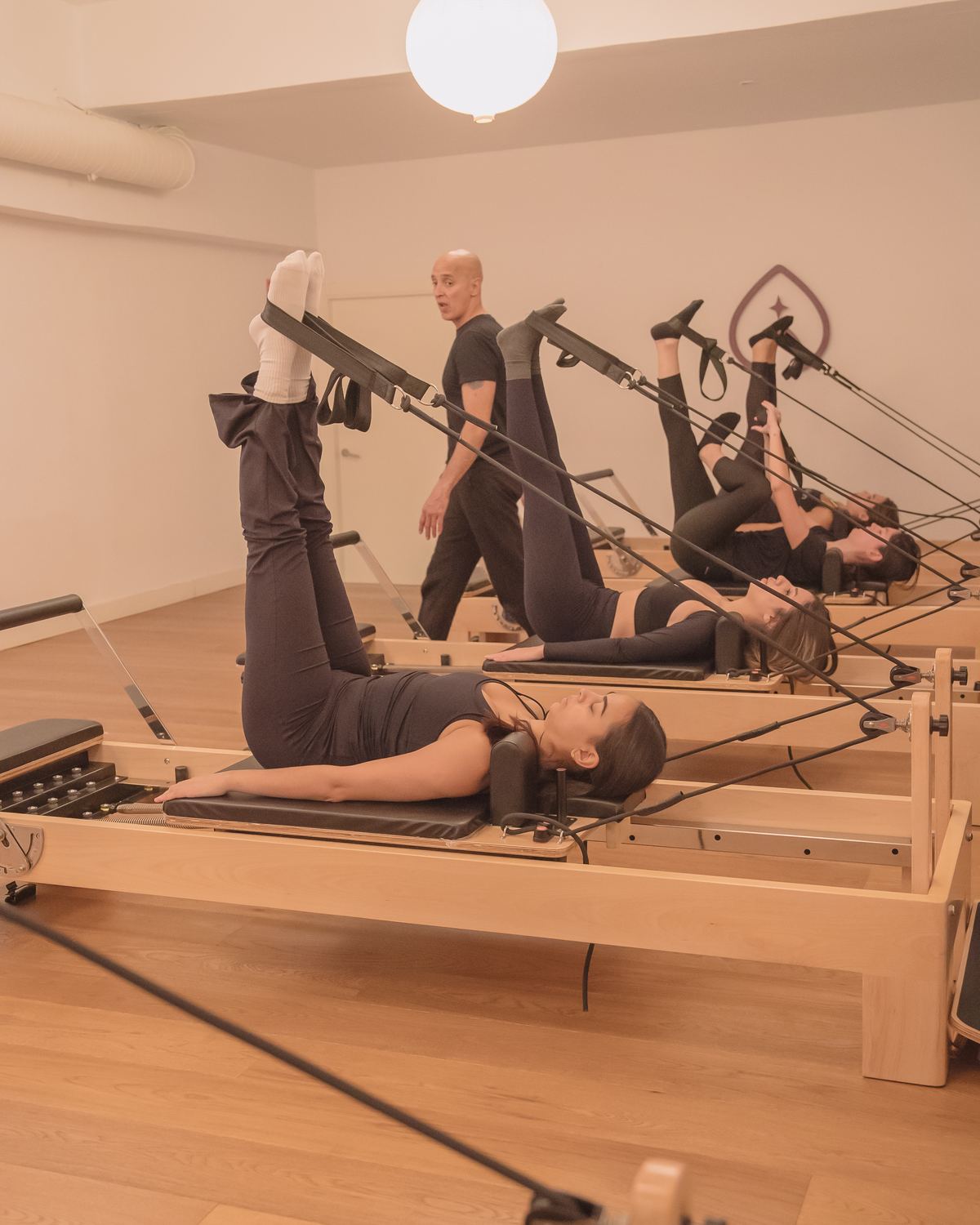
Some exercises have reversed or more complex patterns, especially at multilevel and advanced levels. That is why the instructor’s guidance in the first sessions is key. At Pinar Pilates every class has a maximum of eight people, which lets the teacher correct and guide each student’s breathing individually.
Common breathing mistakes for beginners
If you are starting out, you will probably make some of these mistakes. That is fine: they are universal and are corrected quickly with conscious practice.
Holding your breath during the effort. The most frequent. When an exercise is hard, the instinct is to hold your breath. That raises intra-abdominal pressure in an uncontrolled way and switches off the deep muscles just when you need them most.
Breathing only with the chest without directing the air to the sides. The chest rises a lot but the ribs do not expand. It is shallow breathing that does not activate the diaphragm properly.
Swelling the belly on the inhale. It happens when lateral breathing has not yet been learned. The abdomen relaxes and expands, which switches off the core at the moment of inhaling.
Forcing the exhale until you run out of air. Emptying the lungs completely and abruptly creates unnecessary tension in the neck and shoulders. The exhale should be complete but fluid.
Desynchronising breathing and movement. Moving in one direction while breathing in the opposite one. This is worked on specifically in the first beginner classes. If you have not taken the step yet, our article on Pilates on machines for beginners gives you an idea of how that learning is structured.
4 breathing exercises to practise at home
These exercises need no equipment. You can do them on the floor, in bed or sitting on a chair. They prepare you to arrive at the reformer with a more solid breathing foundation.
1. Lateral breathing with hands on the ribs
As described above. Ten slow cycles, inhaling for four counts, exhaling for six. Focus on opening sideways and closing on the exhale.
2. Zip up on the exhale
Lie on your back with your knees bent. Inhale and prepare. As you exhale, imagine you are pulling up a zip from the pubic bone to the navel: first the pelvic floor lifts, then the lower belly gently flattens. Hold that contraction for three seconds at the end of the exhale. Repeat ten times.
3. Spinal flexion with breathing
Seated with a straight back, inhale to lengthen. As you exhale, slowly roll forward vertebra by vertebra, as if you wanted your forehead to reach your knees. As you inhale, rebuild the spine upwards from the lower back. Four slow repetitions. This exercise directly connects breathing with spinal mobility.
4. Breathing in table-top position
On all fours, spine neutral. Inhale without moving anything. As you exhale, draw the abdomen in without moving the pelvis or the spine. Hold for five seconds. This trains transversus abdominis activation without the extra effort of moving the limbs.
Benefits of correct breathing beyond Pilates
The breathing technique you work on the reformer has an impact that goes far beyond the studio.
Less stress and anxiety. Slow, controlled breathing activates the parasympathetic system. Practised regularly, it lowers cortisol levels and improves the body’s response to pressure. If this is one of your main goals, you may be interested in our article on Reformer Pilates and anxiety.
Better sleep quality. Full diaphragmatic breathing before bed reduces nervous system activation and eases the transition to sleep. Many Pinar Pilates students mention that they sleep better from the first weeks of practice. You can read more in the article on Reformer Pilates for better sleep.
Greater concentration. Breath control improves brain oxygenation and trains the ability to keep your attention on a single task. It is one of the effects most valued by students who practise Pilates in high-pressure work environments.
Better sports performance. More efficient breathing muscles reduce the energy cost of breathing during exercise. That leaves more resources available for overall muscular performance.
How breathing technique evolves from basic to advanced level
In the first sessions, the goal is simple: learn not to hold your breath and start directing the air to the sides. Perfect coordination is not expected. Awareness is.
At multilevel, breathing becomes more precise. The student starts to anticipate the breathing pattern of each exercise before performing it. Core activation on the exhale is more consistent and no longer requires so much conscious attention.
At advanced level, breathing and movement are one and the same. There is no “I think about breathing and then I move”. The breathing cycle organises the movement automatically. At this level intentional variations also appear: faster breathing patterns or specific pauses that increase core work or cardiovascular demand.
This progress takes time. Most students start to feel they have mastered basic breathing between the fourth and eighth session, depending on how often they practise and whether they do complementary exercises at home.
Frequently asked questions about breathing in Reformer Pilates
Do I have to think about breathing in every exercise from the start?
Not obsessively. At first it is enough not to hold your breath and to start exploring lateral breathing. Your instructor will give you progressive cues. Precise coordination comes with the sessions.
Is breathing in Pilates the same as in yoga?
Not exactly. Yoga uses multiple breathing techniques, including deep abdominal breathing. In Pilates the central technique is intercostal or lateral breathing, which keeps the abdomen active. They are complementary but different approaches.
Can I do the breathing exercises at home even without a reformer?
Yes, and it is highly recommended. The four exercises described in this article need no equipment. Doing them three or four times a week noticeably speeds up learning on the reformer.
Why do I feel dizzy when practising the breathing?
Mild dizziness at first is common. It happens because the body is not used to full, deep breathing, and the variation in carbon dioxide can cause a passing feeling of light-headedness. If it happens, pause, breathe normally and resume more gradually. If it persists, tell your instructor.
How long does it take for the breathing technique to become natural?
It depends on the person and how often you practise. With one or two classes a week and some practice at home, most students feel breathing starts to come naturally between the sixth and tenth session. It is not a linear process: there are days when everything flows and days when you have to go back to basics.
Get off to a good start at Pinar Pilates
Breathing is a skill you learn, not a talent you are born with. At Pinar Pilates, in the heart of the Salamanca district (Calle del Pinar 8, Madrid), every class is designed so that the learning curve is clear and progressive.
With a maximum of eight people per class and more than forty sessions a week, you have the flexibility to find the time that fits your week best and the individual attention the method demands. Our more than 490 Google reviews (average 4.9 out of 5) reflect what students find when they arrive: a space where detail matters, including breathing.
If you have questions before booking, you can call us on +34 611 994 729.
Book your first class at 50% off
Pinar Pilates · Salamanca district, Madrid
Your first reformer class, €15
Groups of 8 people maximum, specialist instructors and more than 40 classes a week. Your first class is half price.
Book my first classCalle del Pinar 8, Madrid · Questions? Message us on WhatsApp