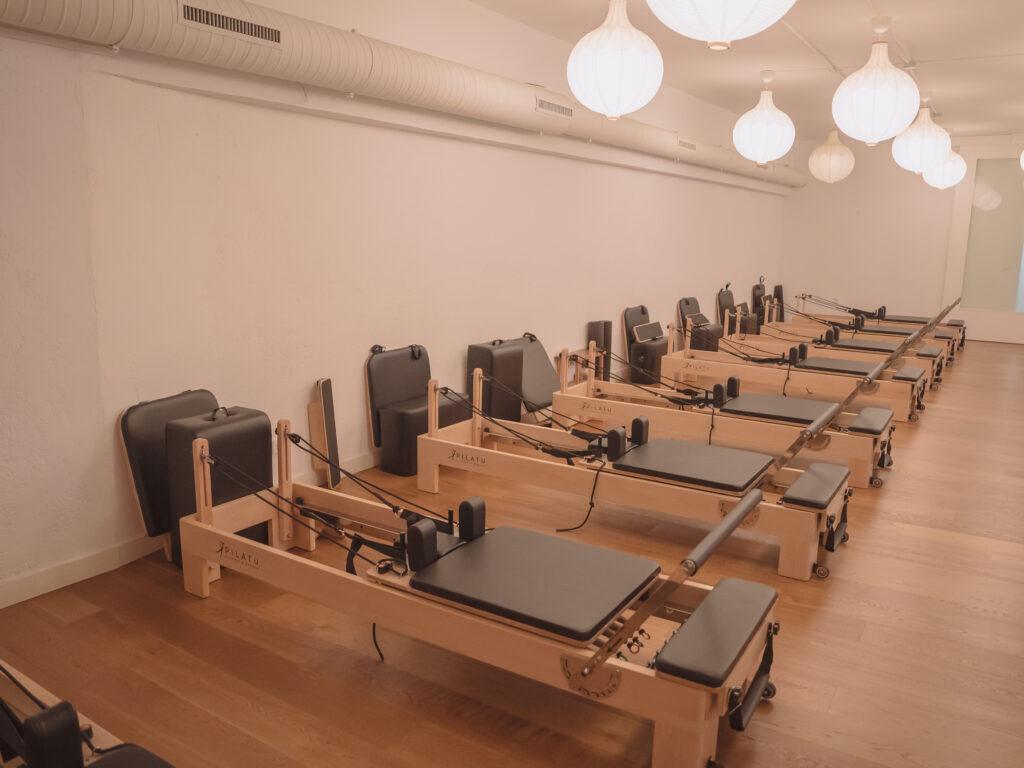
Key answer: if you have never done Pilates, start with a Basic level Reformer class in a small group. At Pinar Pilates (Calle del Pinar 8, Salamanca district, Madrid) every class lasts 50 minutes with 8 people max, and your first class costs €15 (50% off). After that you can carry on with a single class (€30), a 5-class pack (€130) or a membership from €100 a month (4 classes). See the classes · See prices · Book your first class.
| Which class to choose | Basic Reformer Pilates, designed for people who are new to the reformer. Then Multilevel (suitable for all levels) and Advanced. |
| Length | 50 minutes |
| Group size | 8 people max, each with their own machine |
| First class | €15 (50% off the €30 drop-in price) |
| After that | Single class €30 · packs of 5, 10 or 20 classes (€130, €200, €340; valid 90 days) · memberships from €100 a month |
| Where | Calle del Pinar 8, 28006 Madrid (Salamanca district) |
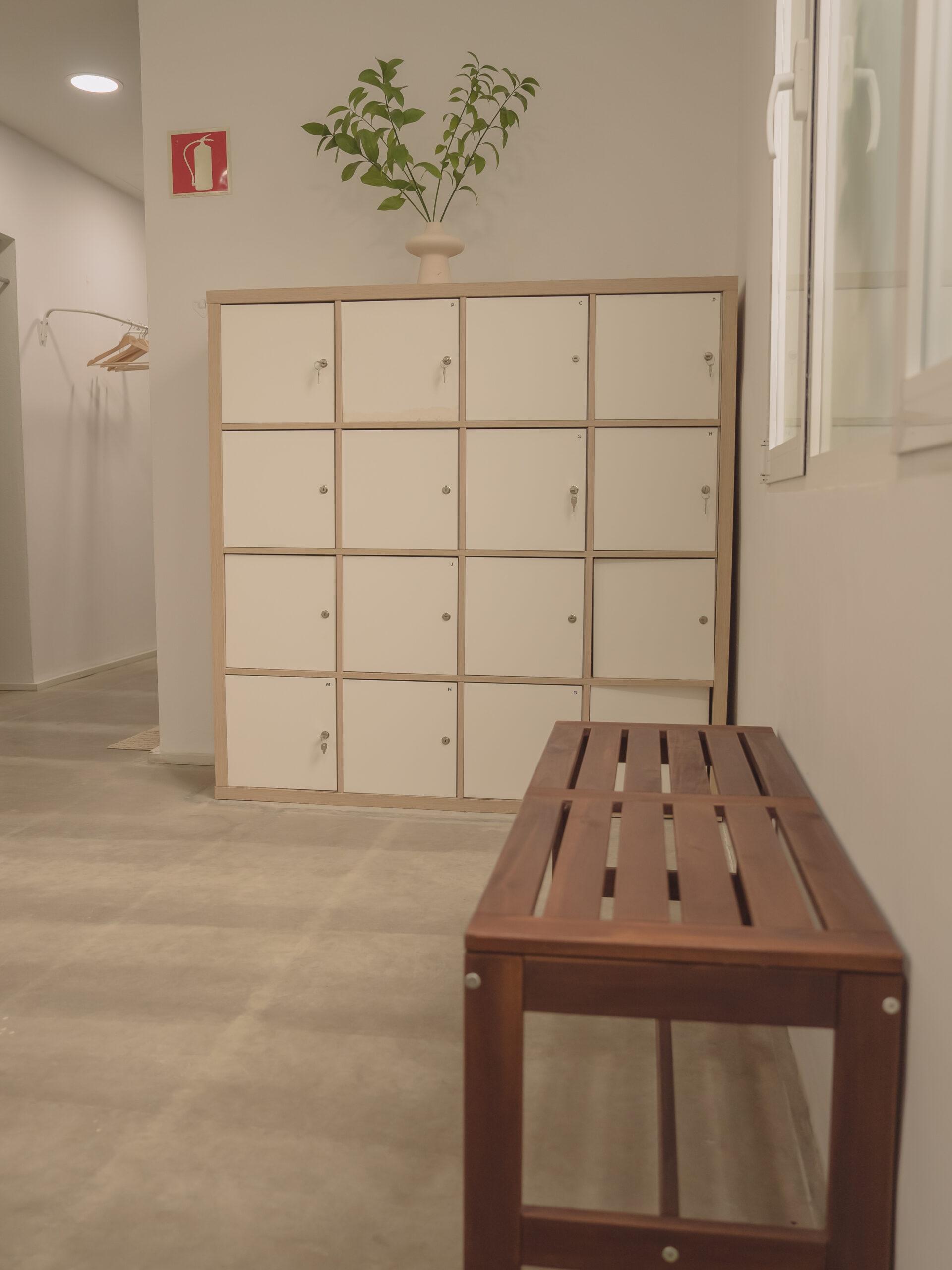
| Facilities | Changing rooms with showers and towels to rent |
The first time you see a Reformer machine it can stir up mixed feelings. On one hand, curiosity. On the other, a certain respect. The apparatus has rails, springs, straps and a sliding platform that looks like nothing you have seen in a conventional gym. It is understandable to wonder whether you will be able to use it.
The short answer: yes. The Reformer was not designed for elite athletes or for people with previous fitness experience. Joseph Pilates created it precisely as a rehabilitation tool, designed to help people with physical limitations to move. If they could, so can you. Pilates on machines for beginners is, in fact, one of the safest and most effective ways to start training.
What the Reformer Machine Is and How It Works
Before your first class it helps to understand the basic parts of the machine. You do not need to memorise anything, the instructor will guide you at every step, but having a reference will help you feel more at ease.
The carriage
This is the padded platform you lie, sit or kneel on. It glides on rails inside a fixed frame. When you push your feet against the bar or pull on the straps, the carriage moves. What controls that movement are the springs.
The springs
They are the heart of the Reformer. They hook between the carriage and the frame and provide resistance when you push the carriage out, and assistance when it returns. There are springs of different tensions (usually identified by colour). By combining different springs, the instructor adjusts the resistance of each exercise to your level.
A detail that surprises beginners: more springs does not always mean harder. For some exercises, reducing the resistance forces the core to work harder to stabilise the movement. It is a very clever system.
The footbar
A horizontal bar at one end of the machine. It is used for pushing with the feet (like a horizontal squat) or with the hands. It has several height positions that are adjusted according to the exercise and each person’s height.
The straps
Two ropes with handles that come from pulleys at the other end of the Reformer. They are used for arm, leg and abdominal exercises. They let you work pulling, extension and rotation against the resistance of the springs.
The headrest
A padded support for the head with two or three positions. It is raised or lowered depending on the exercise to keep the cervical spine in a neutral, comfortable position.
Is Pilates on Machines Hard for Beginners?
No. And there are three fundamental reasons.
The machine helps you. Unlike mat Pilates, where your own weight is all the resistance, the Reformer uses springs that can assist the movements. If an exercise is too demanding for you, the instructor changes the spring set-up and the same movement becomes more accessible. The machine adapts to you, not the other way round.
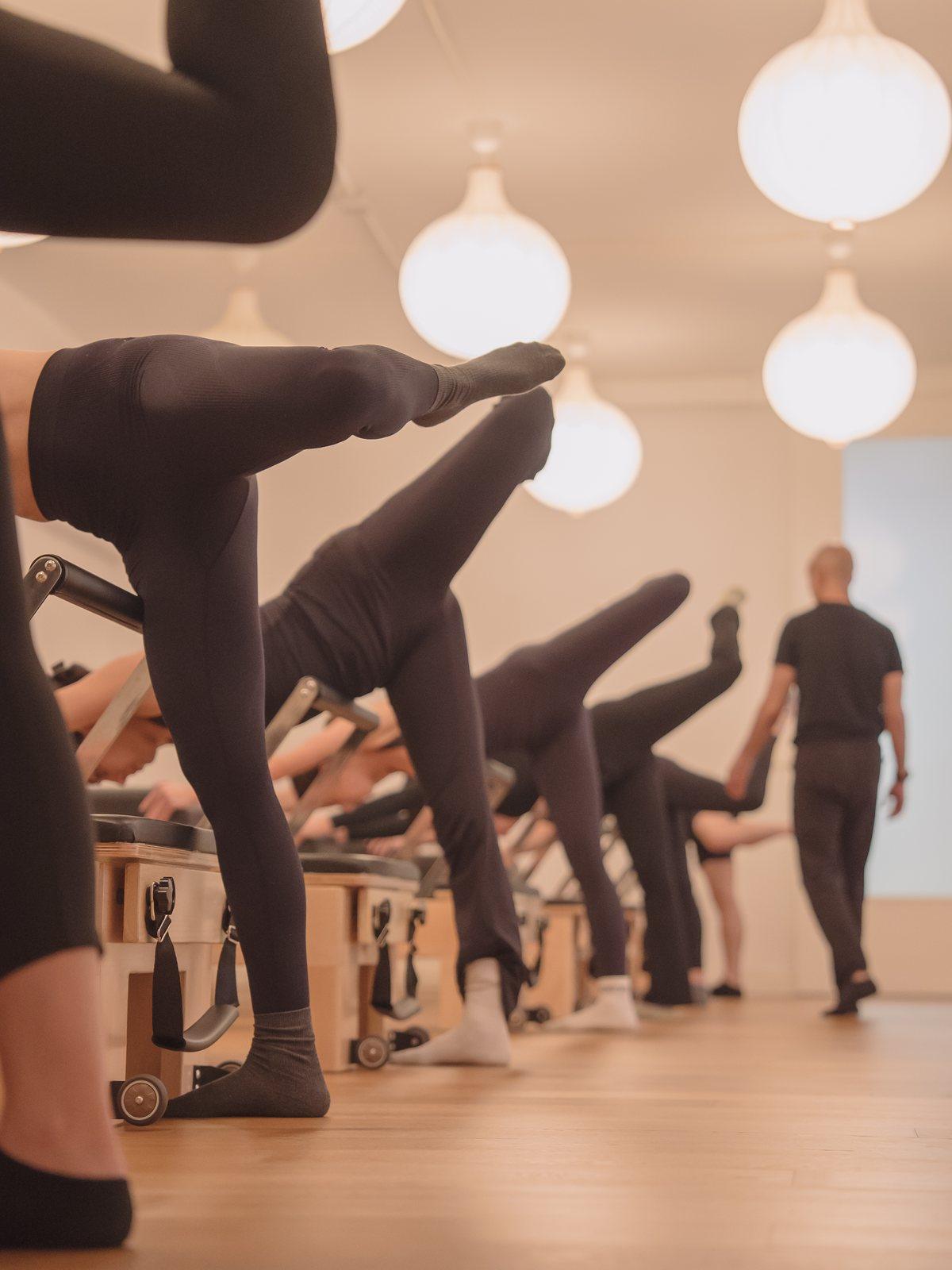
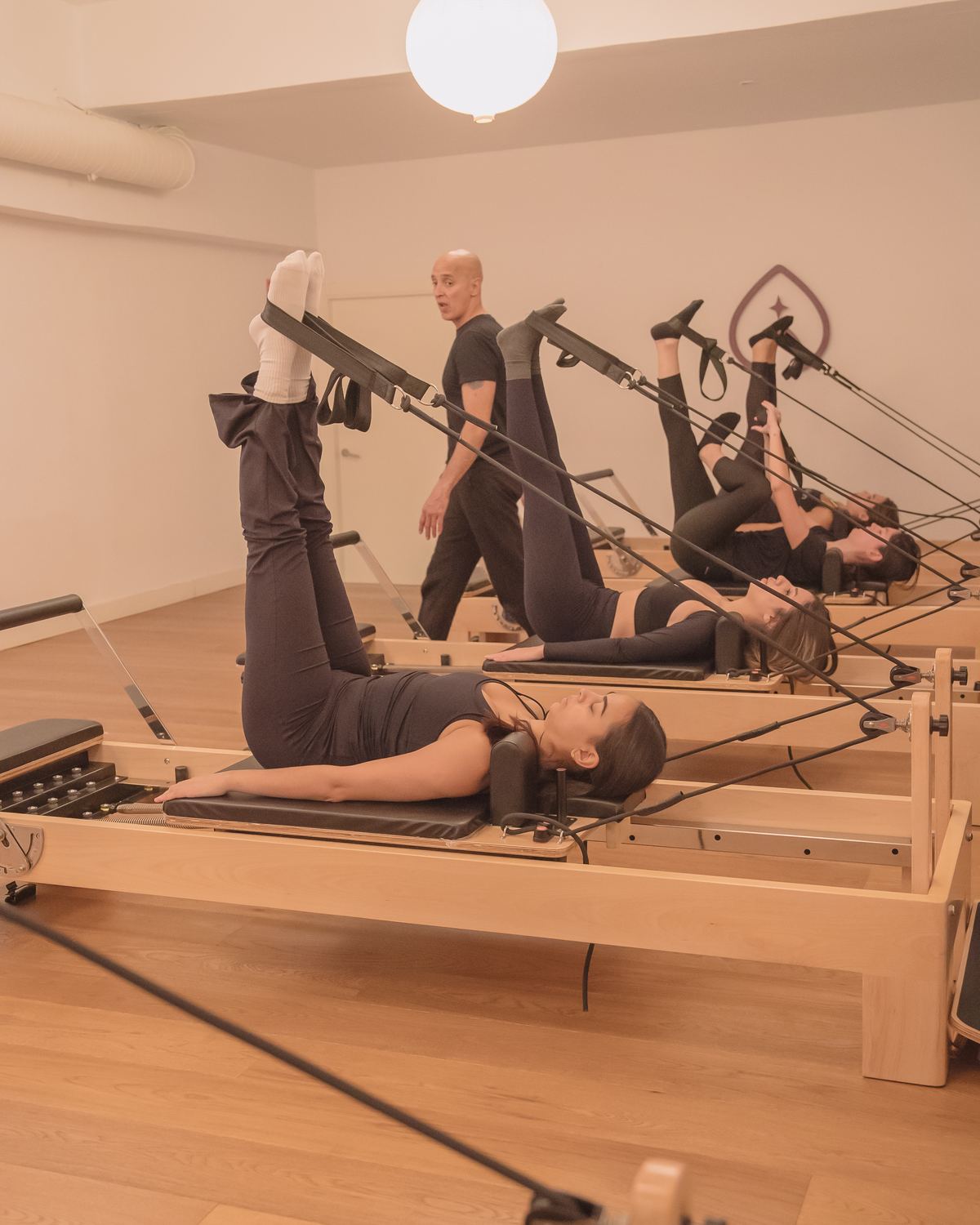
The instructor guides you at every moment. In a studio like Pinar Pilates, with groups of 8 people maximum, the attention is direct. Instructors such as Giuliana Di Giovanni, Gabriela Seminara or Abel Gomez can watch you, correct you and adapt the exercises to your specific needs. You are not alone in front of an unfamiliar machine.
The pace is controlled. Reformer Pilates is not high-intensity training where you have to keep up with the group at all costs. Every movement is performed slowly and with control, with the emphasis on quality. If you need more time, you take it. If you need a pause, the instructor offers you an alternative.
A study published in Physical Therapy in Sport (2015) showed that equipment-based Pilates is safe and effective for beginners, even for people with chronic low back pain. The key lies in proper supervision and gradual progression.
Your First Class on the Machines: Step by Step
Before the class
Arrive 10 minutes early to complete your registration and have a brief chat with the instructor about your history: previous injuries, activity level, current complaints and goals. This information lets them adapt their cues during the session.
Wear comfortable, close-fitting clothes (leggings and a top that is not too loose so the instructor can see your alignment). Bring grip socks if you have them. If not, you can go barefoot.
During the class
The session lasts 50 minutes. The instructor introduces you to the machine, shows you how to adjust the springs and places you in the starting position. The first exercises are simple: footwork on the bar so you feel how the carriage moves, breathing to activate the core, basic leg and arm movements.
Over the course of the class, the instructor gradually increases the complexity. They will tell you when to change the springs, how to hold the straps and which muscles you should be feeling. It is normal to find it hard at first to coordinate your breathing with the movement. That comes with practice.
After the class
It is usual to feel a mix of muscle fatigue and wellbeing. Many beginners notice parts of the body they had never felt before: deep abdominals, hip stabilisers, muscles between the shoulder blades. The next day mild soreness may appear, a sign that you have activated muscles that had been inactive for some time.
Drink water, eat well and make a mental note of how you feel. It will be useful for the next session.
5 Reformer Exercises That Are Ideal for Beginners
These are five exercises you will find in any beginner-level class. You do not need to memorise them, the instructor will guide you, but knowing them in advance can give you more confidence.
1. Footwork
Lying on your back with your feet on the bar, you push the carriage away and return, controlling the way back. It is the equivalent of a horizontal squat, but with no load on the spine. It works the quads, glutes and hamstrings. It is the exercise almost every class starts with because it familiarises you with the movement of the carriage.
2. Pelvic Curl
With your feet on the bar and the carriage still, you peel the pelvis off vertebra by vertebra until you form a bridge. It strengthens the glutes, hamstrings and the deep muscles of the trunk. It is a gentle exercise that teaches segmental control of the spine, a fundamental principle of Pilates.
3. Arms in Straps
Lying on your back, you hold the straps in your hands and perform arm movements against the resistance of the springs: circles, extensions and openings. It strengthens the shoulder girdle and teaches you to stabilise the shoulders while the arms move. It is especially useful for people who spend many hours at a computer.
4. Leg Circles
With your feet in the straps, you draw circles with your legs while keeping the pelvis stable on the carriage. It works the hip flexors, the core and coordination. The challenge is not drawing the circle, but keeping the pelvis still while you do it.
5. Abdominal Series
A sequence of exercises lying on your back that works every layer of the abdominal muscles. The instructor can assist the movement by adding more springs so that the head and shoulders lift with help, or reduce them to increase the demand. It is a perfect example of how the machine adapts to the beginner.
Mistakes Beginners Make (and How to Avoid Them)
Holding your breath
It is the most common mistake. Concentrating on the movement, you forget to breathe. The problem is that without proper breathing, the deep muscles do not activate correctly. The general rule is to exhale on the effort and inhale on the return. Do not worry if it does not come naturally at first. The instructor will remind you.
Going too fast
Reformer Pilates does not reward speed. The benefit lies in control. Moving the carriage slowly, resisting in the return phase and keeping your alignment at all times is far more effective (and demanding) than doing fast repetitions. If the carriage bangs when it comes back, you are probably going too fast.
Choosing the wrong resistance
At the start, the temptation is to use little resistance thinking it will be “easier”. But as we have explained, less resistance can mean more difficulty because the body has to compensate with stabilisation. Trust the instructor when they tell you which springs to use. They know the logic of the system.
Comparing yourself with the rest of the class
In a group of 8 people, everyone will be at a different level. A classmate may be doing an advanced variation of the same exercise you are learning. That is perfectly normal. The beauty of small classes is that each person receives cues adapted to their level. Your only reference should be yourself.
How Many Classes You Need to Feel Comfortable on the Machine
The answer varies from person to person, but the pattern we see at Pinar Pilates is fairly consistent.
Class 1: Everything is new. You concentrate on understanding the machine, following instructions and coordinating basic movements. You leave with a first impression, usually positive, but with the feeling that there is a lot left to discover.
Classes 2-3: You start to recognise the exercises and anticipate the movements. The machine no longer feels strange. You start to feel the right muscles and to connect your breathing with the movement.
Classes 4-5: Something changes. The movements flow more naturally. You start to notice when you lose your alignment or when you are compensating. The instructor starts offering you more challenging variations.
Joseph Pilates used to say: “In 10 sessions you feel the difference, in 20 you see the difference, in 30 you have a new body.” Our experience confirms that from the fifth class, beginners start to enjoy the Reformer in a completely different way.
That is why our first class at 50% off for just €15 is such a popular starting point. One session gives you enough context to decide whether you want to continue with one of our monthly plans.
Start at Pinar Pilates
For anyone looking for a place to take their first steps in Pilates on machines, our studio in the Salamanca district is designed to make that transition as easy as possible.
More than 490 people have rated their experience at Pinar Pilates on Google, with an average of 4.9 out of 5.
Small groups. A maximum of 8 people per class. This is not a slogan, it is the physical capacity of the studio. Every student has a machine and the direct attention of the instructor.
Trained instructors. Giuliana Di Giovanni, Gabriela Seminara, Camila T, Montserrat Sierra and Abel Gomez have specific training in Reformer Pilates and experience working with beginners. They know when to push and when to adapt.
More than 40 classes a week. Finding a time that fits your life should not be the obstacle that stops you from starting. Check our class schedule and choose the one that works best for you.
Central location. Calle del Pinar 8, 28006 Madrid. In the heart of the Salamanca district, well connected by public transport.
If you want to dig deeper into the benefits of the method, we recommend reading our article on the 10 benefits of Reformer Pilates backed by science. And if you are wondering whether to start on machines or on the mat, our Reformer Pilates vs mat Pilates comparison will help you decide.
Frequently Asked Questions
Is Pilates on machines suitable if I have never exercised?
Yes. The Reformer is one of the best options for people with no previous sporting experience. The springs let the movements be assisted, reducing the demand to a level accessible to anyone. The instructor adjusts the resistance and complexity of every exercise to your capacity. You do not need any base of strength, flexibility or coordination to start.
Can I do Pilates on machines if I have an injury?
It depends on the injury, but in most cases yes. The Reformer lets you work unloaded (without bearing your own weight), which makes it an excellent rehabilitation tool for back, knee, shoulder and hip problems. We recommend telling the instructor before the class and, if the injury is recent, checking with your doctor or physiotherapist. For more information, read our article on Reformer Pilates for back pain.
How many times a week should I do Pilates on machines as a beginner?
For beginners, we recommend 2-3 sessions a week. At this frequency, the body has time to recover between sessions and progress is steady. Our 8-class monthly plan (€150/month) is designed exactly for this frequency.
Is it normal to feel sore after the first Reformer Pilates class?
Completely normal. The Reformer activates deep muscles you probably do not use in your daily life. The soreness is usually mild and disappears in 24-48 hours. It is a sign that your body has responded to the stimulus. As your body adapts, soreness will become less frequent.
Which class should I book if I have never done Pilates?
Book a Basic Reformer Pilates class. It is designed for people who are new to the reformer or who prefer a gentler pace: you learn alignment, controlled breathing and core activation while the instructor guides you step by step. Once you know the basics you can move on to Multilevel, which is suitable for all levels, and later to Advanced. See all our classes.
How much does a beginner Reformer class cost at Pinar Pilates?
Your first class costs €15 (50% off). After that a single class is €30, packs of 5, 10 and 20 classes cost €130, €200 and €340 (valid for 90 days), and memberships start at €100 a month for 4 classes. Every plan is on our prices and schedule page.
How many people are in each class?
Eight people max, each with their own machine. With a small group the instructor can adjust the springs and correct your posture during the class.
How do I book my first class?
Online: book your first class and choose a Basic level class, or pick a day and time first in the schedule. The studio is at Calle del Pinar 8, in the Salamanca district of Madrid.
Are there changing rooms and showers?
Yes. The studio has changing rooms with showers, and you can rent a towel, so you can come straight from work or head to the office after class.
Take Your First Step
You do not need to be fit to start Pilates on machines. You need to start Pilates on machines to get fit. That is the difference.
Book your first experience at Pinar Pilates:
- First class at 50% off for just €15: your first contact with the Reformer, guided step by step. Perfect whether you have never done Pilates or you want to try our studio.
We are at Calle del Pinar 8, Salamanca district. We look forward to seeing you.
Pinar Pilates · Salamanca district, Madrid
Your first reformer class, €15
Groups of 8 people maximum, specialist instructors and more than 40 classes a week. Your first class is half price.
Book my first classCalle del Pinar 8, Madrid · Questions? Message us on WhatsApp