Making mistakes when you start on the Reformer is not a sign of clumsiness or poor coordination. It is completely normal. The machine is new, the movement patterns are different from anything you have done before and your body needs time to learn to listen to instructions in a different way.
What does help is knowing the most frequent mistakes in advance. Not so you obsess over doing everything perfectly from day one, but so you have more body awareness, progress more safely and get the most out of every session.
At Pinar Pilates, we have spent years accompanying people who come to the Reformer for the first time. These are the ten mistakes we see most often, explained in detail so you can avoid them.
1. Holding your breath instead of breathing laterally
Breathing in Pilates is not a secondary detail. It is part of the exercise. Yet when attention is focused on the movements of the arms and legs, many beginners unknowingly stop breathing or breathe shallowly and tensely.
The problem is that holding your breath activates the neck and shoulder muscles, raises internal pressure and makes the movement less fluid. The connection with the core also weakens because the diaphragm cannot work properly.
The correct technique on the Reformer is lateral or thoracic breathing: inhale expanding the ribs sideways without lifting the shoulders, exhale emptying the air in a controlled way while activating the pelvic floor and the deep abdomen. The exhale usually coincides with the effort of the exercise.
If breathing is hard at first, do not worry. Within a few sessions it starts to fall into place on its own. You can read more about this in the article on breathing in Reformer Pilates.
2. Using momentum instead of muscular control
The Reformer has springs that return the carriage to the starting position. The most common trap for beginners is letting themselves be carried by that return of the carriage instead of actively controlling it with the muscles.
When the movement is driven by momentum and not by muscular work, the exercise stops being effective and the risk of injury increases, especially in the lower back and the joints. It can feel like you are doing far more than your body is actually working.
The correction is simple to understand, although it takes some practice: the return movement must be as conscious and controlled as the outward movement. If the carriage comes back on its own without you guiding it, slow down and mentally connect with the muscles that should be working.
3. Tensing the neck and shoulders instead of activating the core
This mistake is so common that instructors correct it several times per class. When the body looks for stability, it tends to raise the shoulders towards the ears and clench the jaw and neck. It is an instinctive response, but the wrong one.
Stability in Pilates does not come from superficial tension but from deep activation of the core: transversus abdominis, pelvic floor and multifidus. When those muscles work as they should, the shoulders can stay low and relaxed, the neck long and the jaw free of tension.
To correct it, do a quick check before each exercise: draw the shoulders away from the ears, slide the shoulder blades gently downwards and activate the deep abdomen as if you wanted to draw your navel away from your waistband, without sucking in your stomach excessively.
4. Choosing the wrong spring resistance
The Reformer springs let you adjust the resistance of each exercise. More springs mean more resistance; fewer springs, less. The most typical mistake is choosing the wrong resistance: too much load makes the exercise happen with incorrect muscular compensations, and too little makes it unstable and hard to control.
The instructor always indicates the right set-up for each exercise and each person, but it helps to understand the principle: the correct resistance is the one that lets you complete the movement with good technique, without the target muscles failing early and without the carriage becoming uncontrollable.
If at any point you feel something is not working, that the movement is too hard or too unstable, tell the instructor. Changing one spring can make the same exercise feel completely different.
5. Rushing the movements
Reformer Pilates is not speed training. The effectiveness of the method depends directly on the quality of the movement, not on the number of repetitions or how fast they are performed.
When beginners feel unsure, they sometimes speed up to “get through” the exercise as soon as possible or to look as if they are keeping up. The result is that the deep stabilising muscles do not have time to activate, the movement loses precision and the risk of getting hurt increases.
The right speed is the one that lets you keep body awareness at every moment of the movement: the start, the path and the return. If in doubt about how fast to go, go slower. In Pilates, slower almost always means more real work.
6. Comparing yourself with the other people in the class
In a Reformer class you may see someone who has been practising for months or years doing exercises that look impossible to you right now. It is tempting to watch and get frustrated.
Progress in Pilates is completely individual. It depends on your movement history, your physical condition, how long you have been practising and many other factors that have nothing to do with the person next to you. Comparing yourself not only does not help, it distracts you from what matters most: listening to your own body.
Every session is a starting point. What matters is not what someone else does, but whether today you feel more connected to the movement than last week.
7. Skipping the warm-up or the cool-down
Reformer classes in a well-organised studio always include a warm-up phase at the start and a cool-down at the end. Some beginners arrive late and miss the first minutes, or leave before the end because they are in a hurry.
The warm-up prepares the nervous system and the tissues for the work to come. Without it, the muscles respond less efficiently and the risk of strains increases. The cool-down helps the body return to rest progressively and lets the muscles that have worked recover better.
If you know you are going to be late, let the instructor know in advance. If you have to leave before the end, say so too. A good studio will always find a way to adapt so that your session is as complete as possible.
8. Not telling the instructor about injuries or discomfort
This is one of the most important mistakes and, paradoxically, one of the most frequent. Out of embarrassment, not wanting to “be a bother” or simply not knowing whether what they feel is relevant, many beginners do not tell the instructor that they have a past injury, a recent complaint or that something does not feel right during an exercise.
The instructor needs that information to adapt the exercises to your situation. It is not about limiting you, but about giving you a version of the exercise that is safe and effective for your specific body. In most cases, a good instructor can modify any exercise so you can take part without risk.
Before you start, tell them about any injury or recent procedure. And during the class, if something creates a sensation that does not seem right, say so. That communication is part of the training.
9. Expecting immediate results
The Reformer is a training method with a therapeutic basis and long-term conditioning. It is not a 45-minute HIIT circuit that leaves you breathless. Its benefits build up progressively and deeply: better posture, motor control, core strength, flexibility and less pain.
Leaving the first class thinking “I don’t notice anything” is normal. The nervous system’s adaptation to new movement patterns is a process that needs time and repetition. Studies and practical experience in the studio point to 5 to 10 sessions as the point when most beginners start to feel that the basic movements come more naturally and their body starts to respond differently.
Consistency is the main ingredient. Coming two or three times a week regularly produces far more solid results than coming many times for a month and then stopping.
10. Signing up for classes that are too advanced too soon
The Reformer has a learning curve. The more advanced exercises require the basic patterns to be well integrated: alignment, core activation, breath control, coordination of movements. If you skip that foundation and try complex exercises too early, the risk of injury multiplies and so does the frustration.
If you are a beginner, start with classes labelled for beginners or at basic level. It is not a step backwards, it is building the right foundation so you can progress solidly. Once the fundamentals are in place, progression to more intense classes will be much faster and safer.
You can read more about the most common Reformer Pilates exercises to get an idea of the kind of work you will do in the first weeks.
Why small-group classes help you avoid these mistakes
In a class of 20 people it is practically impossible for the instructor to spot and correct each student’s individual mistakes. They slip by. Bad habits set in without anyone pointing them out, and what could have been corrected in session two becomes a habit that takes far more effort to unlearn later.
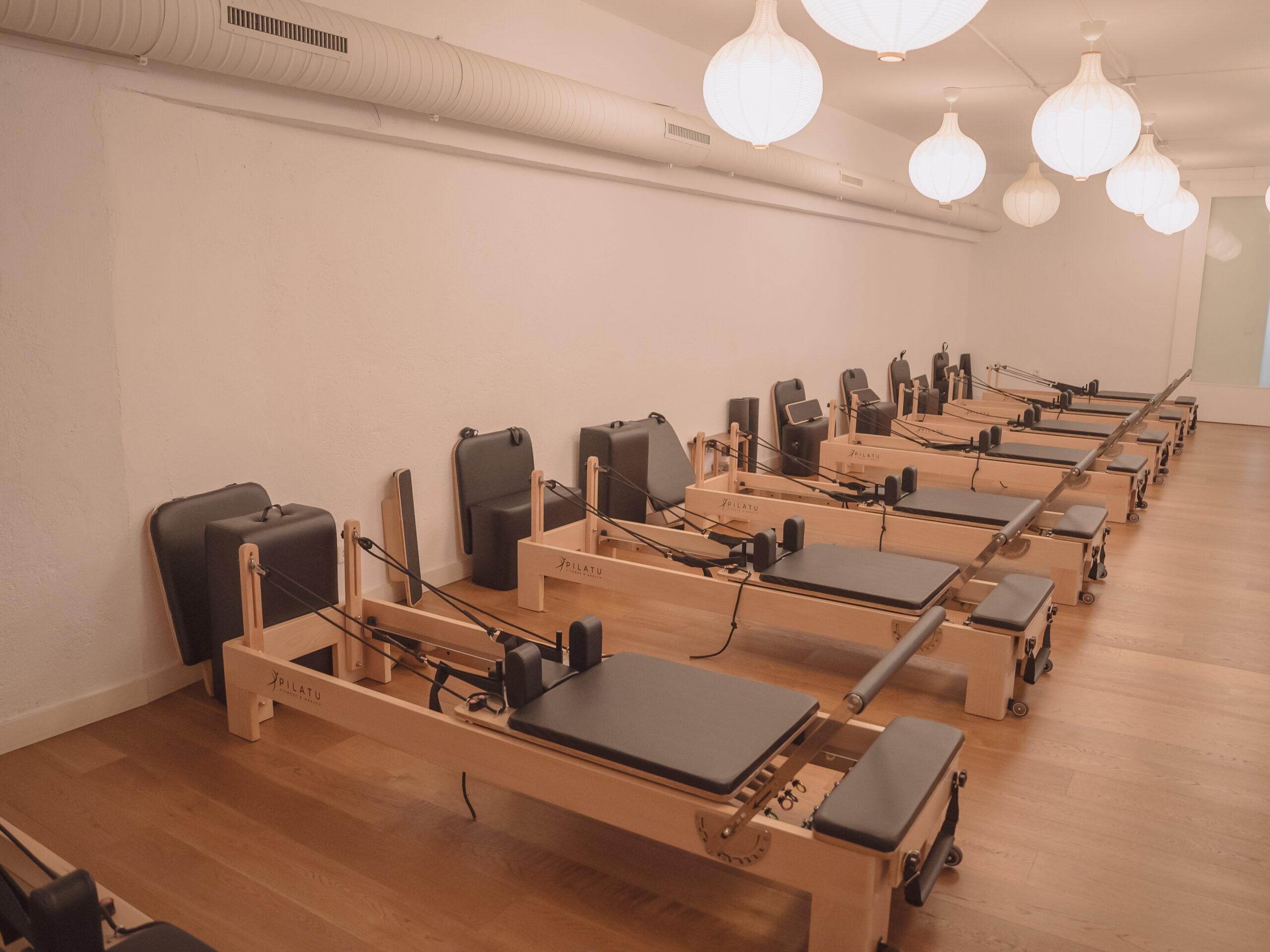
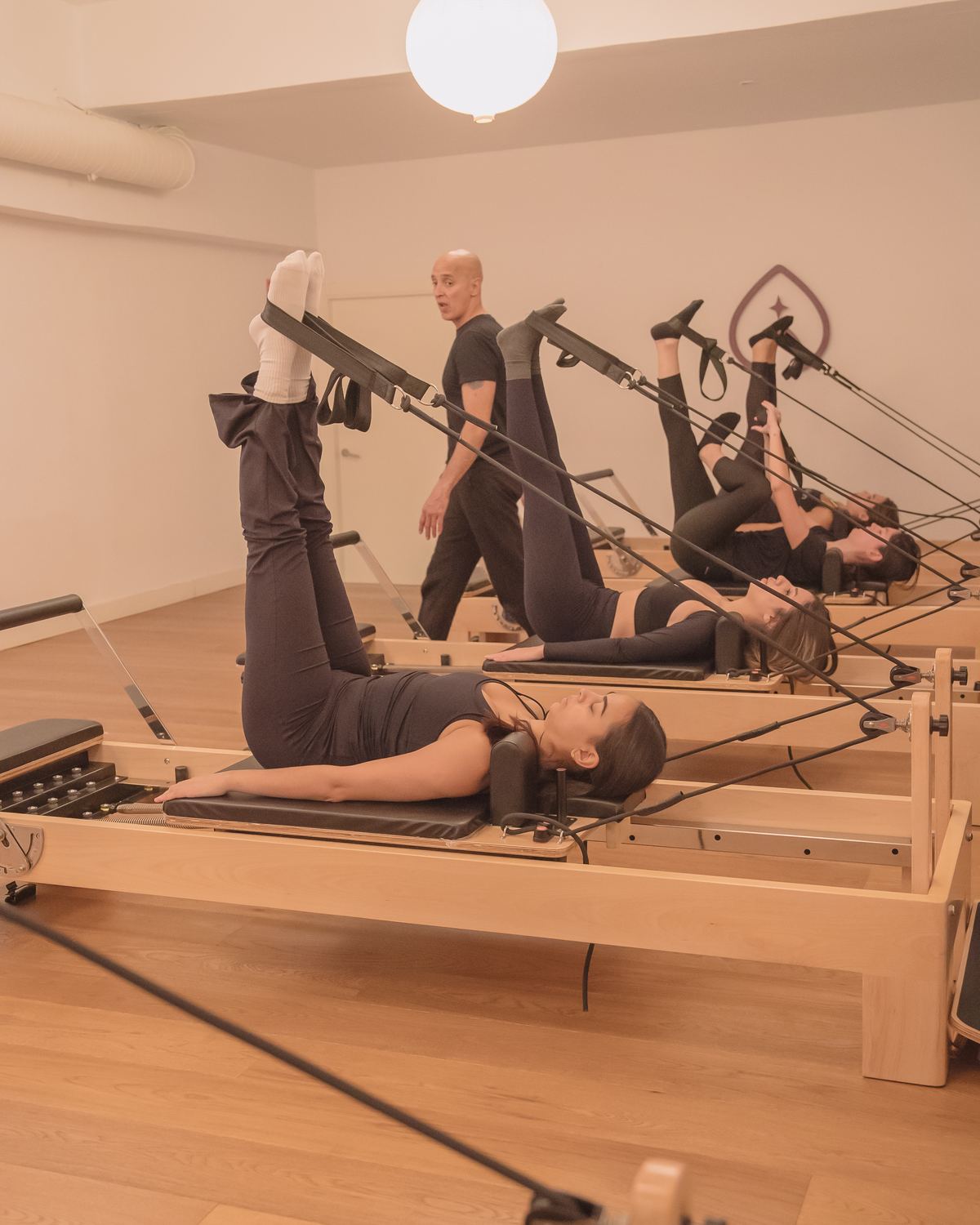
At Pinar Pilates, the maximum is 8 people per class. That number is not arbitrary. It is the one that lets the instructor watch every person, correct in real time, adjust the spring resistance individually and give personalised instructions without interrupting the flow of the session.
For a beginner, that individual attention makes an enormous difference. Mistakes are corrected before they become habits, progress is faster and the feeling of safety in the class is greater.
If you would like to understand better how the machine works before your first session, the article on what Reformer Pilates is gives you a complete overview.
How long it takes for it to “click”
A question almost every beginner asks: “When will I feel like I’ve got the hang of it?”
The honest answer is that it depends on the person, but there is a fairly reliable general pattern: between 5 and 10 sessions, most beginners start to feel that the basic movements are no longer a mystery. Breathing starts to fall into place on its own, core activation becomes more instinctive and moving on the machine creates less uncertainty.
That does not mean that from the tenth class you have mastered everything. Reformer Pilates has many levels of depth and there is always something new to learn. But it does mean that after those first sessions the experience changes: from bewildering it becomes stimulating.
The key to getting there is going regularly. Two or three times a week in the first weeks significantly speeds up that learning process. If you want to know what to expect from that first experience, the article on the first Reformer Pilates class explains it in detail.
Frequently asked questions
Is it normal for my body to ache after the first classes?
Yes. It is common to feel sore in muscles you did not know you had, especially in the deep abdominal area, the glutes and the inner thighs. It is a sign that you have activated muscles that do not normally work. If the pain is sharp or located in a specific joint, tell the instructor.
Do I need previous fitness experience to start on the Reformer?
No. The Reformer is designed to adapt to any level of fitness. The instructors adjust the exercises, the resistance and the speed to each person’s needs. You do not need to have done sport in your life to start.
Can I come to class if I have a back injury?
In many cases, yes. In fact, Reformer Pilates is often used as a rehabilitation tool for back problems. What matters is telling the instructor about your situation before the class so they can adapt the exercises. If in doubt, check first with your doctor or physiotherapist.
How many times a week should I come to progress?
For beginners, two or three times a week is the ideal rhythm for progressing consistently and letting the movement patterns settle. Once a week is also valid, although the learning curve is slower. More than four times a week in the first weeks can be too much if the body is not yet adapted.
What if I feel lost in class and do not understand an exercise?
Ask without any hesitation. The instructors would rather you stop for a moment and ask for clarification than keep doing an exercise incorrectly. Nobody will judge you for not understanding something new. Being in a small-group class is precisely what makes that kind of direct communication easy.
Get off to the right start at Pinar Pilates
Making mistakes at the start is part of the process. What matters is having someone to correct them before they become habits, and an environment where you can learn without rush and without pressure.
More than 490 people have rated their experience at Pinar Pilates on Google, with an average of 4.9 out of 5.
At Pinar Pilates, at Calle del Pinar 8 in Madrid (Salamanca district), we offer more than 40 classes a week with a maximum of 8 people per session. Our instructors know these mistakes inside out and know how to help you avoid them from day one.
If you have any questions before booking, you can call us on +34 611 994 729. And if you already know you want to start, take advantage of our welcome offer: the first class is 50% off.
Book your first class at 50% off
Pinar Pilates · Salamanca district, Madrid
Your first reformer class, €15
Groups of 8 people maximum, specialist instructors and more than 40 classes a week. Your first class is half price.
Book my first classCalle del Pinar 8, Madrid · Questions? Message us on WhatsApp