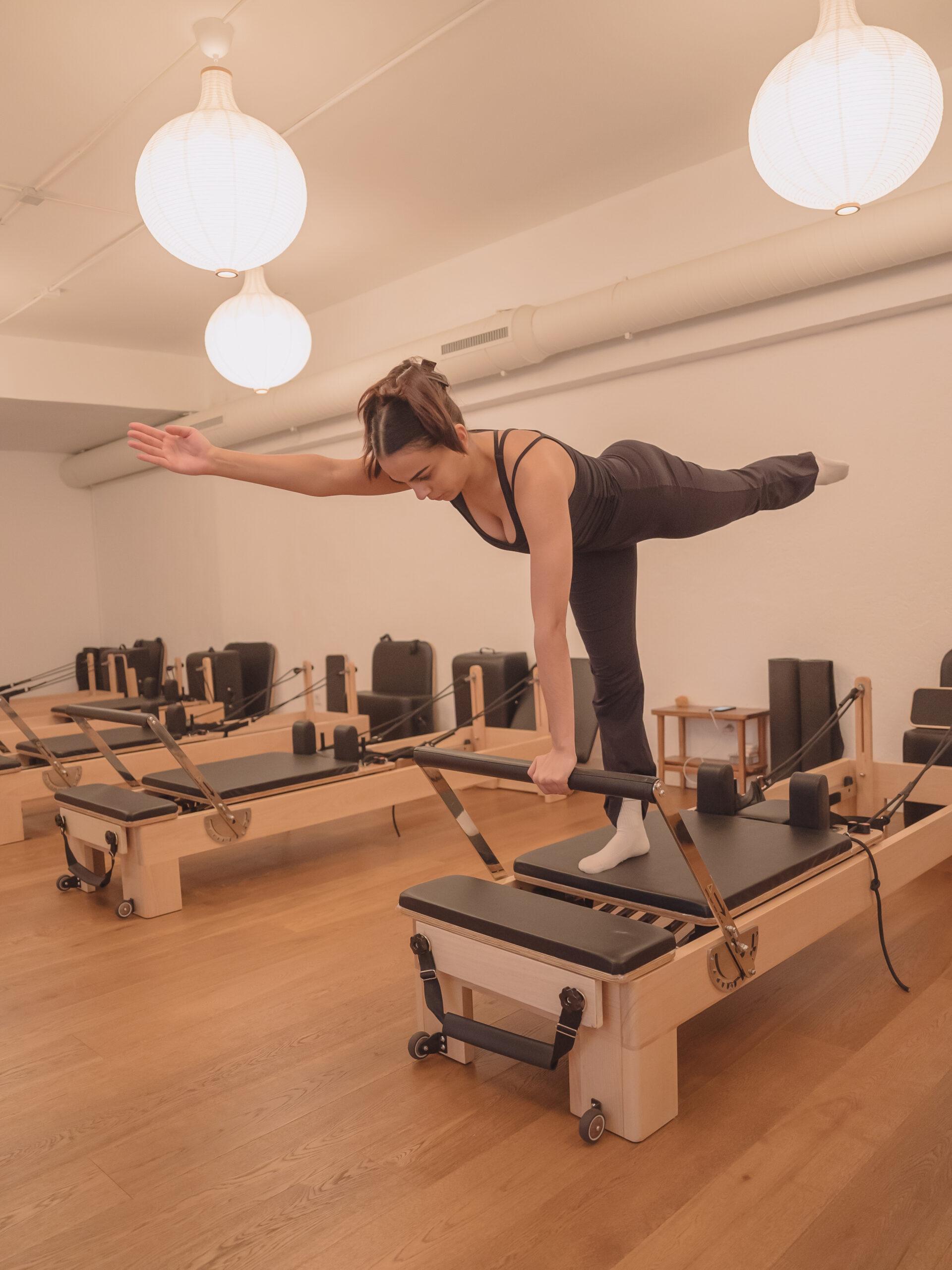
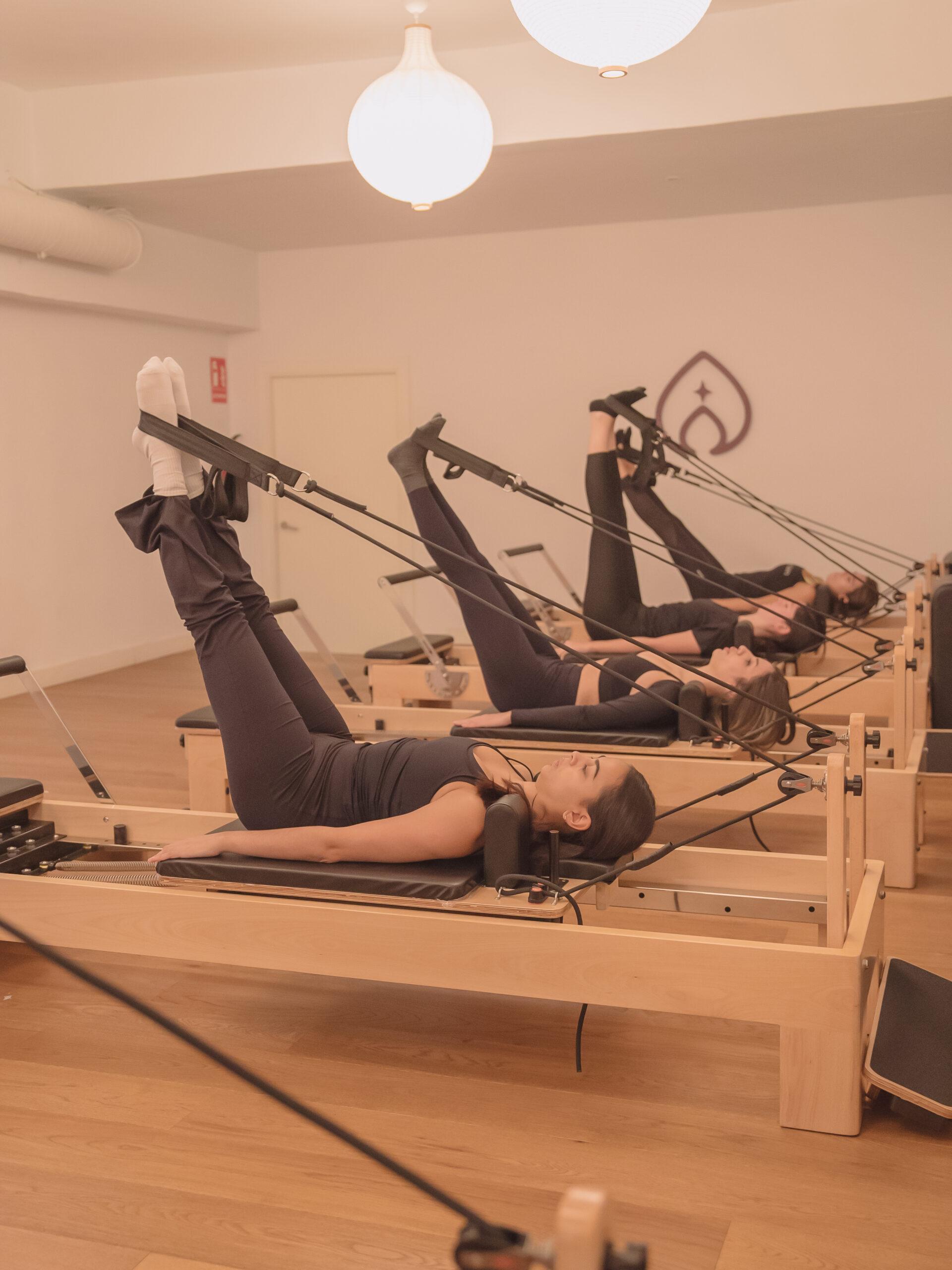
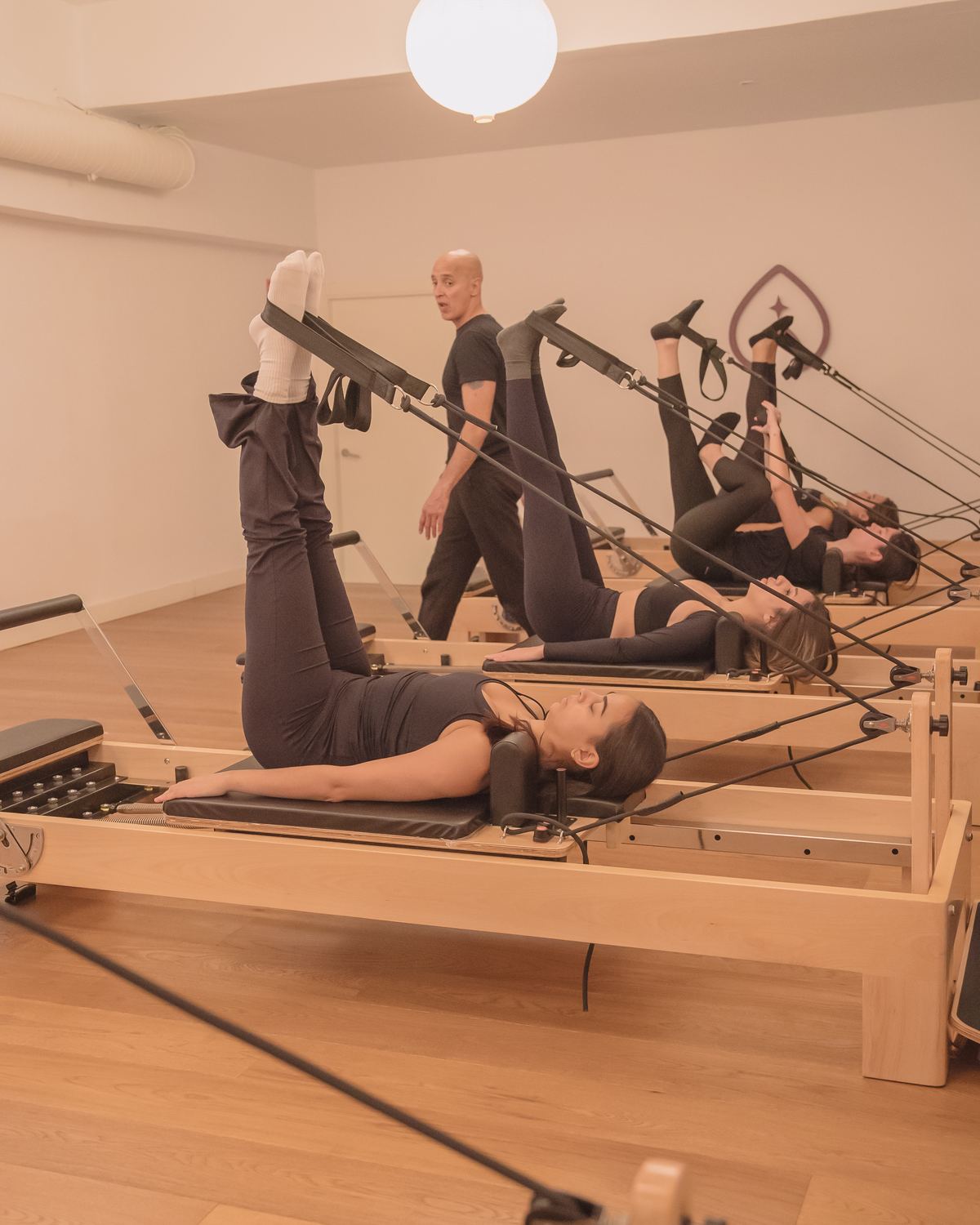
When most people think about working their abs, they picture sets of crunches on the floor, plank holds or machines at the gym. The goal is usually the same: a flat stomach or a visible six-pack. But there is a basic problem. Those exercises work almost exclusively the rectus abdominis, the muscle that forms the famous “six-pack”, and leave untouched the deep muscles that are actually responsible for stability, spinal protection and the real function of the core.
Reformer Pilates works differently. It is not designed to isolate the rectus abdominis or to rack up fast repetitions. It is designed to activate the entire system of deep muscles that surrounds the trunk, coordinate it with the breath and build stability that carries over into every movement of daily life.
This article explains what the core is, why the Reformer works it better than traditional exercises, which specific exercises are most effective and what you can realistically expect.
What the core is (and why the six-pack is not the most important part)
The “core” is not the abdomen. It is a three-dimensional structure that surrounds the trunk like a cylinder. It is made up of several layers of muscle that work in coordination to stabilise the spine, transfer force between the upper and lower body and protect the internal organs.
The main components of the core are:
Transversus abdominis. The deepest muscle of the abdominal wall. It acts like a natural corset that compresses the abdomen and stabilises the spine before any arm or leg movement. It should be the first muscle to fire, but in most people it is inhibited or fires with a significant delay.
Internal and external obliques. They form the middle layers of the abdominal wall. They control trunk rotation and side bending and contribute to stability when the body meets asymmetric forces.
Multifidus. Deep back muscles that join the vertebrae to one another. They are essential for segmental stability of the spine. In people with low back pain, these muscles often show atrophy documented on MRI.
Pelvic floor. It forms the base of the core cylinder. It works in synergy with the transversus abdominis. A pelvic floor dysfunction compromises the stability of the whole core.
Diaphragm. The lid of the cylinder. It coordinates intra-abdominal pressure with every breathing cycle. Correct breathing is not optional in core work: it is a structural part of the system.
The rectus abdominis, the superficial muscle that forms the six-pack, plays a secondary role in stability. Its main function is trunk flexion. Overworking it without first activating the deep muscles creates imbalances, overloads the lower back and, in many cases, makes existing back pain worse.
Why crunches and sit-ups fall short
Conventional ab exercises have three fundamental limitations:
First, they work in a single plane of movement. The human body moves in three planes. Crunches only train trunk flexion. The real core has to stabilise in every plane at once.
Second, they do not prioritise the deep muscles. Electromyography (EMG) studies show that crunches generate high activation of the rectus abdominis but minimal activation of the transversus. The order of muscle recruitment is wrong from a functional point of view.
Third, they create spinal compression. The classic sit-up generates compressive forces on the intervertebral discs that can exceed 730 N, according to studies by Stuart McGill at the University of Waterloo. For people with disc problems or low back pain, this exercise can be directly counterproductive.
The Reformer solves all three limitations at once.
How the Reformer activates the deep core differently
The design of the Reformer creates conditions that force the core to work in a functional, complete way. There are three main mechanisms:
The unstable carriage. The moving platform of the Reformer has no fixed position. The core must activate constantly to control the carriage, anticipate its movements and keep the spine stable while the arms or legs move. This kind of reflex activation is exactly what the transversus abdominis needs in order to work properly.
The variable resistance of the springs. The springs do more than add resistance. They also assist in certain phases of the movement. The core has to manage both the concentric and the eccentric phase of the exercise, including the controlled deceleration of the carriage as it returns to the start. Eccentric work is especially effective for building functional strength in the deep muscles.
Breath integration. The Reformer requires you to coordinate movement with the breathing cycle explicitly. That coordination activates the diaphragm, the pelvic floor and the transversus in sync, replicating the activation pattern the core needs in real life.
A study published in the Journal of Bodywork and Movement Therapies in 2016 measured muscle activation by EMG in Reformer Pilates exercises compared with mat exercises. The results showed that exercises such as the Hundred and the stretch series on the Reformer produced notably higher transversus abdominis activation than their mat equivalents, especially in the stabilisation phase.
6 Reformer Pilates exercises for the core
These are the most effective exercises for working the core on the Reformer, with the technical keys that make the difference. Many of them are described in detail in our article on Reformer exercises.
The Hundred
Level: Beginner-intermediate. Springs: Medium.
The activation exercise par excellence in the Pilates method. Lying on your back with the legs raised and the arms parallel to the floor, you breathe in a controlled five-count inhale and five-count exhale while the arms pump in small, rhythmic movements.
The technical key is not the position of the legs or the movement of the arms. It is keeping the lower back in contact with the carriage throughout the exercise. When the transversus abdominis is properly engaged, the lumbar spine stabilises naturally. When it is not, the lower back arches and the exercise stops working the core and becomes a hip-flexor effort.
Coordination
Level: Intermediate. Springs: Light to medium.
Lying on your back with feet in the straps and knees bent, you combine a trunk curl, a leg extension, a lateral opening of the legs and a return to the start, all coordinated with one full breathing cycle.
This exercise trains coordination between core, hips and limbs under dynamic resistance. The lateral opening of the extended legs creates a lateral stability challenge that intensely activates the internal obliques and the transversus.
Knee Stretches
Level: Beginner-intermediate. Springs: Medium to heavy.
On all fours on the carriage, hands on the shoulder rests and knees on the carriage, you push the carriage back with the knees while keeping the spine neutral and the pelvis still.
The most common mistake is letting the lower back arch as the carriage moves out. Preventing that movement requires intense, constant activation of the transversus abdominis and the multifidus. It is one of the few exercises that trains co-contraction between the front and back of the core so directly.
Long Stretch
Level: Intermediate-advanced. Springs: Medium.
In a front plank position with hands on the shoulder rests and feet on the carriage, you push the carriage back and return to the start keeping the body in a straight line.
The Reformer turns the static plank into a dynamic exercise with a deceleration component. The core has to work to stop the hips from rising or dropping as the carriage moves away. The real difficulty is not pushing the carriage but controlling it on the way back.
Short Spine
Level: Intermediate. Springs: Light.
Lying on your back with feet in the straps, you lift the pelvis up into full spinal flexion and roll down vertebra by vertebra.
This exercise is especially effective for coordination between the deep core and segmental articulation of the spine. It requires the multifidus and the transversus to work precisely to control the descent. It is also a spinal mobility exercise that complements the stabilisation work.
Teaser
Level: Advanced. Springs: Light.
The Teaser is the final progression of the trunk-flexion series in Pilates. Lying on your back, you lift the trunk and the legs at the same time until the body forms a V, hold the position and lower with control.
On the Reformer, the spring system can be used to assist or challenge the movement depending on your level. The assisted version lets intermediate students build the strength and coordination they need before doing the free Teaser. In any version, the transversus abdominis must fire before the body starts to move, or the lumbar spine will lose stability immediately.
A strong core: benefits beyond appearance
Strengthening the core on the Reformer produces concrete effects in three areas:
Preventing and easing back pain. The deep core muscles are the main support system of the spine. When they work properly, the load on the intervertebral discs and the facet joints drops significantly. A meta-analysis published in Spine (2013) concluded that core stabilisation exercise is superior to general exercise for reducing chronic low back pain in the long term. You can read more in our article on Pilates for better posture.
Better posture. A weak or poorly coordinated core produces postural compensations. The most common are lumbar hyperlordosis, anterior pelvic tilt and forward head posture. Working the deep muscles on the Reformer corrects those compensations at the root, not through forced postures or passive stretching.
Sports performance. The core is the link between the upper and lower body. In any athletic movement, the force generated in the legs has to travel through the trunk to the arms or to the point where the force is applied. A weak core leaks energy in that transfer. A strong, coordinated core transmits it efficiently. That is why athletes at every level have added Reformer Pilates as a training complement.
About the flat stomach: realistic expectations
Reformer Pilates strengthens the core. It also improves the tone of the abdominal wall and can reduce waist circumference by improving posture and transversus activation. However, how visible your abs are depends above all on your body fat percentage, which is determined mainly by diet and overall physical activity.
To put it plainly: the Reformer alone will not give you a flat stomach if the rest of your habits do not follow. What it does give you is stronger deep abdominal muscles, a firmer abdominal wall, a more upright posture and a real reduction in waist circumference when combined with a balanced diet and regular physical activity.
The goal of core training should be function, not aesthetics. A core that works well is a core that protects the spine, makes movement easier and prevents injury. The aesthetic improvement, when it comes, is a consequence, not a cause.
You can read a broader take on this in our article on Reformer Pilates and weight loss.
Scientific evidence on Pilates and core activation
Research on Pilates and the core has grown considerably over the past decade. Here are some relevant findings:
A study by Herrington and Davies (2005) published in the Journal of Bodywork and Movement Therapies compared transversus abdominis activation in Pilates exercises with conventional physiotherapy exercises. The Pilates exercises showed greater transversus activation, especially when the principle of lumbar “imprinting” was maintained during the movement.
Escamilla et al. (2010) used EMG to analyse muscle activation in several Pilates exercises and concluded that exercises performed with the spine in flexion (such as the Hundred or the Roll-Up) generate high activation of the rectus abdominis and the obliques, while exercises on all fours such as the Knee Stretch preferentially activate the transversus and the multifidus.
A randomised clinical trial by Massey et al. (2017) with 60 participants showed that 8 weeks of Reformer Pilates three times a week produced significant improvements in core endurance measured with standardised tests, as well as reductions in reported low back pain compared with the control group.
These studies confirm that the Reformer not only works the core more completely than conventional ab exercises, but does so more safely and more functionally.
Frequently asked questions
How long does it take to notice a stronger core with Reformer Pilates?
Most students who practise two or three times a week start to notice differences in stability and body awareness within two to four weeks. Measurable strength gains are usually significant between six and eight weeks. Progress depends on your starting level, frequency and the technical quality of your practice.
Is Reformer Pilates suitable for people with chronic low back pain?
Yes, with proper supervision. The Reformer lets you adapt resistance, range of movement and position so that core work is safe even for people with active lumbar problems. The key is having trained instructors who know the contraindications and adapt the programme. At Pinar Pilates, every student has an initial assessment before starting.
Does Reformer Pilates work the core more than mat Pilates?
Mat Pilates also works the core, but the Reformer adds three variables that increase effectiveness: the instability of the carriage, the variable resistance of the springs and the eccentric deceleration work. The EMG studies cited above show higher transversus abdominis activation in Reformer exercises compared with their mat equivalents, especially in dynamically loaded positions.
Can I do Reformer Pilates if I have diastasis recti?
Diastasis recti is precisely one of the conditions that benefits most from deep core work. The transversus abdominis and the pelvic floor are the key muscles in its rehabilitation. However, certain trunk-flexion exercises may be contraindicated in active cases. It is essential to tell your instructor and, in moderate or severe cases, to have a prior assessment by a specialist physiotherapist.
Is there a difference between “strengthening the core” and “getting visible abs”?
Yes, and it is an important one. Strengthening the core means developing the functional capacity of all the deep muscles of the trunk. Getting visible abs means reducing the subcutaneous fat that covers the rectus abdominis until it shows. The first is achieved with specific training. The second depends mainly on a calorie deficit and total body fat percentage. The Reformer does the first very effectively. The second also requires a nutrition and overall activity strategy.
Reformer Pilates for the core in Madrid: Pinar Pilates
At Pinar Pilates, every Reformer class includes deep core work from day one. Not as a separate block of the programme, but built into every exercise, every transition and every technical cue. Because in Pilates, the core is not one part of the class: it is the foundation of everything that happens in it.
We work in groups of 8 people maximum at our studio in the Salamanca district, Calle del Pinar 8, Madrid. That ratio lets our instructors correct transversus activation, adjust lumbar position and progress each student’s level individually. That is not possible in classes of 20 or 25 people.
We have more than 490 Google reviews (average 4.9 out of 5), more than 40 classes a week and a team of instructors specialised in therapeutic and functional Reformer Pilates.
Prices:
– First class: €15 (50% off the usual price of €30)
– Drop-in class: €30
– 4-class plan: €100
– 8-class plan: €150
– 12-class plan: €200
– Unlimited monthly membership: €250
For any questions, call us on +34 611 994 729.
Book your first class at 50% off
Pinar Pilates · Salamanca district, Madrid
Your first reformer class, €15
Groups of 8 people maximum, specialist instructors and more than 40 classes a week. Your first class is half price.
Book my first classCalle del Pinar 8, Madrid · Questions? Message us on WhatsApp