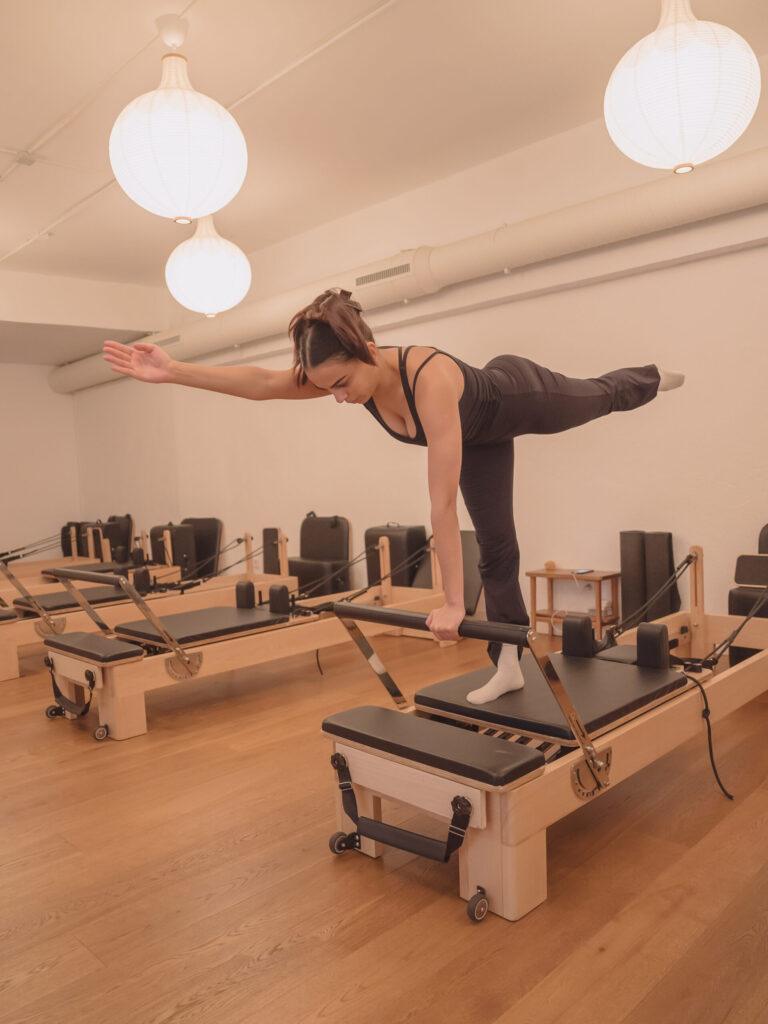
It is one of the questions we hear most at Pinar Pilates: “Is it better to do Reformer Pilates or go to the gym?” The honest answer is that it depends on what you are looking for. But so you can decide with real information rather than marketing slogans, we have put together this detailed comparison.
We are not going to tell you that Reformer Pilates beats the gym at everything. Nor the opposite. What we will do is analyse both options against objective criteria so that you can decide which one fits your goals, your body and your lifestyle.
What the science says: Reformer Pilates vs the gym
- Pilates was the most effective exercise for reducing pain (93% probability) and disability (98%) compared with strength training, core exercises and mind-body techniques, in a meta-analysis of 118 trials with 9,710 participants.
Source: Fernández-Rodríguez R et al. (2022). JOSPT, 52(8):505-521. - Experienced Pilates practitioners activate the external oblique 35% more than beginners when performing the same mat exercise (54.6% vs 40.3% of maximum voluntary contraction, measured by electromyography).
Source: Ko et al. (2024). Frontiers in Physiology, 15:1435671. - An 8-week mat Pilates programme (two 45-minute sessions a week) improved sit-and-reach flexibility from 27.69 cm to 34.89 cm (+26%), while the control group was unchanged (22.74 cm to 22.91 cm; p = 0.849).
Source: Phrompaet S, Paungmali A, Pirunsan U, Sitilertpisan P (2011). Asian Journal of Sports Medicine, 2(1):16-22. - Pilates practitioners show notably lower levels of anxiety, depression and somatisation than sedentary people of the same age, psychological benefits that are hard to obtain from conventional strength training.
Source: Fossati C et al. (2024). PMC11988874.
Reformer Pilates: What It Is and How It Works
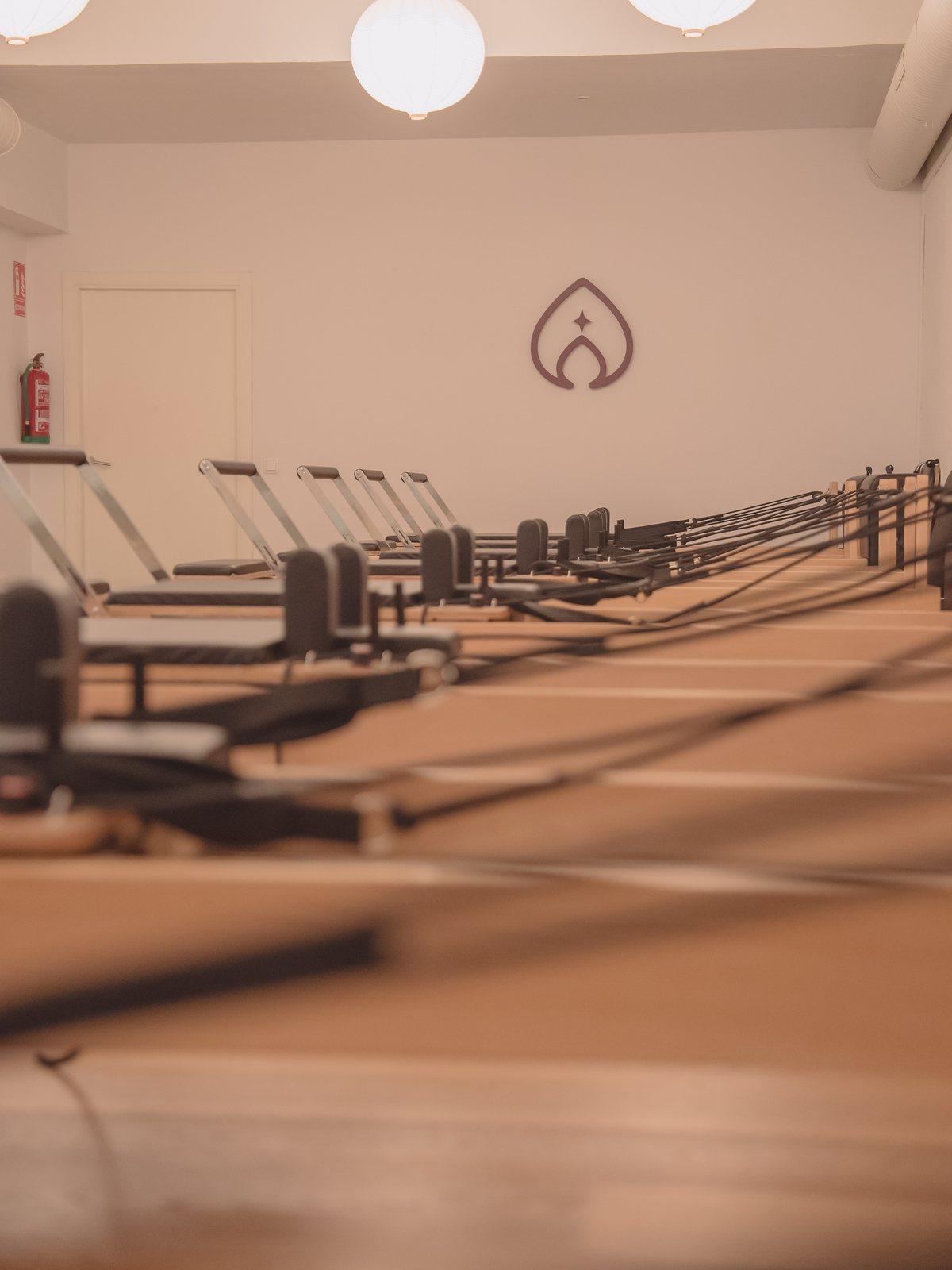
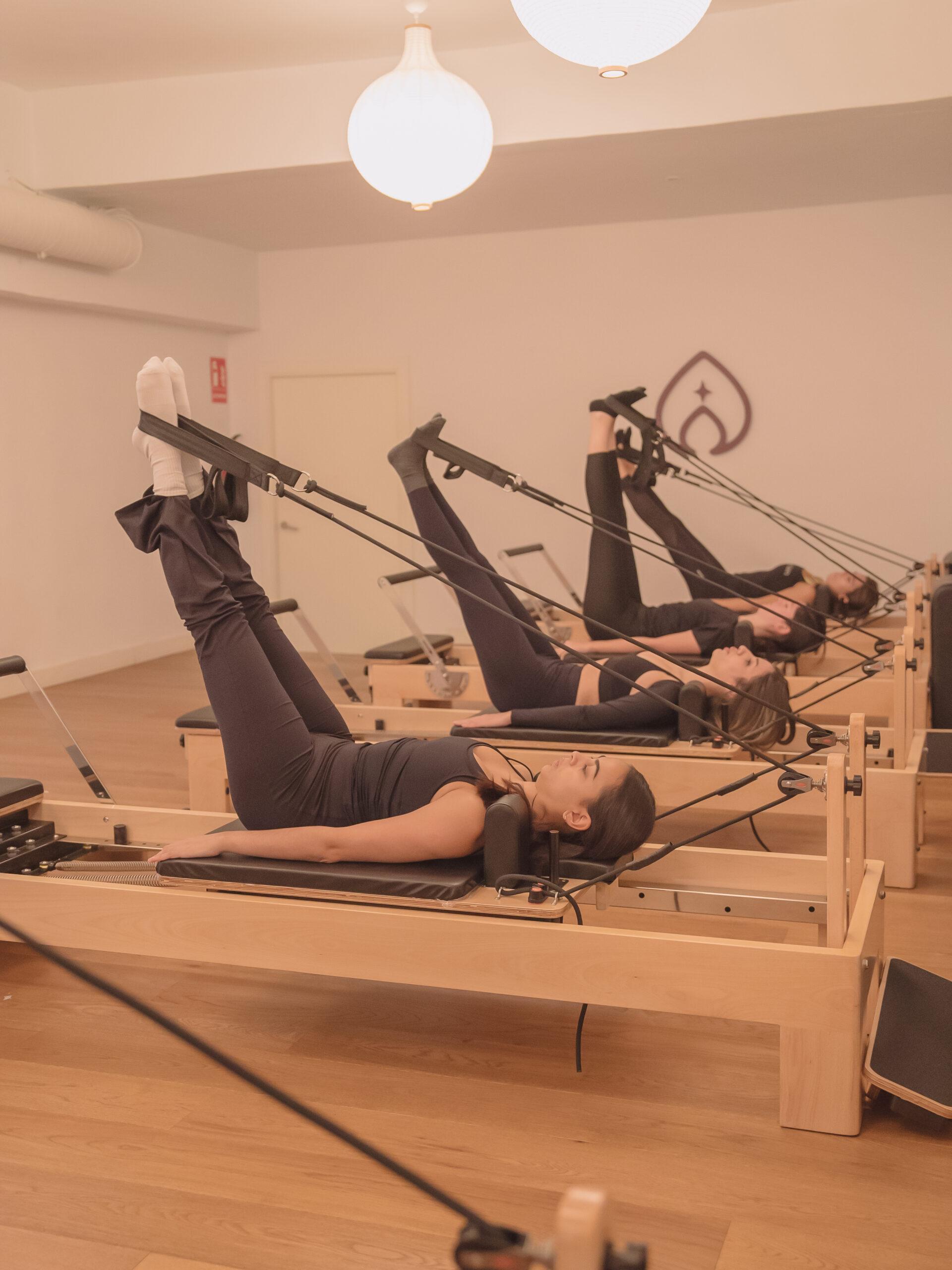
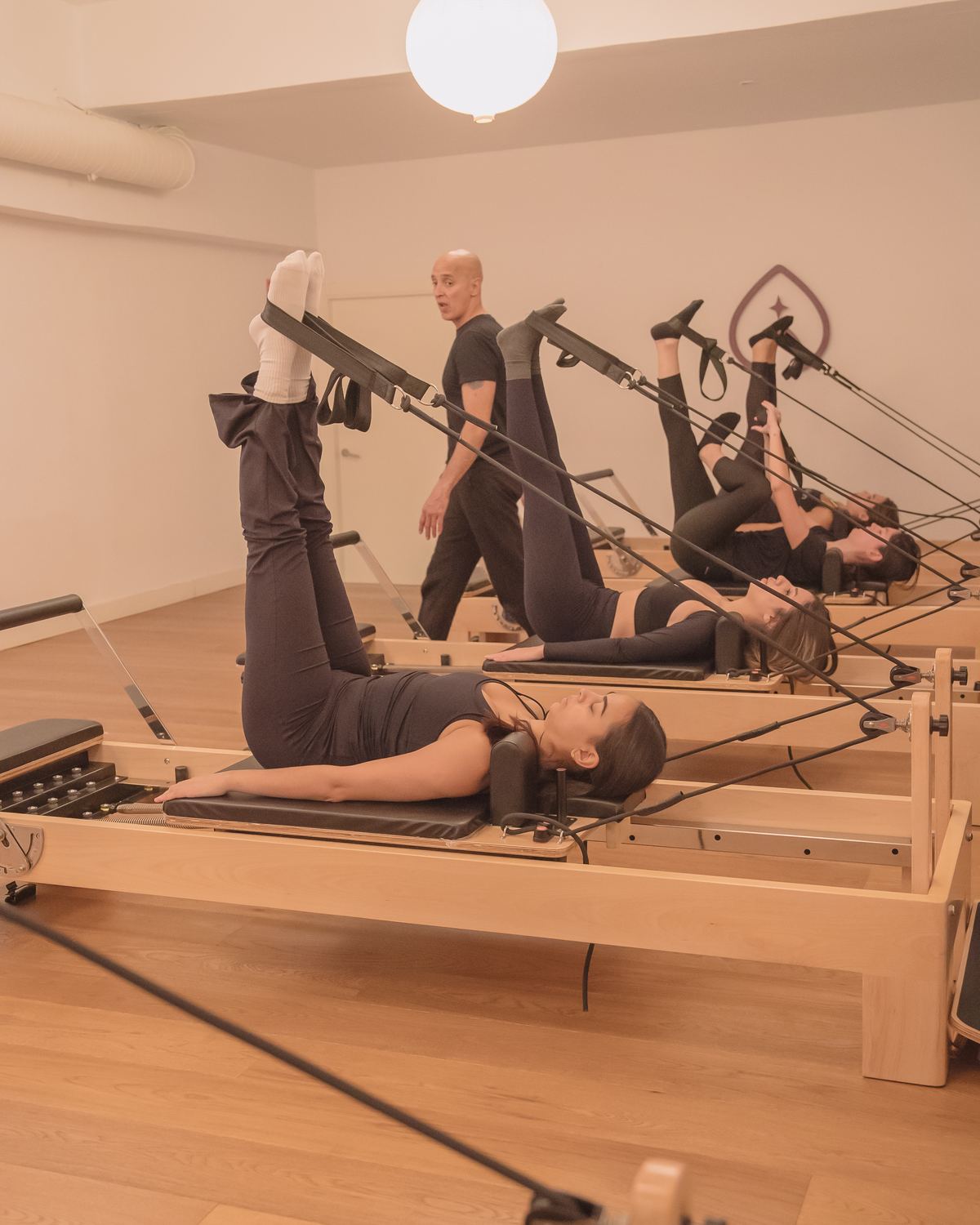
Key answer: Reformer Pilates is a form of exercise practised on a machine with a sliding carriage and a system of springs of variable tension. You work lying down, seated, kneeling and standing, against adjustable resistance. Classes are held in small groups (8-10 people maximum) with direct supervision from an instructor who corrects you in real time.
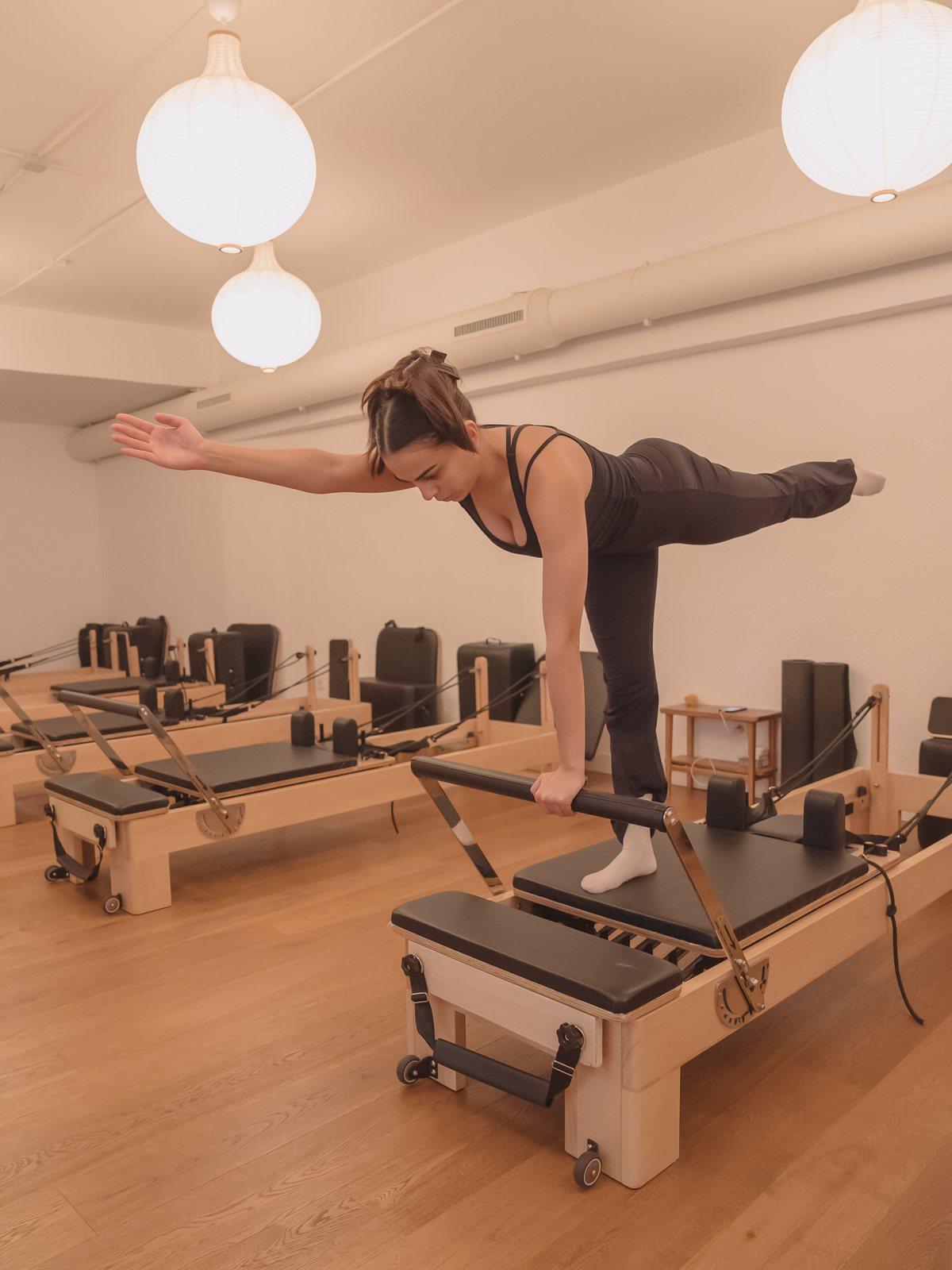
Reformer Pilates is a branch of the Pilates method practised on a machine with a sliding carriage, a system of springs of variable tension, a footbar and straps with handles. The student works against the resistance of the springs in different positions: lying down, seated, kneeling and standing.
The resistance is not fixed. It is graded by changing the number and tension of the springs, which allows every exercise to be adapted to each person’s level. A beginner can get assistance from the machine to complete a movement, while an advanced student can increase the load to add intensity.
The principles of the Reformer are control, precision, conscious breathing and body alignment. Every repetition counts. It is not about doing many, it is about doing them well. If you want a more detailed explanation, read our complete guide to what Reformer Pilates is.
Classes are taught in small groups (at Pinar Pilates, 8 people maximum) with an instructor who watches and corrects in real time. A typical session lasts 50 minutes and works the whole body.
The Conventional Gym: What It Offers
The gym is a versatile space that brings different types of training under one roof. Depending on the centre, you can find:
Weights room. Free weights (dumbbells, barbells, plates), guided-load machines (leg press, cable pulley, assisted pull-up machine) and functional equipment (kettlebells, TRX, medicine balls). Weight training is based on progressive overload: gradually increasing the weight to stimulate muscle growth.
Cardio area. Treadmills, exercise bikes, ellipticals, rowers and stair climbers. Machines designed to raise your heart rate and improve aerobic endurance.
Group classes. Spinning, body pump, HIIT, zumba, yoga, body combat. The range varies by gym. Groups are usually 15 to 40 people with one instructor at the front.
Stretching area. Mats, foam rollers and resistance bands for the cool-down.
The gym model offers freedom: you decide what to do, when and for how long. That same freedom can be an advantage or a drawback, depending on your level of knowledge and motivation.
Head to Head: Reformer Pilates vs the Gym
Key answer: The main differences are: the Reformer works deep and superficial muscles at the same time (the gym focuses on superficial ones); it has very low joint impact (the gym can be high); it improves posture as a core component (at the gym it is optional); it works flexibility in every session (at the gym it needs extra time); and it offers personalised supervision in groups of 4-10 (gym classes are 15-40).
This table summarises the key differences between the two options. We then go through them point by point.
| Criterion | Reformer Pilates | Conventional Gym |
|---|---|---|
| Type of muscle work | Deep and superficial muscles simultaneously | Mostly isolated superficial muscles |
| Joint impact | Very low, unloaded work | Variable, can be high with heavy loads |
| Postural improvement | Core component of the method | Only if trained specifically |
| Flexibility | Worked actively in every session | Requires dedicated extra time |
| Calories burned per session | 200-450 kcal (depending on intensity) | 300-600 kcal (depending on activity) |
| Injury risk | Low, controlled and supervised movements | Moderate, depends on technique and load |
| Personalisation | High, the instructor adapts every exercise | Variable, depends on hiring a trainer |
| Group size | 4-10 people | 15-40 in classes, open floor otherwise |
| Average monthly price | €150-250 (depending on frequency) | €30-80 (standard fee) |
| Social component | Small groups, close-knit community | Large community, more anonymity |
| Visible results | Toning and definition in 6-8 weeks | Visible hypertrophy in 8-12 weeks |
| Exercise variety | More than 100 exercises and variations | Unlimited (weights, machines, classes) |
| Professional supervision | Included in every class | Only with a personal trainer (extra cost) |
| Suitability for rehabilitation | High, therapeutic origins | Limited without specialist guidance |
5 Advantages of Reformer Pilates over the Gym
1. It works the body as a unit, not in parts
At the gym, conventional training tends to isolate muscle groups: “today is leg day”, “today is chest and triceps”. This approach can create imbalances if it is not planned properly.
Reformer Pilates works complete muscle chains in every exercise. When you do footwork, it is not only your quads working: your core stabilises the pelvis, your adductors control knee alignment and your glutes control the return of the carriage. A single exercise involves the whole body. This integrated approach is one of the reasons Reformer Pilates offers so many benefits for overall health.
2. It protects the joints while it strengthens
The Reformer lets you work horizontally (lying on the carriage), which removes the compressive load of gravity on the spine, knees and hips. This is especially relevant for people with joint problems, herniated discs or those in rehabilitation.
At the gym, exercises such as the barbell squat, the deadlift or the shoulder press load the joints significantly. With correct technique, the risk is low. But the reality is that in a crowded gym, with no direct supervision, many people perform these exercises with poor technique. A study published in the Journal of Strength and Conditioning Research (2017) estimated that the injury rate in weight training is 2.4 to 3.3 per 1,000 hours of practice.
3. Supervision is included, not an extra
At a gym, the monthly fee gives you access to the facilities. If you want someone to watch you, correct your technique and design your programme, you need to hire a personal trainer (€40-80 per session in Madrid). Without a trainer, you rely on your own knowledge.
In Reformer Pilates, the instructor is part of every class. At Pinar Pilates, with a maximum of 8 people per session, individual correction is constant. Instructors such as Giuliana Di Giovanni, Gabriela Seminara, Camila T, Montserrat Sierra and Abel Gomez watch how you perform every repetition and adjust the exercise according to what they see.
4. Better posture is a built-in result, not an option
Every Reformer Pilates exercise includes a body alignment component. The instructor corrects the position of your spine, shoulders, pelvis and head in every movement. After several weeks of regular practice, those postural patterns carry over into your daily life.
At the gym, posture only improves if you dedicate specific time to postural exercises, which few people do on their own. In fact, certain gym exercises (bench press, biceps curls) can worsen a rounded upper back if they are not balanced with back work and chest opening.
5. Motivation lasts in the long run
One of the biggest problems with the gym is the drop-out rate. According to data from the International Health, Racquet & Sportsclub Association (IHRSA), roughly 50% of new gym members stop attending within the first 6 months.
Reformer Pilates has a noticeably higher retention rate. There are several reasons: the variety of the repertoire (more than 100 exercises), the relationship with the instructor, the community effect of small groups and the feeling of constant progress. At Pinar Pilates, many of our students have been practising for years without losing motivation.
Ready to feel the difference?
When the Gym May Be the Better Option
It would be dishonest to claim that Reformer Pilates is superior to the gym for every goal. There are situations where the gym is the better choice.
If your main goal is significant muscle hypertrophy. If you want to gain substantial muscle size (for example, visibly increasing your chest, biceps or quads), training with heavy weights is more effective. Reformer Pilates tones and defines, but it does not produce the same degree of hypertrophy as a strength programme with progressive overload.
If your budget is very tight. A gym membership in Madrid costs between €30 and €80 a month. Reformer Pilates at a boutique studio has higher prices (at Pinar Pilates, from €100/month for 4 classes). The price difference reflects group size, instructor qualifications and the level of individual attention, but it is a real factor to consider.
If you want to train for more than an hour a day with varied activities. The gym lets you combine weights, cardio and group classes in a single session. Reformer Pilates centres on 50-minute sessions with a specific focus. If you need extreme variety or long sessions, the gym gives you more options under one roof.
If self-directed training motivates you. Some people prefer to put their headphones on, follow their own programme and train without anyone directing them. The gym offers that autonomy. Reformer Pilates is a guided practice in which the instructor sets the pace and the exercises.
Can You Combine Reformer Pilates and the Gym?
Key answer: Yes, Reformer Pilates and the gym complement each other well. The most effective combination is to use the Reformer for deep core, flexibility and posture (2 sessions/week) and the gym for strength and hypertrophy (2-3 sessions/week). The Reformer also works as active recovery between strength sessions.
Not only can they be combined, it is one of the smartest strategies you can adopt.
For runners and cyclists. Reformer Pilates strengthens the core and corrects the muscle imbalances that repetitive sports create. Two Reformer sessions a week complement cardiovascular training and reduce the risk of overuse injuries.
For people who lift weights. The Reformer improves joint mobility, flexibility and body awareness. Many athletes who train with weights find that their squat, deadlift or press technique clearly improves when they add Reformer Pilates to their routine. The reason is simple: the Reformer teaches them to activate the core correctly and hold alignment under load.
For those who want a functional, athletic-looking body. Combining 2-3 Reformer Pilates sessions with 2-3 gym sessions a week gives you the best of both worlds: the strength and hypertrophy of the gym with the flexibility, posture and control of the Reformer.
The key is in the programming. Avoid doing Reformer and an intense gym session on the same day. Alternate and give your body time to recover. If you need guidance, our instructors at Pinar Pilates can help you integrate both activities coherently.
Our Experience at Pinar Pilates
We have spent years working with students who come straight from the gym, who combine both activities, or who choose the Reformer as their only form of exercise. Every profile is valid.
What we do consistently observe is this:
Students who left the gym because of injuries find in the Reformer a way to keep training without aggravating their problems. Unloaded work and constant supervision let them strengthen the body safely.
Students who combine both report improvements in their gym performance, especially in core stability, shoulder and hip mobility, and postural awareness during weight exercises.
Students who only do Reformer get a toned, flexible and functional body. It is not the route if you want bulky muscles, but it is very effective for muscle definition, posture and overall wellbeing.
Our studio at Calle del Pinar 8, in the Salamanca district, offers more than 40 classes a week with a maximum of 8 people per session. Our instructors, Giuliana Di Giovanni, Gabriela Seminara, Camila T, Montserrat Sierra and Abel Gomez, work with every kind of profile and level. With more than 490 Google reviews (average 4.9 out of 5), our students’ experience speaks for itself.
If the Reformer is new to you, take a look at our guide to Pilates on machines for beginners or read what to expect in your trial class.
Pilates vs gym: the questions that come up most
Many of the people who land here are not after a long comparison: they want a short answer to a specific question. These are the four that come up most often, answered directly.
Which is better, Pilates or the gym?
Neither is better in the abstract: they are tools for different things. The gym is better if your top priority is building muscle mass or lifting ever-heavier loads, because progressive overload is exactly what makes muscle grow and stimulates bone. Reformer Pilates is better if what you need is control, mobility, core work and strength without joint impact, or if you carry back discomfort from sitting for many hours.
If you are only going to do one of the two, the useful question is not which is better but which solves your problem this year.
What is the difference between Pilates and the gym?
The underlying difference is not in the equipment, it is in what gets trained. At the gym you train capacity: how much weight you move and how many reps you can hold. In Reformer Pilates you train quality of movement: how you move, with what alignment and with what control through every part of the range.
All the other practical differences follow from that. The gym is self-service and in Pilates an instructor guides the whole session. The gym has open hours and Pilates runs as classes at fixed times. And at the gym progress is measured in kilos, while on the Reformer it is measured in control and range of movement.
And the difference between Pilates and the gym for losing weight?
Neither makes you lose weight on its own: that depends above all on energy balance. What does make a difference in the medium term is the muscle mass you keep, and there strength work — at the gym and on the Reformer — beats cardio alone. Treating either as a quick weight-loss tool leads to quitting within six weeks.
Is Pilates enough, or do I also need the gym?
For most health, mobility and posture goals, the Reformer twice a week is enough. If your goal includes gaining significant muscle mass or protecting bone density — something that matters especially from your mid-forties — it is worth adding strength work with progressive load. They are not mutually exclusive and in fact complement each other well.
Frequently Asked Questions
Does Reformer Pilates tone as much as the gym?
Yes, but differently. Reformer Pilates produces more even, balanced toning, working deep and superficial muscles at the same time. The result is a defined, streamlined body. The gym with weights can generate more hypertrophy (muscle size) in specific muscle groups. If your goal is definition without excess bulk, the Reformer is very effective. If you want significant muscle mass, you will need to include weight training.
Can I lose weight doing only Reformer Pilates?
Reformer Pilates contributes to weight loss by increasing muscle mass (which speeds up your basal metabolism), improving body composition and burning between 200 and 450 calories per session. Combined with a suitable diet, it is possible to lose weight with the Reformer as your main activity. If rapid weight loss is your top priority, adding cardiovascular activity (walking, swimming, cycling) will boost your results.
Is Reformer Pilates only for women?
No. Reformer Pilates was created by a man (Joseph Pilates) and was originally practised by boxers, dancers and soldiers. At Pinar Pilates, Abel Gomez is part of our team of instructors and we have students of every profile. The Reformer works strength, stability and control in a way that benefits anyone, regardless of gender.
How much does Reformer Pilates cost compared with the gym?
A monthly gym membership in Madrid costs between €30 and €80. At Pinar Pilates, plans go from €100/month (4 classes) to €250/month (unlimited). The difference includes groups of 8 people maximum, a qualified instructor in every class and personalised correction. If you compare the price of the Reformer with that of a personal trainer at the gym (€40-80 per session), the Reformer works out cheaper for the level of attention you receive. See our prices for more details.
Decide with a Trial Class
The best way to compare Reformer Pilates with your gym experience is not to read about it. It is to try it.
At Pinar Pilates we give you several ways to take the first step:
- First class at 50% off for just €15: experience a full Reformer Pilates session and compare. Perfect whether you have never done Reformer or you simply want to try our studio.
We are at Calle del Pinar 8, Salamanca district, Madrid. More than 40 classes a week, groups of 8 people maximum and an average of 4.9 out of 5 on Google. Come, try it and decide with your own body.
Pinar Pilates · Salamanca district, Madrid
Your first reformer class, €15
Groups of 8 people maximum, specialist instructors and more than 40 classes a week. Your first class is half price.
Book my first classCalle del Pinar 8, Madrid · Questions? Message us on WhatsApp