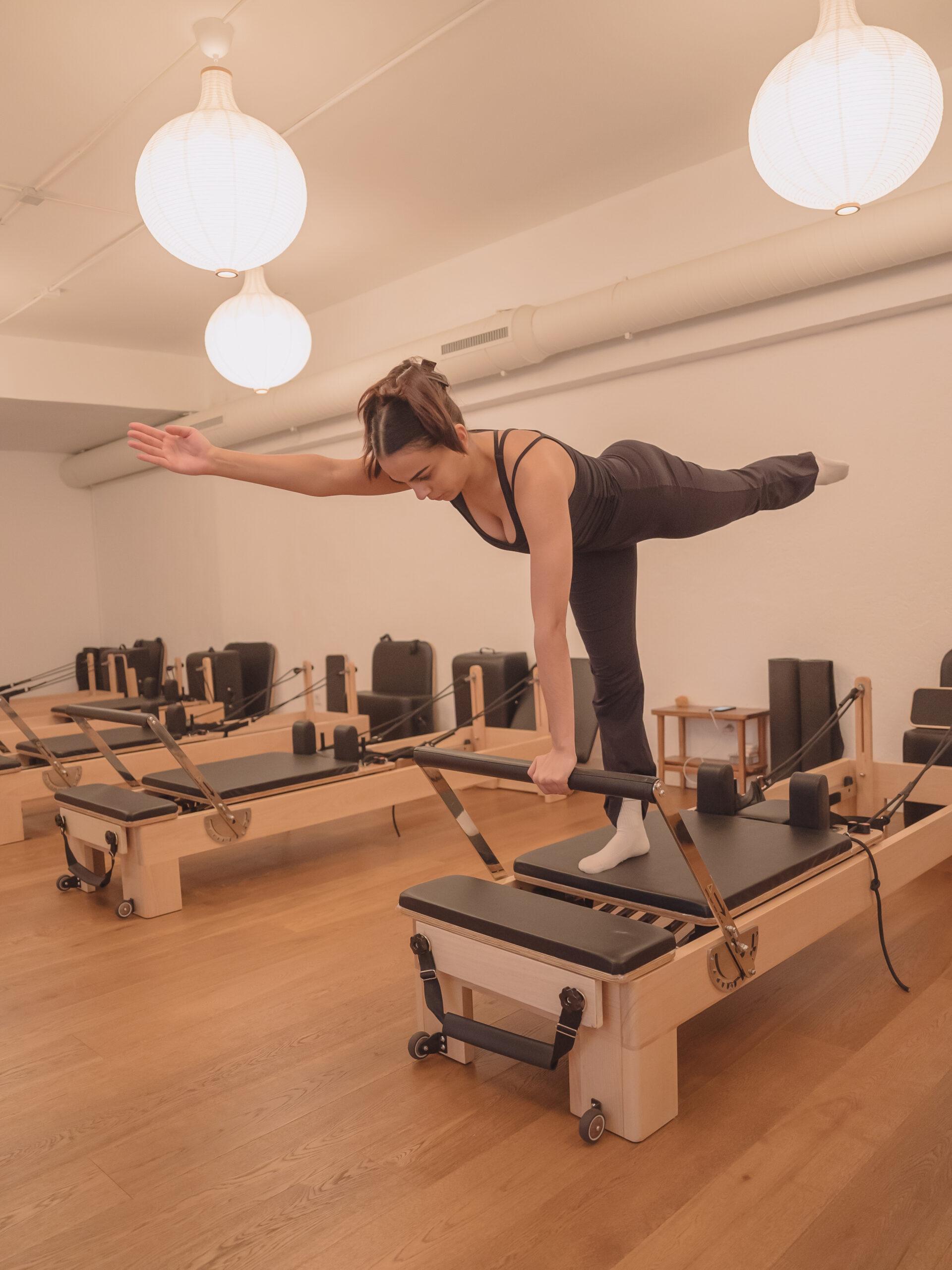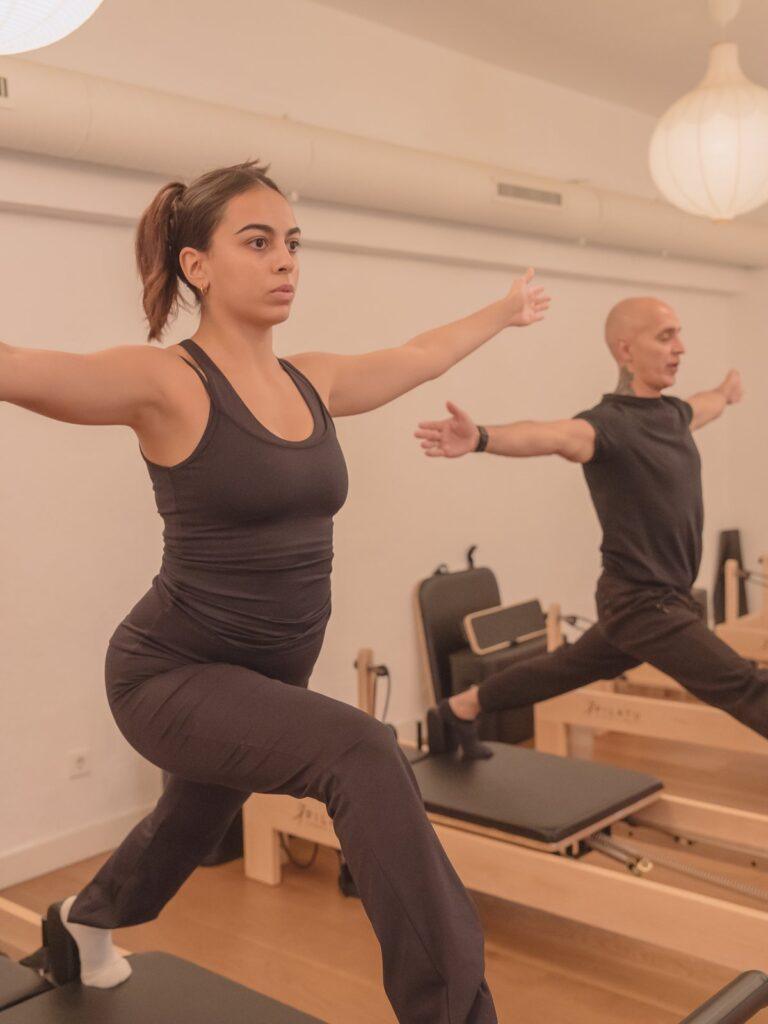
The Reformer Pilates repertoire includes more than 100 different exercises. Some work specific muscles. Others challenge the whole body in a single sequence. There are exercises you spend weeks perfecting and others your instructor introduces when they see you are ready for the next level.
But if you had to choose the most effective ones, those that offer the greatest functional benefit per minute of practice, the list shrinks considerably. In this article we have selected 15 Reformer Pilates exercises that cover every area of the body: core, legs and glutes, arms and upper body, full body and flexibility. For each one you will find the difficulty level, the recommended springs, the muscles involved and the technical keys that make the difference between performing the movement and doing it well.
If you have never been on a Reformer, we recommend reading our guide on what Reformer Pilates is and our article for beginners first. The exercises you will see here require, at the very least, familiarity with the machine and an understanding of the basic principles of control and breathing.
How to Read This Guide
For each exercise we include the following information:
- Level: Beginner, intermediate or advanced.
- Springs: Indicative setting (light, medium, heavy). The exact setting depends on the Reformer manufacturer and on each person’s characteristics. Your instructor will adjust the springs to your level.
- Main muscles: The muscle groups that work hardest during the exercise.
- Description: How the movement is performed, in summary.
- Technical key: The point of attention that separates a correct execution from a mediocre one.
Core Exercises (4 exercises)
The core is the centre of all work in Pilates. Joseph Pilates called it the “powerhouse” and considered it the origin of every movement. The following Reformer exercises work the deep muscles of the trunk: transversus abdominis, obliques, multifidus, pelvic floor and diaphragm.
1. The Hundred
Level: Beginner (with variations up to advanced)
Springs: Medium (2 medium springs or 1 heavy + 1 light)
Main muscles: Transversus abdominis, rectus abdominis, obliques, hip flexors, scapular stabilisers
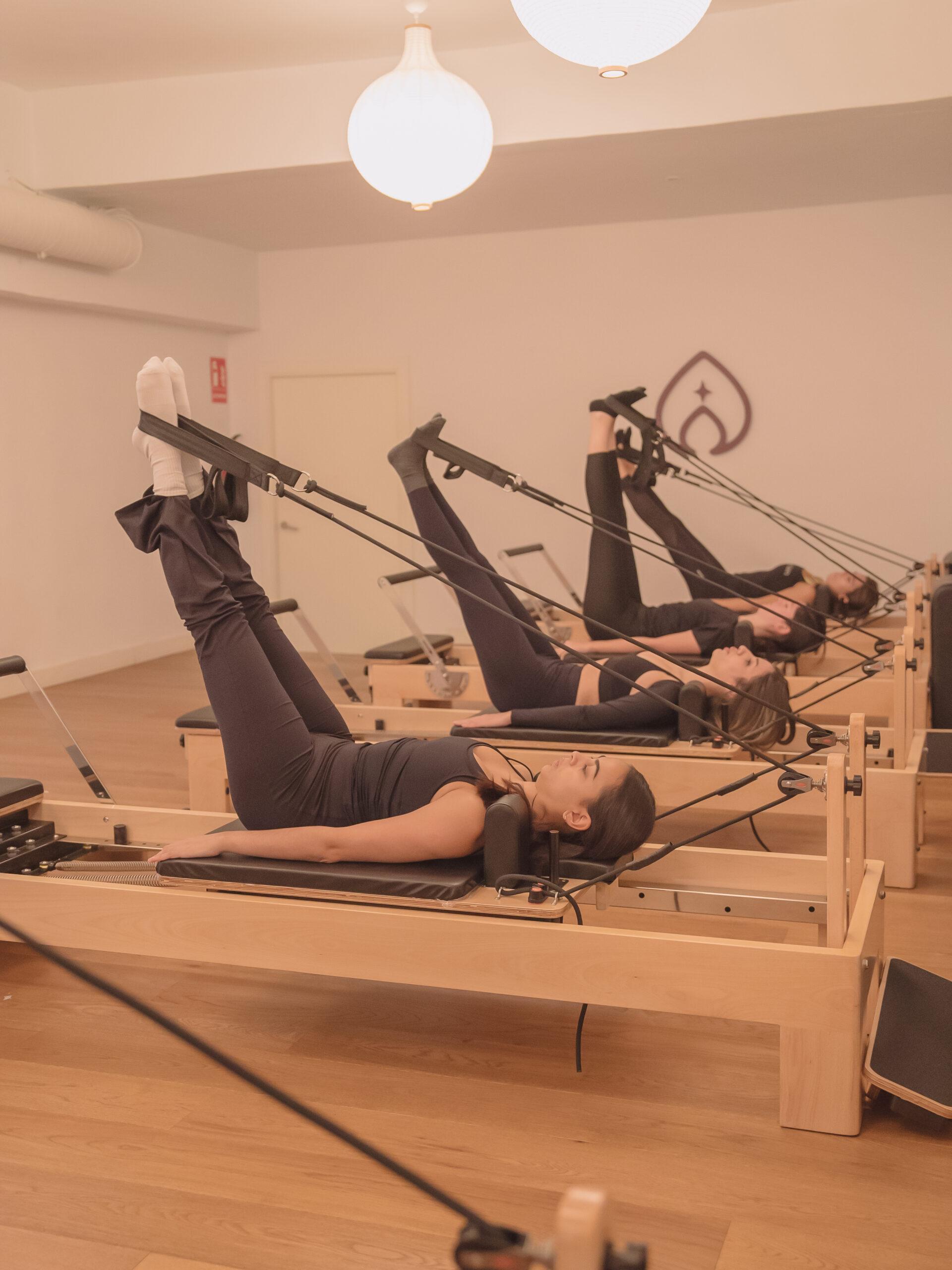
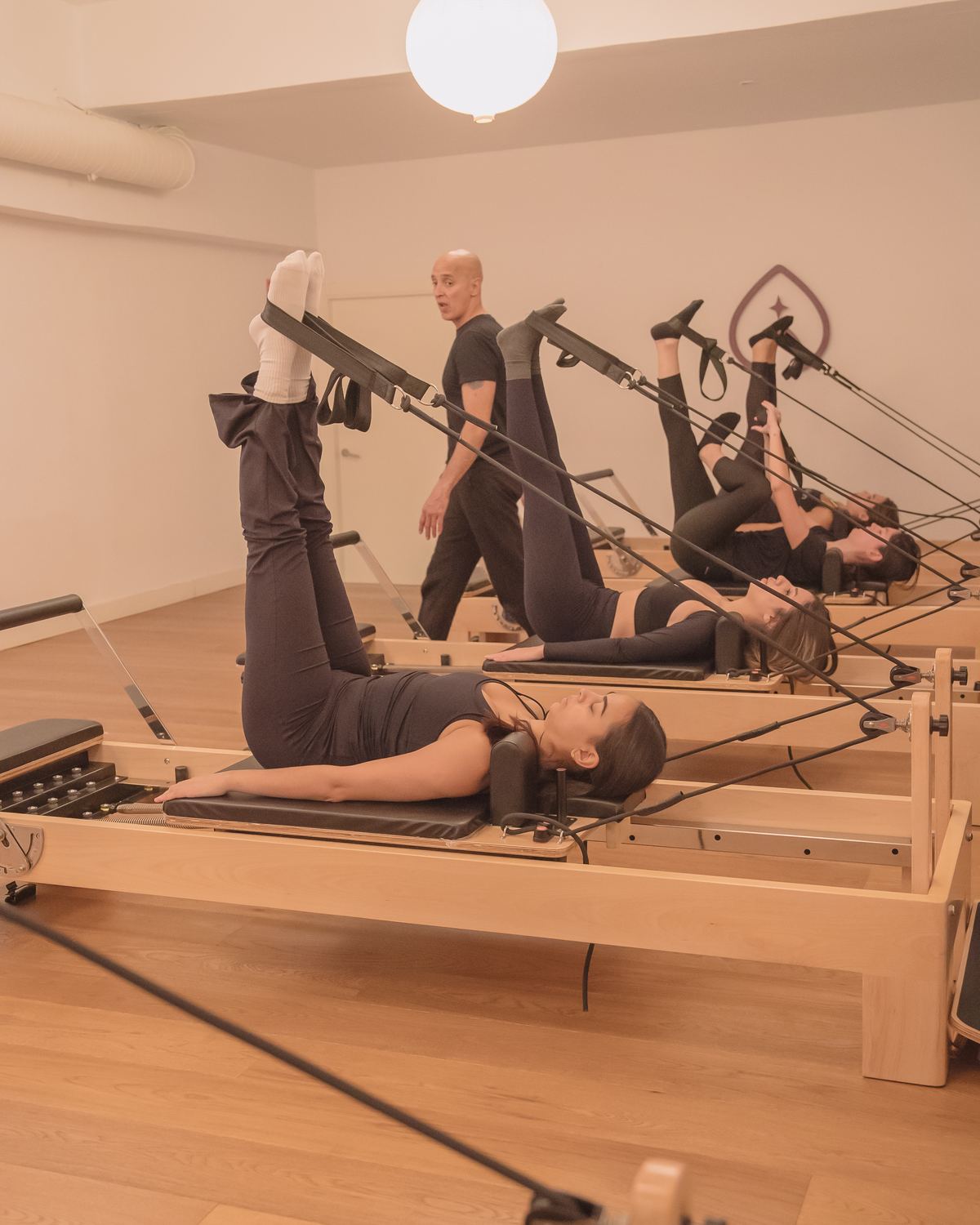
Description: Lying on your back with your legs in “table top” (knees at 90 degrees) or extended on a diagonal. The arms go in the straps. The head and shoulders lift off the carriage while the arms pump up and down in short, rhythmic movements. You perform 100 pumps (10 sets of 10), coordinated with a breathing pattern of 5 inhalations and 5 exhalations.
Technical key: The power of the movement comes from the centre, not from the arms. The shoulders stay away from the ears. The lower back stays in contact with the carriage throughout the exercise. If your neck tenses up, lower your head and work with legs in table top.
The Hundred is one of the most recognisable Reformer exercises and usually opens most sessions because it raises body temperature and activates the whole abdominal wall from the first minute.
2. Coordination
Level: Intermediate
Springs: Light (1 light spring or 1 medium)
Main muscles: Rectus abdominis, obliques, transversus abdominis, quadriceps, adductors
Description: Lying on your back with your hands in the straps, elbows bent at your sides. From an abdominal curl position, arms and legs extend simultaneously on a diagonal. With the limbs extended, the legs open and close. Then the knees bend and, finally, the elbows bend to return to the starting position.
Technical key: The abdominal curl is held throughout the whole sequence. It is not about moving arms and legs; it is about keeping the trunk absolutely stable while the limbs work. If your lower back lifts off the carriage when you extend your legs, reduce the angle of extension.
This exercise demands real coordination between breathing, movement and stabilisation. It is especially useful for developing the connection between upper and lower body through the core.
3. Short Spine
Level: Intermediate
Springs: Medium (2 medium springs)
Main muscles: Deep abdominals, spinal extensors, hamstrings, glutes
Description: Lying on your back with your feet in the long straps. The legs extend, pushing the carriage until the ropes are taut. From there, the hips lift, articulating the spine vertebra by vertebra until the weight rests on the shoulders and upper back. The knees bend towards the shoulders. The spine lowers slowly, articulating each segment back down to the carriage.
Technical key: The lift and the descent must be slow and controlled, with clear spinal articulation. If you feel pressure in your neck or cervical spine, you are lifting too high. The springs help support the weight, but the control comes from the abdominals, not from momentum.
Short Spine is one of the best Reformer exercises for spinal mobility. The combination of traction, flexion and articulated spinal extension makes it a therapeutic and demanding exercise in equal measure.
4. Knee Stretches
Level: Beginner (round back) / Intermediate (flat back) / Advanced (knees off)
Springs: Medium to heavy (2-3 medium springs)
Main muscles: Transversus abdominis, obliques, quadriceps, hip flexors, shoulder stabilisers
Description: Kneeling on the carriage with your hands on the footbar. From this position, you push the carriage back with your feet and bring it back to the starting position using the abdominal muscles. There are three variations: with a rounded back (round back), with a flat back (flat back) and with the knees lifted off the carriage (knees off).
Technical key: The carriage moves, but the trunk does not. The distance between the hands and the knees stays constant. All the movement is generated from the hip joint and controlled from the abdomen. In the “knees off” version, the knees lift just a few centimetres off the carriage, which multiplies the demand on the core.
The progression of Knee Stretches from round back to knees off is a reliable indicator of the level of abdominal control. It is an exercise that looks simple until you try to keep your trunk stable for 10 repetitions in a row.
Leg and Glute Exercises (4 exercises)
The Reformer allows you to work the lower-body muscles with a precision that bodyweight exercises cannot match. The variable resistance of the springs, combined with the horizontal position of the body, reduces the load on the joints while maintaining a high muscular demand.
5. Footwork
Level: Beginner
Springs: Heavy (3-4 springs, a combination of heavy and medium)
Main muscles: Quadriceps, hamstrings, glutes, calves, intrinsic foot muscles
Description: Lying on your back with your feet on the bar (in different positions: parallel, in a V, apart, on the heels, on the toes). The legs extend, pushing the carriage out, and bend to bring it back in a controlled way. It is the equivalent of a horizontal squat with spring resistance.
Technical key: The pelvis stays neutral throughout the movement. It is not about pushing hard, but about keeping control in the return phase. Many beginners focus on the extension and let the carriage “bounce” on the way back. The real work is in braking the carriage in a controlled way, activating the hamstrings and glutes in the eccentric phase.
Footwork is usually the first exercise taught to beginners because it lets you get used to the movement of the carriage in a safe context. But it is not an exercise just for newcomers. With variations in position, tempo and springs, Footwork challenges any level.
6. Single Leg Press
Level: Intermediate
Springs: Medium (2 medium springs)
Main muscles: Quadriceps, glutes, hamstrings, hip stabilisers, adductors
Description: Lying on your back with one foot on the bar and the other leg lifted (extended towards the ceiling or in table top). The supporting leg extends, pushing the carriage, and returns with control. You complete all the repetitions on one side before changing.
Technical key: The pelvis stays level at all times. The natural tendency when working with one leg is for the hip on the free side to lift or rotate. That compensation cancels out the benefit of the exercise. Imagine you have a glass of water on each hip bone and you cannot spill a drop.
This exercise reveals asymmetries between legs that go unnoticed in bilateral work. It is common to discover that one leg is clearly weaker or less stable than the other. Working on those differences prevents injuries and improves functional performance.
7. Skating
Level: Intermediate
Springs: Light to medium (1 medium spring or 1 light + 1 medium)
Main muscles: Adductors, abductors, gluteus medius, quadriceps, hip and ankle stabilisers
Description: Standing on the Reformer with one foot on the carriage and the other on the fixed platform. The carriage slides sideways as you push out with the carriage leg and bring it back with control using the adductors. The movement mimics the pattern of ice skating.
Technical key: The torso stays upright and centred over the supporting leg. The movement is lateral and controlled, with no leaning of the trunk. The return phase (adduction) is where the work happens: the carriage comes back slowly, resisted by the adductors of the carriage leg. Avoid putting weight on the sliding leg.
Skating is one of the most effective Reformer exercises for the adductors and gluteus medius, muscles that play a fundamental role in knee and hip stability during activities such as walking, running or climbing stairs.
8. Standing Lunges
Level: Intermediate to advanced
Springs: Light to medium (1 light spring or 1 medium)
Main muscles: Quadriceps, glutes, hamstrings, hip flexors, ankle stabilisers, core
Description: Standing next to the Reformer with one foot on the fixed platform and the other on the carriage (behind the body). The front knee bends as the carriage slides back, taking the back leg into a deep lunge position. The front leg extends to bring the carriage back.
Technical key: The front knee does not go past the toes. The weight is distributed over the heel of the front leg. The spine stays vertical. Control of the movement comes from the glutes and quadriceps of the fixed leg, not from the momentum of the carriage leg. The slower, the harder.
Standing Lunges combine strength, balance and proprioceptive control. They are a functional exercise with direct transfer to everyday movements such as climbing stairs, crouching or walking on uneven ground.
Arm and Upper-Body Exercises (3 exercises)
The Reformer allows you to work the muscles of the arms, shoulders and back with pulling and pushing patterns that respect joint biomechanics. The straps and the footbar offer support points that make it possible to isolate muscle groups without overloading the shoulder joints.
9. Arms Pulling Straps
Level: Beginner to intermediate
Springs: Light (1 light spring)
Main muscles: Latissimus dorsi, rhomboids, middle and lower trapezius, posterior deltoid, spinal extensors
Description: Lying face down on the carriage (the box can be placed on the carriage for more support). The hands hold the straps. You pull the straps towards your hips, extending your arms along your body while your chest lifts slightly off the carriage. The legs stay together and active.
Technical key: The movement starts from the shoulder blades, not from the arms. Before pulling, retract and depress the scapulae (draw them down and towards the spine). The shoulders never rise towards the ears. The spinal extension is moderate and controlled, not an excessive lumbar arch.
This exercise is essential for counteracting the rounded-shoulder posture that sedentary work creates. It strengthens the entire posterior musculature of the trunk, the same muscles that weaken when we spend hours in front of a computer.
10. Chest Expansion
Level: Beginner to intermediate
Springs: Light to medium (1 light spring or 1 medium)
Main muscles: Pectoralis major, anterior and posterior deltoid, triceps, rhomboids, trapezius, spinal extensors
Description: Kneeling on the carriage (or standing on the platform, depending on the variation), facing the springs. The hands hold the straps. You pull the straps back until the arms are behind the body. Hold the position for a moment, turn your head to one side, then the other, return to centre and release the straps in a controlled way.
Technical key: The torso does not lean forwards or backwards during the pull. The force comes from the back and shoulders, not from a swing of the body. The head turn at the end of the movement adds a cervical mobility component and forces the trunk to stabilise while the head rotates.
Chest Expansion is an exercise that combines upper-body strengthening with thoracic opening. The benefits of Reformer Pilates for posture show very clearly in this movement.
11. Long Stretch
Level: Advanced
Springs: Medium (2 medium springs)
Main muscles: Pectoralis major, deltoids, triceps, full core, quadriceps, shoulder stabilisers
Description: In a plank position with your hands on the footbar and your feet against the shoulder blocks of the carriage. From this position, the carriage is pushed back by extending the shoulders, creating a diagonal line of the body. The carriage returns to the starting position while the plank is held throughout.
Technical key: The body forms a straight line from the heels to the crown of the head throughout the movement. There is no hip flexion or sagging in the lower back. If the hips drop or lift, the springs are too light or the exercise is too advanced for your current level. It is an exercise of total dynamic stabilisation.
Long Stretch is one of the most demanding Reformer exercises for the upper body. It requires pushing strength, shoulder stability and core control all working at the same time. It is a clear progression goal for those looking for a real challenge.
Full-Body Exercises (2 exercises)
These exercises demand the simultaneous involvement of multiple muscle chains. They are the most complex in the repertoire and the ones that require the most control, strength and coordination.
12. Snake/Twist
Level: Advanced
Springs: Medium (1-2 medium springs)
Main muscles: Obliques, transversus abdominis, latissimus dorsi, deltoids, quadriceps, adductors, shoulder and hip stabilisers
Description: Standing at the side of the Reformer, you place one hand on the footbar and your feet on the carriage (one in front of the other, on the edge). The body forms a side line supported on the hand. You push the carriage out as the body lowers into a controlled lateral flexion, and bring the carriage back as the body rotates and rises. The “twist” version adds a thoracic rotation on the return.
Technical key: The stability of the supporting shoulder is key. If the shoulder rises towards the ear or loses its scapular retraction, the exercise can compromise the joint. The movement is fluid, not segmented. The twist comes from the thoracic spine, not from the lumbar spine.
Snake/Twist is an advanced-level exercise that integrates lateral strength, rotation, balance and breath control in a single sequence. It is not introduced until the student has solid command of the side plank and of rotation exercises in more stable positions.
13. Up Stretch
Level: Intermediate to advanced
Springs: Medium (2 medium springs)
Main muscles: Full core, deltoids, pectorals, latissimus dorsi, hamstrings, hip flexors
Description: Standing with your hands on the footbar and your feet against the shoulder blocks of the carriage, forming an “inverted V” position (similar to downward dog in yoga). You push the carriage back while holding the inverted V. Then the body lowers into a plank position as the carriage moves forward, and rises back to the inverted V.
Technical key: The transition between inverted V and plank must be fluid and controlled. The shoulders stay stabilised throughout the range. The most demanding phase is the rise from plank to inverted V, where the abdominals and hip flexors work against the resistance of the springs to lift the hips.
Up Stretch tests your ability to keep control while the body changes position. It is an exercise that reveals the quality of your core work: if the abdominals are not active, the hips do not rise.
Flexibility Exercises (2 exercises)
Flexibility on the Reformer is not achieved by forcing static positions. The springs accompany the movement, allowing the body to gain joint range actively and progressively. These two exercises are benchmarks for improving the mobility of the spine and the posterior chain.
14. Mermaid
Level: Beginner to intermediate
Springs: Light (1 light spring)
Main muscles: Obliques, quadratus lumborum, latissimus dorsi, intercostals, lateral trunk muscles
Description: Sitting sideways on the carriage with your legs crossed or folded. One hand rests on the footbar. You push the carriage out with your hand as the body leans sideways, creating a deep stretch through the whole lateral chain of the trunk. You bring the carriage back and repeat on the other side, changing position.
Technical key: The stretch happens in the side of the body, not in the shoulder. If you feel tension in the supporting shoulder, the hand position or the distance to the carriage is not right. The opposite hip stays anchored to the carriage. It is not about reaching as far as possible, but about feeling the opening between the ribs on the side being stretched.
Mermaid is one of the most rewarding Reformer exercises. It opens up spaces in the trunk that sedentary life closes. Many students describe it as the moment of the class when they feel they “can breathe better”.
15. Elephant
Level: Beginner to intermediate
Springs: Medium to heavy (2-3 medium springs)
Main muscles: Hamstrings, calves, deep abdominals, spinal extensors, posterior chain muscles
Description: Standing on the carriage with your hands on the footbar, forming a trunk-flexion position with straight legs (similar to a standing forward fold). You push the carriage back with your feet, stretching the hamstrings, and bring it back using the abdominals and the connection of the posterior chain.
Technical key: The spine stays in a rounded, even flexion throughout the movement. It is not about pushing the carriage with the legs, but about bringing the carriage back by pulling from the abdomen. Think about lifting your navel towards your spine to bring the carriage home. The heels press down throughout the exercise to maximise the stretch of the posterior chain.
Elephant combines flexibility work with core strengthening in a position that challenges the connection between the abdominal muscles and the posterior chain. It is an exercise that improves with practice and with patience.
How These Exercises Fit into a Typical Class
In a 50-minute session at Pinar Pilates, the instructor does not pick 15 exercises at random. Each class follows a deliberately designed sequence to warm up, activate, challenge and recover.
Warm-up (5-8 minutes). The class usually begins with Footwork to warm up the legs and activate the connection with the carriage. In some cases, Elephant is added to mobilise the spine and stretch the posterior chain from the very start.
Core activation (8-10 minutes). The Hundred opens the abdominal work. Depending on the level of the group, Coordination or Knee Stretches (round back version) may follow to consolidate the activation of the centre.
Leg and glute block (10-12 minutes). Single Leg Press, Skating or Standing Lunges are built into sequences that alternate bilateral and unilateral work. The goal is functional strength and correction of asymmetries.
Upper body and back (8-10 minutes). Arms Pulling Straps and Chest Expansion are common in this phase. In advanced classes, Long Stretch replaces or complements these exercises.
Full-body work (5-8 minutes). In multilevel and advanced classes, Up Stretch and Snake/Twist appear as challenges that integrate everything worked on. In beginner classes, they are replaced by more accessible variations.
Flexibility and cool-down (5-8 minutes). Mermaid and Short Spine close the session with movements that lengthen the muscles, mobilise the spine and leave the body in a state of openness and balance.
This structure can vary depending on the day, the level of the group and the goals of the session. With groups of a maximum of 8 people, the instructor is able to adapt the sequence to the real needs of the people in the room.
Progression: from Beginner to Advanced
Not all Reformer exercises are for all levels. A sensible progression might follow this line:
First weeks: Footwork, The Hundred (with legs in table top), Knee Stretches (round back), Elephant, Mermaid, Arms Pulling Straps. These are basic Reformer Pilates exercises that build the technical foundation and the mind-body connection.
Months 2-4: Single Leg Press, Coordination, Chest Expansion, Short Spine, Skating. Unilateral work, greater coordination demands and exercises that require spinal articulation are introduced.
From month 4-6: Standing Lunges, Up Stretch, Long Stretch, Knee Stretches (knees off). Work in standing and plank positions demands a control that is built over the previous months.
Advanced level (6+ months of regular practice): Snake/Twist and the most demanding variations of each exercise. These movements require strength, flexibility, coordination and breath control all working simultaneously.
Progression does not depend strictly on time. It depends on the quality of practice, on frequency and on supervision. Someone who trains 3 times a week with constant correction progresses much faster than someone who trains 5 times without individual attention.
Why Supervision Matters
Knowing the 15 best Reformer exercises is useful. But the difference between reading about an exercise and performing it correctly is enormous. The Reformer is a machine that amplifies both good and bad technique. A Footwork with a misaligned pelvis does not strengthen the glutes; it compensates with the quadriceps and overloads the knee. A Short Spine without abdominal control does not mobilise the spine; it compresses the cervical vertebrae.
At Pinar Pilates we work with groups of a maximum of 8 people per class. This format allows the instructors to observe each student’s execution, correct alignment in real time and offer variations adapted to each body. With more than 490 Google reviews (average rating 4.9 out of 5), our students confirm that this personalised attention makes a difference you feel from the first session.
Start Practising These Exercises
The Reformer Pilates exercises we have described cover the whole body: from the deep core muscles to the adductors, from the shoulder stabilisers to the posterior chain. Each one has a specific purpose and a place within a well-structured session.
If you want to experience how these exercises feel with the guidance of a qualified instructor and in a small-group setting, we invite you to get to know our studio in the Salamanca district (Calle del Pinar 8, Madrid).
Book your first class with 50% off and discover why Reformer Pilates has become the favourite workout of thousands of people in Madrid.
Frequently Asked Questions
How many exercises are done in a Reformer Pilates class?
A 50-minute class usually includes between 8 and 12 exercises, depending on the level and the complexity of each movement. Quality of execution always takes priority over quantity.
Can I do these exercises if I am a beginner?
Some, yes (Footwork, adapted The Hundred, Elephant, Mermaid). Others require months of practice to be performed safely. See our beginner’s guide to find out where to start.
How often should I practise?
Joseph Pilates recommended 3 sessions per week. In our experience, 2-3 classes a week produce significant results in strength, flexibility and posture within 8-12 weeks.
What is the difference between doing these exercises in a studio and at home on a Reformer?
Supervision. A home Reformer lets you practise, but without technical correction it is easy to develop compensations that limit results or cause discomfort. In a studio like Pinar Pilates, every movement is supervised and adjusted.
How much does Reformer Pilates cost in Madrid?
At Pinar Pilates we offer different options: a 4-class pack for 100 euros, 8 classes for 150 euros, 12 classes for 200 euros, an unlimited flat rate for 250 euros per month and a single class for 30 euros. You can see all the details on our schedule and prices page.
Pinar Pilates · Salamanca district, Madrid
Your first reformer class, €15
Groups of 8 people maximum, specialist instructors and more than 40 classes a week. Your first class is half price.
Book my first classCalle del Pinar 8, Madrid · Questions? Message us on WhatsApp