The Reformer is not a machine you master in a few weeks. It has a broad technical repertoire, a very clear logic of progression and a learning curve that takes time. That is why at Pinar Pilates we organise our full-body classes in three levels: basic, multilevel and advanced. It is not a question of ego or speed, but of making sure every student works safely and effectively at the right point in their journey.
In this article we explain what each level contains, how long it usually takes to move from one to the next, how to know whether you are ready to move up and why forcing that progression is the most common cause of injuries and bad postural habits in Pilates.
Why Reformer Pilates has levels
Note: what other studios call “intermediate”, at Pinar Pilates we call multilevel, which is how it appears in the booking calendar.
The Pilates method has a technical foundation that is non-negotiable. Before working with loads, increasing range of movement or adding complex coordination, the body needs to learn to activate the centre correctly, respect alignment and synchronise movement with the breath.
Skipping those foundations does not speed up progress. What it does is create compensations that become harder to correct the longer they go unaddressed. A student who has spent six months in the basic class paying full attention to the details will have a far more solid base than one who forced the jump to multilevel after two months.
Levels are not a barrier. They are the structure that makes Pilates work.
Basic Level: learning the language of the body and the machine
The basic level is not easy. It is different. It demands a kind of attention many people have never had to give to movement before: where the pelvis is, what the shoulder blade is doing, how to coordinate breathing with muscle action. That takes concentration, not brute strength.
If you are new to the world of the Reformer, first read our guide to Pilates for beginners to understand how the machine works before you start.
What you will learn at basic level
The main goal is to get to know the machine and establish the fundamental movement patterns. In the first classes you will become familiar with the carriage, the springs, the footbar and the straps. You will understand what it means to work with different resistances and why the spring set-up matters for each exercise.
The exercises you will regularly find at basic level include:
- Footwork: the foot series on the footbar, which builds leg strength, activates the centre and establishes axial alignment.
- Pelvic Curl: mobilising the spine in progressive vertebral flexion, working the posterior chain.
- Basic Leg Circles: leg circles in the straps that improve hip mobility and train pelvic stability.
- Hundred (adapted version): activating the powerhouse with percussive breathing.
- Introductory Short Box Series: trunk work seated on the carriage.
What is trained at this level
Beyond the specific exercises, the basic level builds body awareness, correct breathing, activation of the pelvic floor and transversus abdominis, and the ability to hold a neutral or imprinted spine under load. These are the foundations. Without them, the next levels lose their effect and the risk of injury increases.
Multilevel: more complexity, more demand
Once the basic patterns are internalised, multilevel introduces longer sequences, greater resistance, work in different planes and exercises that demand more sophisticated coordination between trunk and limbs.
Here it is no longer only about performing the movement correctly. It is about keeping that control under more demanding conditions.
Characteristic multilevel exercises
- Short Spine: spinal flexion and extension in the straps, with eccentric control of the posterior chain.
- Stomach Massage Series: leg work with the spine in active flexion, four progressive variations.
- Knee Stretches: kneeling with the carriage moving, working hip, knee and core in a closed chain.
- Long Stretch Series: moving planks and variations that demand total trunk stability.
- Semi-Circle: a spinal mobility exercise combined with leg work in transition.
- Elephant: posterior-chain work with extended legs and a moving carriage.
The qualitative difference of multilevel
At multilevel the student works faster, with fewer verbal corrections from the instructor and more autonomy. Transitions between exercises start to flow. Spring resistance increases in some exercises. And the demand for concentration does not drop; it is maintained despite the greater technical complexity.
It is also the level where many of the patterns learned at basic are consolidated. There are students who have been at multilevel for months and still discover nuances in exercises they thought they had mastered.
Advanced Level: flow, control and the full repertoire
The advanced Reformer level is demanding. Not because of the physical difficulty of the exercises themselves, but because of the technical precision they require and the ability to maintain that precision throughout the class, in quick transitions and with varying resistance.
Reaching the advanced level takes time. And that is part of what makes it valuable.
Advanced-level exercises
- Snake and Twist: an asymmetric diagonal exercise that combines spinal rotation, extension and total body control.
- Control Balance: an inversion in the straps that requires core strength, hip mobility and confidence in movement.
- Long Spine: full lengthening of the spine in the straps with partial inversion.
- Tendon Stretch: ankle and posterior-chain work with extreme control of the centre.
- Advanced Short Spine and Corkscrew: inversion and rotation variations with high mobility demands.
- Russian Splits: progressive splits on the moving carriage.
What sets the advanced student apart
An advanced-level student does not only perform the exercises correctly. They chain them fluidly, adjust their breathing without thinking, keep the connection with the centre even in the most challenging positions and can tell for themselves when something is not properly aligned. They have developed what the Pilates method calls body intelligence.
You can see some of these exercises explained in detail in our guide to Reformer exercises.
How long it takes to move up a level
This is the question new students ask most. And the honest answer is: it depends, but there are realistic timeframes.
From basic to multilevel: 3 to 6 months
With a frequency of two classes a week, most students are ready for multilevel between three and six months. The factors that speed up or slow down that process are regular attendance, previous body experience (dance, yoga, athletics), the ability to apply corrections and the attention paid in each class.
Some students have solid foundations after four months. Others are still working on nuances of the basic level at six months, and those nuances deserve the time. Both paths are valid.
From multilevel to advanced: 6 to 12 months
The jump from multilevel to advanced is longer and more demanding. The body needs to consolidate not only technique but also the functional strength, joint mobility and neuromuscular endurance the advanced exercises require. With two or three classes a week, most students reach the advanced level between six months and a year of multilevel work.
Forcing this jump too early is the most frequent cause of injuries in Reformer Pilates, especially in the lower back and shoulders, because the advanced exercises take the spine and joints through ranges the body is not prepared to control without the foundation.
If you want to know how often to practise to progress optimally, we explain it in detail in our guide on how many times a week to do Pilates.
Signs that you are ready to move up a level
It is not the instructor who unilaterally decides when you move up. It is a conversation between what the instructor observes and what the student experiences. But there are clear indicators.
Signs that you can move from basic to multilevel
- You perform the basic exercises with real control, without needing constant corrections.
- You keep the centre activated throughout the class, not only in isolated exercises.
- Breathing no longer requires conscious attention; it flows with the movement.
- You can hold a neutral pelvis and spine under load without losing it.
- You know the usual spring set-up for the basic exercises without being told every class.
Signs that you can move from multilevel to advanced
- The multilevel sequences flow without technical interruptions.
- You identify your own compensations and correct them without waiting for the instructor’s cue.
- You have enough mobility in the spine, hips and shoulders for the advanced ranges.
- Work with the straps and high pulley is precise and controlled.
- You do not reach the end of the class with accumulated fatigue that compromises your technique.
Signs that you should stay at your current level
- There are exercises at your current level that still need frequent corrections.
- You notice tension or discomfort in areas that should not be working in that exercise.
- Fatigue makes you lose form before the end of the class.
- Your breathing disconnects from the movement when the exercise gets harder.
Staying at your current level is not a failure. It is intelligent training. The instructors at Pinar Pilates watch for these signs in every class and guide you personally.
Why you should not rush to change level
Western fitness culture tends to value rapid progression as a sign of success. In Pilates, that logic can be counterproductive.
A student who moves up to advanced too soon without having consolidated the multilevel patterns not only works less effectively, but creates compensations that settle in as habits. Those compensations are far harder to correct afterwards than if they had never appeared.
Most of the mistakes we see in students with some experience on the Reformer stem from having skipped stages. We explain this in detail in our guide to the most common mistakes beginners make in Reformer Pilates.
The time invested in each level is not lost. It accumulates as the foundation for what comes next.
How Pinar Pilates structures its classes by level
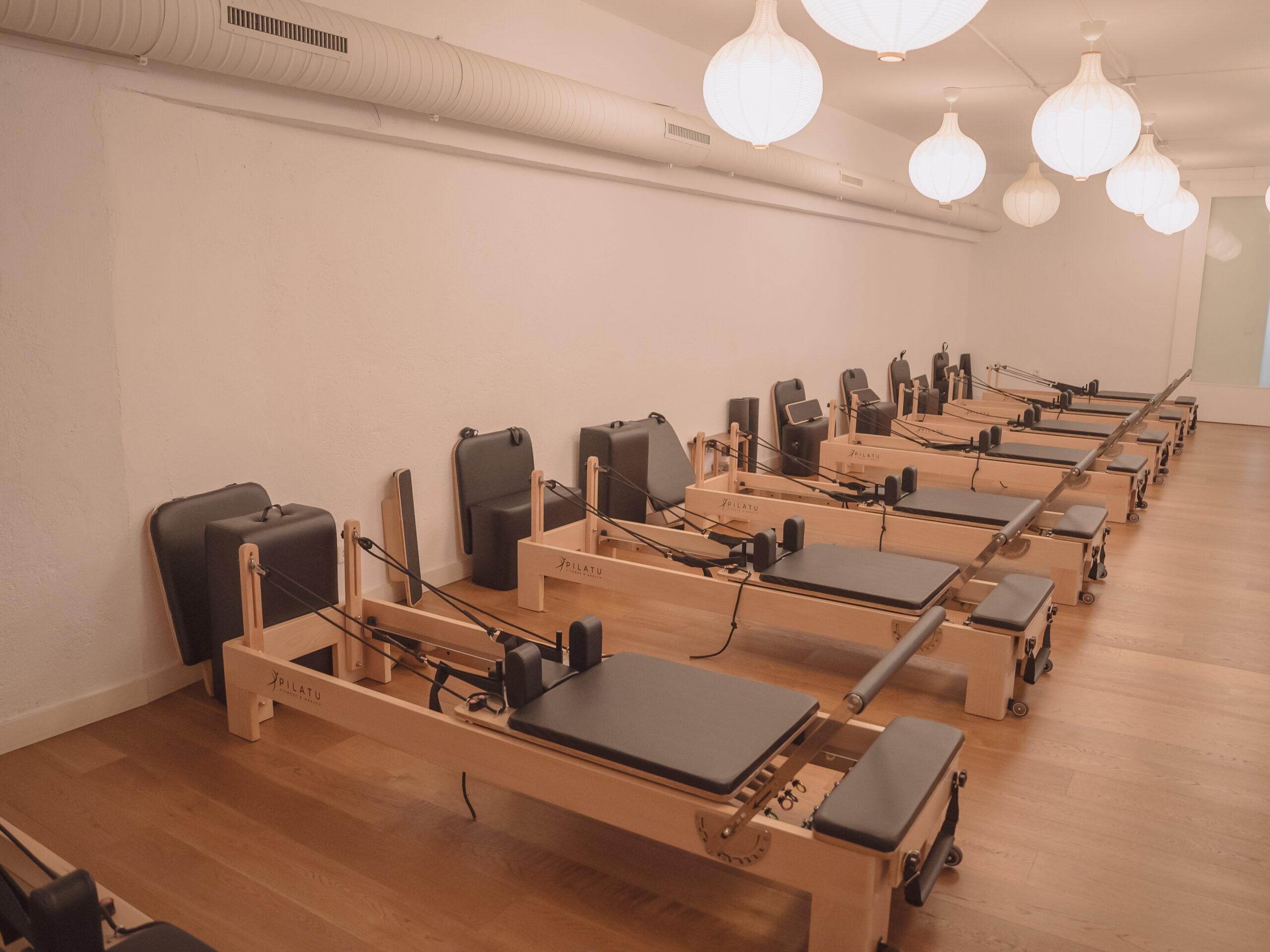
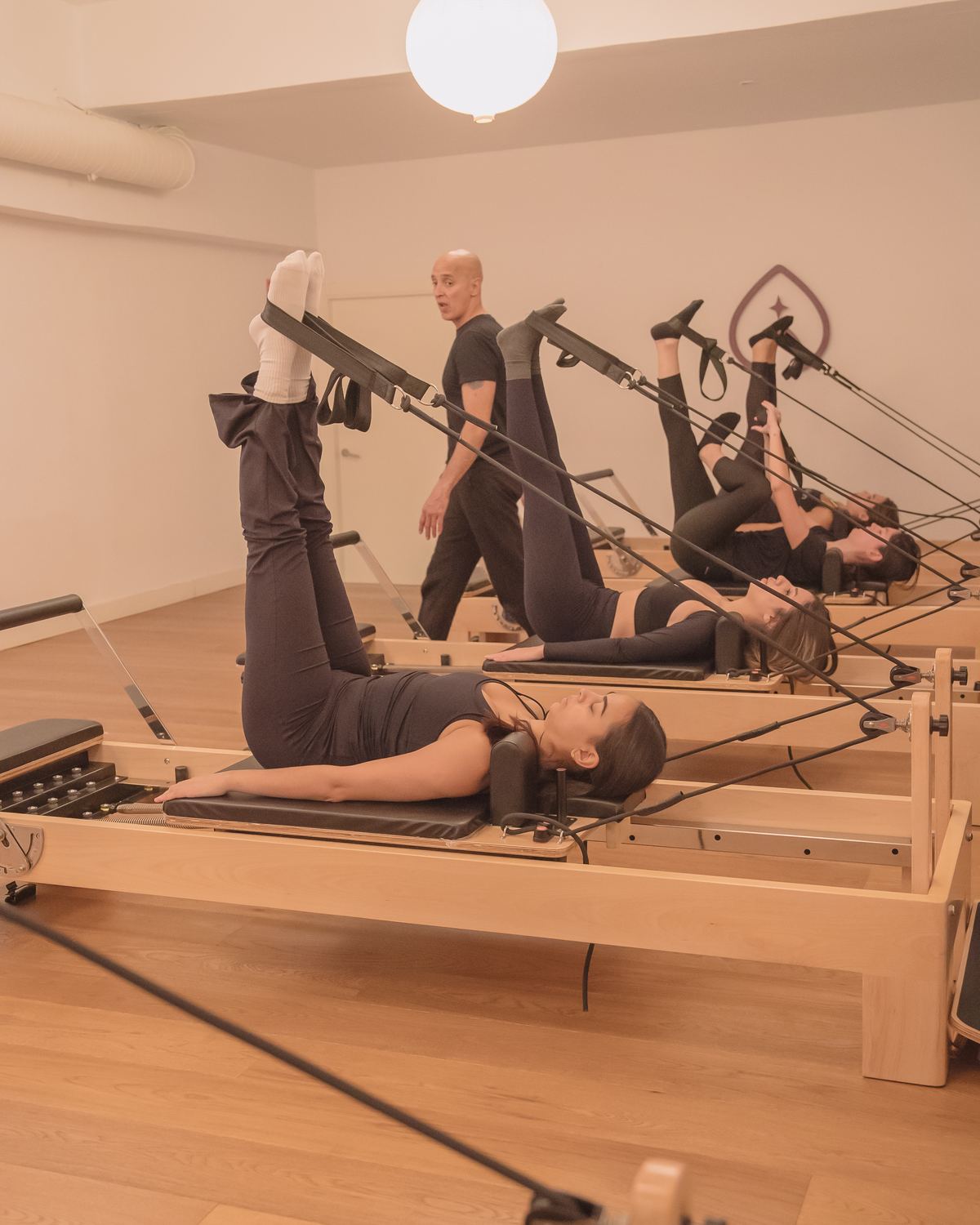
At Pinar Pilates we offer more than 40 classes a week: full-body classes at the three levels (basic, multilevel and advanced) and six focus classes (Glutes & Legs, Strength & Sculpt, Cardio, Upper Body, Core & Posture and Control & Precision) open to all levels. Every class has a maximum of 8 people, which lets the instructor attend to each student genuinely, not only give general instructions to the group.
When a new student arrives, they always start at basic level regardless of previous experience at other studios or in other disciplines. This is not bureaucracy. It is because every studio works with its own methodology and we need to assess, in the context of our classes, what each person’s real level is.
Progression between levels is assessed continuously. When the instructor considers a student ready for the next level, they discuss it with them and the change is made progressively, sometimes attending classes at both levels during a transition period.
If you want to know what the first-class experience is like before committing to a plan, we tell you in our guide to the first Reformer Pilates class in Madrid.
Prices and options at Pinar Pilates
We offer different options to suit each student’s frequency:
- First class: €15 (50% off)
- Drop-in class: €30
- Packs of 5, 10 and 20 classes: €130, €200 and €340 (valid for 90 days)
- 4-class monthly plan: €100 a month
- 8-class monthly plan: €150 a month
- 12-class monthly plan: €200 a month
- Unlimited membership: €250 a month
The studio is at Calle del Pinar 8, 28006 Madrid, in the Salamanca district. We have more than 490 Google reviews (average 4.9 out of 5).
Frequently asked questions about Reformer Pilates levels
I have mat Pilates experience, can I start directly at multilevel?
Not necessarily. Mat Pilates and Reformer Pilates share principles but are technically different. The Reformer introduces variables of resistance, carriage movement and strap use that require specific learning. The usual path is to start at basic and progress quickly if the mat Pilates foundation is solid.
If I come only once a week, how long will it take to change level?
With one class a week, the timeframes get longer. From basic to multilevel it could be six months to a year. From multilevel to advanced, one to two years. Frequency is one of the factors that most influences the speed of progression.
Can an advanced student attend basic classes?
Yes, and many do when they want to work on a specific technical detail or recover after a period without training. Basic classes have value for students at every level. The level defines the content of the class, not the quality of the student.
Is there any risk in moving between levels too fast?
Yes. The most frequent injuries in Reformer Pilates, especially in the lower back, hips and shoulders, usually happen when the student works with exercises for which the body does not yet have the technical preparation or the joint capacity required. Progressing at the right pace notably reduces that risk.
How do I know whether I can go straight into multilevel or advanced?
At Pinar Pilates we do an initial assessment with every new student. If you have previous Reformer experience at another studio, tell us when you book and the instructor will assess your real level in the first session before assigning you a group.
Start at the level that is right for you
Reformer Pilates levels are not obstacles to get past as fast as possible. They are the structure that guarantees the method works: that the body learns well, that the technique is solid and that progression is sustainable in the long term.
At Pinar Pilates we have spent years accompanying students from their first basic class to the advanced level. We know how long each stage takes, which exercises mark the transition and how to support that process personally in groups of 8 people maximum.
If you have any questions before booking, call us on +34 611 994 729.
Book your first class at 50% off
Pinar Pilates · Salamanca district, Madrid
Your first reformer class, €15
Groups of 8 people maximum, specialist instructors and more than 40 classes a week. Your first class is half price.
Book my first classCalle del Pinar 8, Madrid · Questions? Message us on WhatsApp