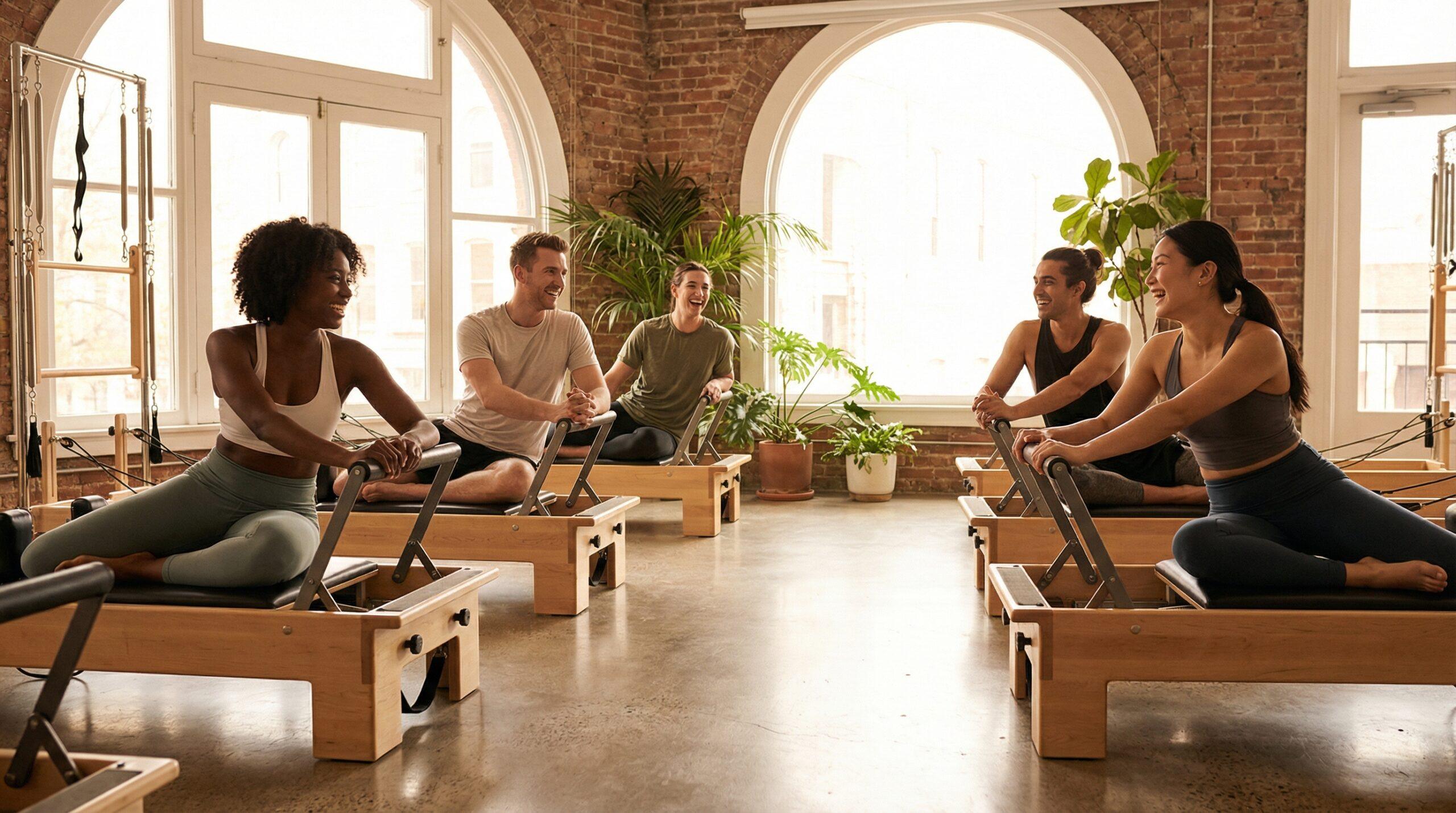
Reformer Pilates is no longer a niche activity. The big fitness chains have added Reformer classes to their offering, and new specialist boutique studios open in Madrid every month. With so much choice, the legitimate question is: is it worth paying more for a boutique studio when my gym already offers Reformer Pilates?
The answer depends on what you are looking for. But to make an informed decision, it helps to understand what separates a boutique studio from a gym chain. It is not only about price or aesthetics: they are structural differences that directly affect your experience, your safety and your results.
8 Differences between a Boutique Studio and a Gym Chain
1. Group size: 8 vs 15-20+
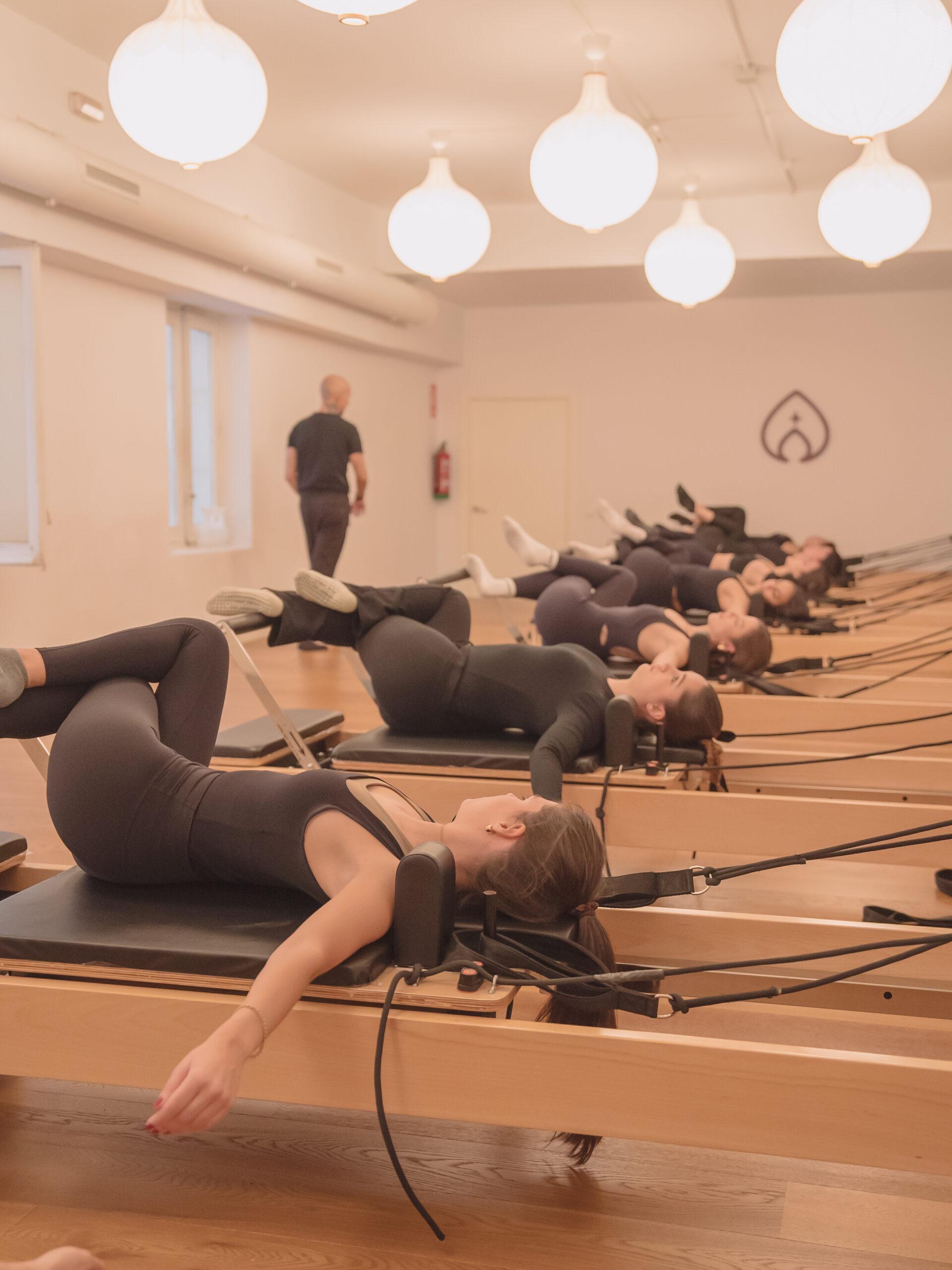
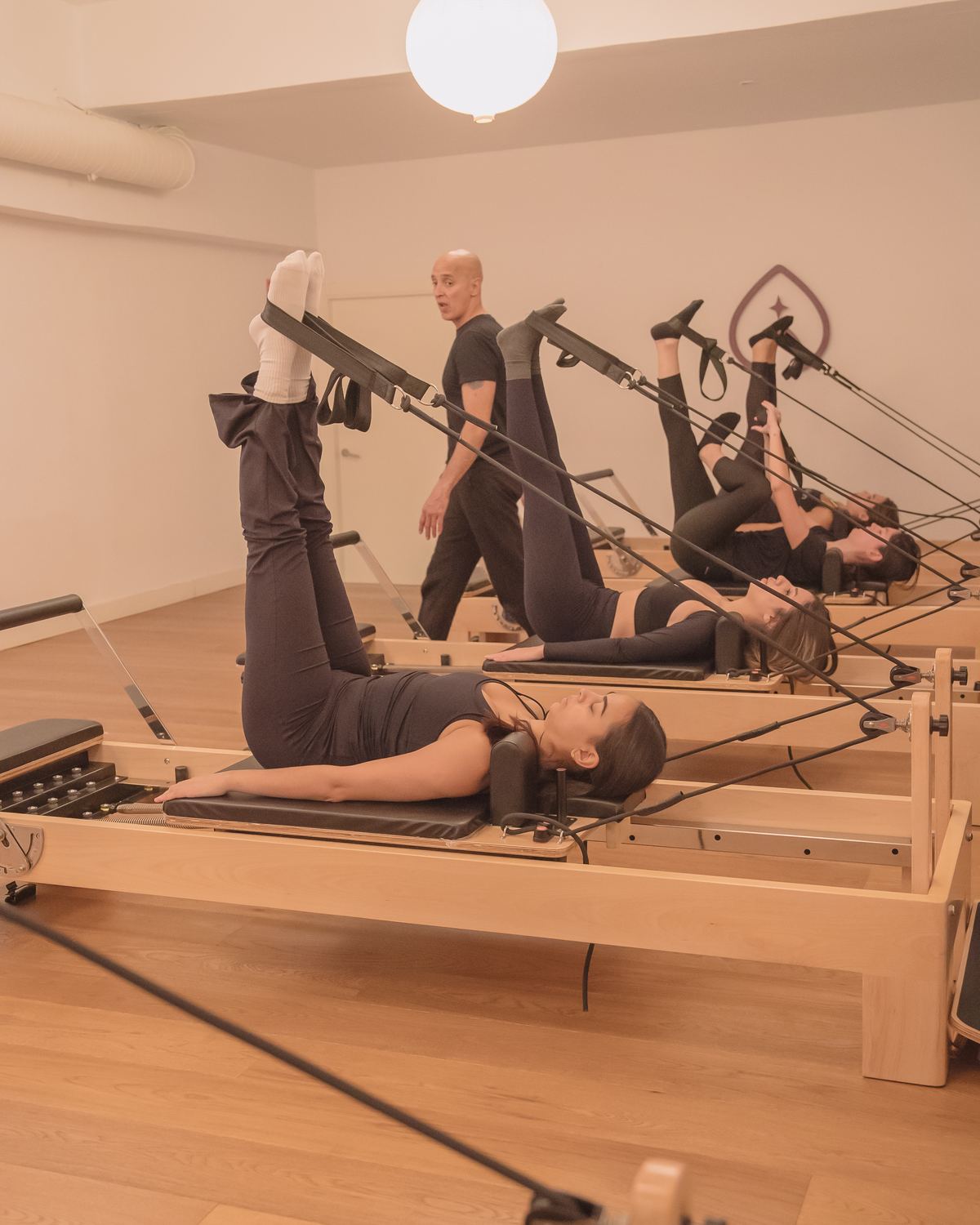
It is the most visible difference and the one with the biggest impact. Gym chains usually offer Reformer classes with 12 to 20 people (or more) to make the investment in machines pay. A boutique studio like Pinar Pilates limits its classes to a maximum of 8 people.
The consequence is direct: in a group of 8, the instructor sees you, corrects you and adapts exercises to your level. In a group of 20, the instructor leads the class from the front and can barely attend to anyone individually. It is the difference between a guided class and a supervised class.
2. Instructor qualifications: specialists vs generalists
At a gym chain, the same monitor may teach spinning at 9:00, Body Pump at 10:00 and Reformer at 11:00. Their Pilates training is usually a complementary course of a few hours.
At a boutique studio, the instructors are Reformer Pilates specialists. At Pinar Pilates, our team (Giuliana Di Giovanni, Gabriela Seminara, Camila T, Montserrat Sierra and Abel Gomez) devotes 100% of their professional activity to Pilates. That specialisation translates into better correction skills, more tools for adapting exercises and a deep knowledge of the method.
3. Equipment quality: premium vs basic Reformers
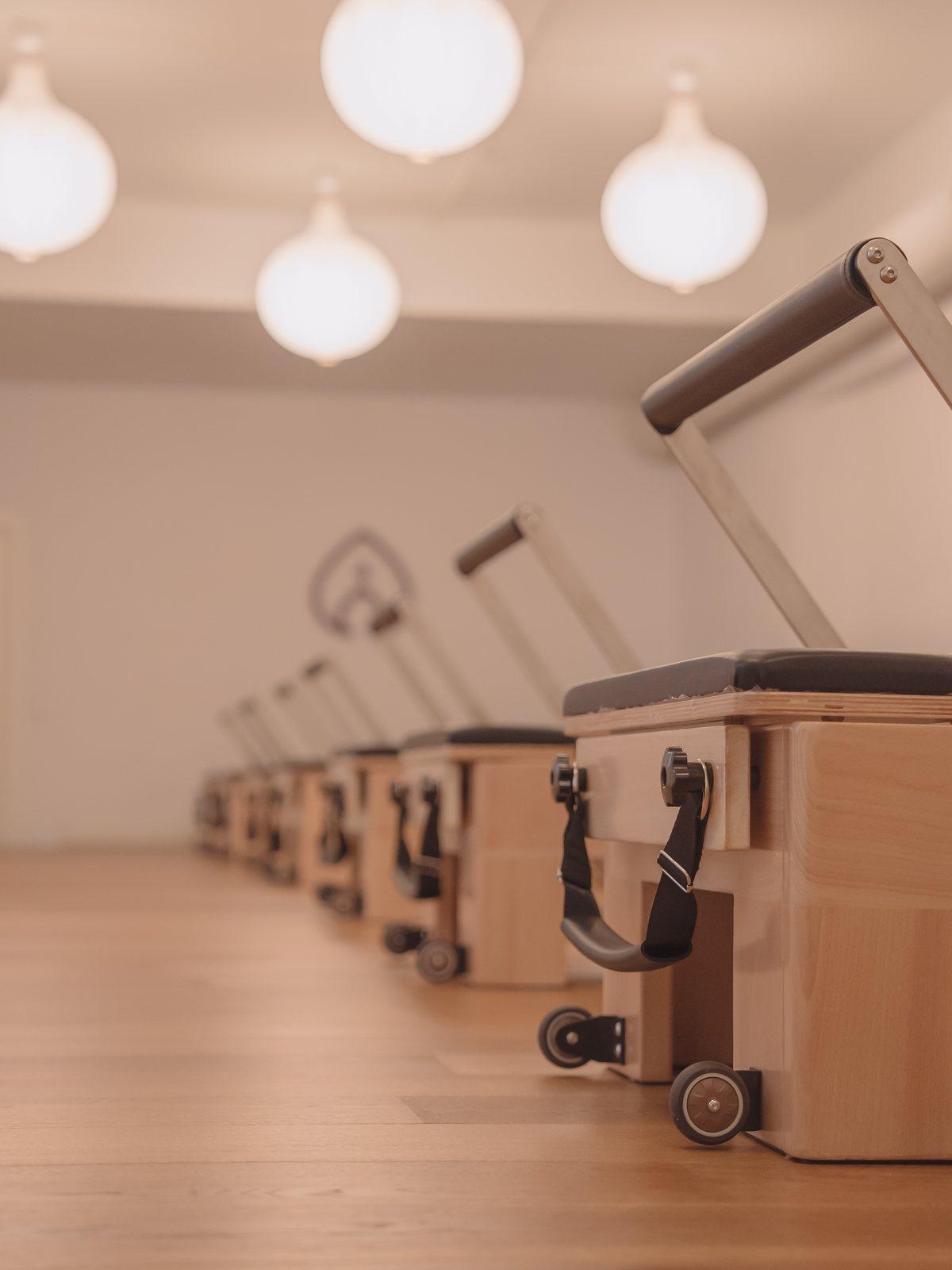
Chains usually work with mid- to low-range Reformers, mass-produced and designed to withstand intensive use with minimal maintenance. They work, but the difference from a high-end professional Reformer shows in the smoothness of the glide, the precision of the spring resistance, the stability of the carriage and the ergonomics of the supports.
A boutique studio invests in premium equipment because it is its main (and only) working tool. The springs are checked regularly, the upholstery is renewed and the machines are kept in optimal condition. In a chain with 50 Reformers and massive turnover, individual maintenance is logistically complicated.
4. Personal attention: they know you by name
At a boutique studio, the team knows its students. They know that María has a protrusion at L5, that Pedro needs to work his posterior chain more and that Ana prefers the Glutes & Legs class. That information builds up class after class and allows ever more precise attention.
At a chain, student turnover is high, groups are large and monitors change frequently. It is hard for anyone to remember your particularities when they share a class with you among 15-20 different people every day.
5. Atmosphere and community: intimacy vs anonymity
A boutique studio creates community. You see the same people, the instructors greet you by name, you recognise faces. That social component increases adherence to exercise: it is harder to stop going when you feel part of something.
At a chain, the experience tends towards anonymity. You go in, do your class among dozens of people, and leave. There is nothing wrong with that, but the emotional bond with the activity is weaker, and the statistics show that the drop-out rate at gym chains is notably higher than at boutique studios.
6. Consistency of the experience: quality control vs variability
At a boutique studio with a small team and its own method, the experience is consistent. It does not matter whether you come on Monday at 7:30 or Saturday at 10:00: the quality of the class, the corrections and the level of demand stay the same. The team is aligned on methodology, standards and goals.
At a chain with 20 different monitors, variability is inevitable. One monitor may be excellent and another mediocre. There is no guarantee that Tuesday’s class will resemble Thursday’s.
7. Specialisation: only Reformer Pilates vs 50 different activities
A boutique studio exists to do one thing very well. At Pinar Pilates we offer classes by level (basic, multilevel and advanced) and six focus classes (Glutes & Legs, Strength & Sculpt, Cardio, Upper Body, Core & Posture and Control & Precision), all on the Reformer, all with the same philosophy. That specialisation makes it possible to refine the method, train instructors better and offer an experience a generalist gym cannot replicate.
A gym chain offers Reformer as one more activity in a catalogue of 40-50 disciplines. Pilates competes for resources (space, investment, staff) with spinning, CrossFit, yoga, aqua aerobics and zumba. It is not the priority of the business: it is an add-on.
8. Results: faster, safer, more sustainable
The sum of the previous seven differences (small groups, specialist instructors, premium machines, personal attention, community, consistency and specialisation) produces a measurable result: students at boutique studios progress faster and with a lower risk of injury.
At Pinar Pilates, students who come 2-3 times a week report visible postural improvements in 4-6 weeks, less back pain in 3-4 weeks and more flexibility and strength in 6-8 weeks. Those timeframes stretch considerably when instruction is generic and corrections are scarce.
When Does It Make Sense to Choose a Chain?
Being honest matters. A boutique studio is not for everyone or for every moment:
- If you want a variety of sports: you want a pool, a padel court, a weights room and varied group classes, an all-in-one gym is more efficient.
- If your budget is very tight: chains offer monthly fees of €30-50 with access to everything, including the Reformer. No boutique studio can compete with that price.
- If you like anonymity: not everyone wants to be known by name. If you prefer to go in, train and leave without interaction, a big chain gives you that freedom.
- If the Reformer is an occasional extra: you do one Reformer class a month as a “bonus”. In that case, paying a boutique fee makes no financial sense.
The choice stops being obvious when Reformer Pilates becomes your main activity. If you go 2-3 times a week, if you want concrete results (less pain, better posture, real toning), if you want someone to supervise your technique: a boutique studio is objectively the better investment.
The Boutique Experience at Pinar Pilates
At Pinar Pilates we have built the studio around a simple idea: that every person who walks through the door receives an excellent experience in every class.
That means:
- A maximum of 8 people per class. Always. No exceptions.
- 5 specialist instructors who work exclusively in Reformer Pilates.
- More than 40 classes a week from Monday to Sunday, so you can find a slot whatever your schedule.
- Classes by level and six focus classes (Glutes & Legs, Strength & Sculpt, Cardio, Upper Body, Core & Posture and Control & Precision) so your body never settles.
- Salamanca district, at Calle del Pinar 8, with easy access by metro, bus and car.
- 4.9 out of 5 on Google with more than 490 reviews from real students.
Our prices start at €100/month (4 classes) and go up to €250/month (unlimited). More than a chain, yes. But as you have read, what you get is above all different.
Frequently Asked Questions
Is a boutique studio only for people with Pilates experience?
No. Our classes welcome absolute beginners as well as people with years of practice. Small groups let the instructor adapt the exercises to each student’s level within the same class. In fact, a beginner benefits more from a small group, because corrections are especially important when learning the basic technique.
Is boutique Pilates elitist?
Boutique Pilates is more expensive than a chain, but it is not an unreachable luxury. Our 4-class monthly plan costs €100 (€25 per class). Many people spend that amount or more on coffees, meals out or subscriptions they do not use. It is a question of priorities, not of extreme purchasing power.
Can I combine a gym and a boutique studio?
Yes, and many of our students do. They use the gym for cardio, weights or swimming, and come to Pinar Pilates twice a week for postural work, flexibility and the deep muscles. It is a very effective combination.
How do I try the experience before committing?
Book your first class at 50% off to live the boutique experience for just €15. One session is enough to notice the difference.
The difference between a boutique studio and a gym chain is not explained, it is experienced. Book your discounted first class at Pinar Pilates and see for yourself. Calle del Pinar 8, Salamanca district. Phone: +34 611 994 729.
Pinar Pilates · Salamanca district, Madrid
Your first reformer class, €15
Groups of 8 people maximum, specialist instructors and more than 40 classes a week. Your first class is half price.
Book my first classCalle del Pinar 8, Madrid · Questions? Message us on WhatsApp