Eight hours sitting in front of a screen. Shoulders forward, head tilted towards the monitor, lower back with no real support. Multiply that by 220 working days a year and the result is predictable: back pain, neck stiffness, chronic fatigue and a posture that deteriorates a little more every month.
Back pain is the most widespread complaint among Spanish workers: according to the VII National Survey of Working Conditions (INSHT, 2011), 77.5% report some musculoskeletal discomfort they attribute to the postures and efforts of their job, and the lower back is the most frequent location (44.9%). It is no coincidence. The human body is not designed to stay still in the same position for hours. And when you decide you need to exercise, the second problem appears: after an exhausting day at work, the last thing you feel like is an hour at the gym lifting weights or a cardio class that leaves you even more drained than you already were.
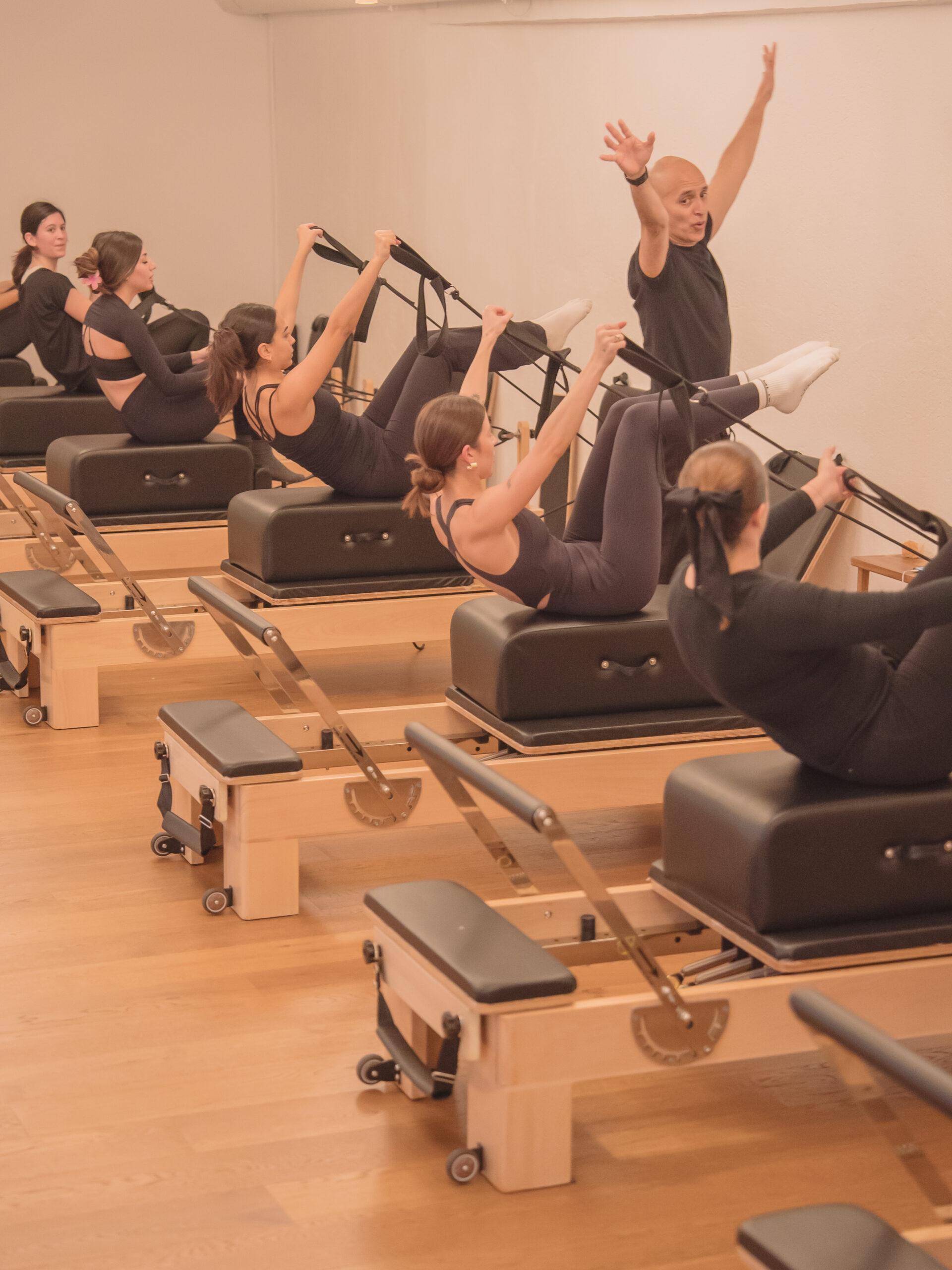
Reformer Pilates solves both problems. It is a low-impact exercise that directly counteracts the effects of sedentary life (posture, pain, stiffness), it is done in 50 minutes and it leaves you with more energy than you had when you walked in. You do not need previous experience, you are not wrecked for the next day and the results show in your performance at work.
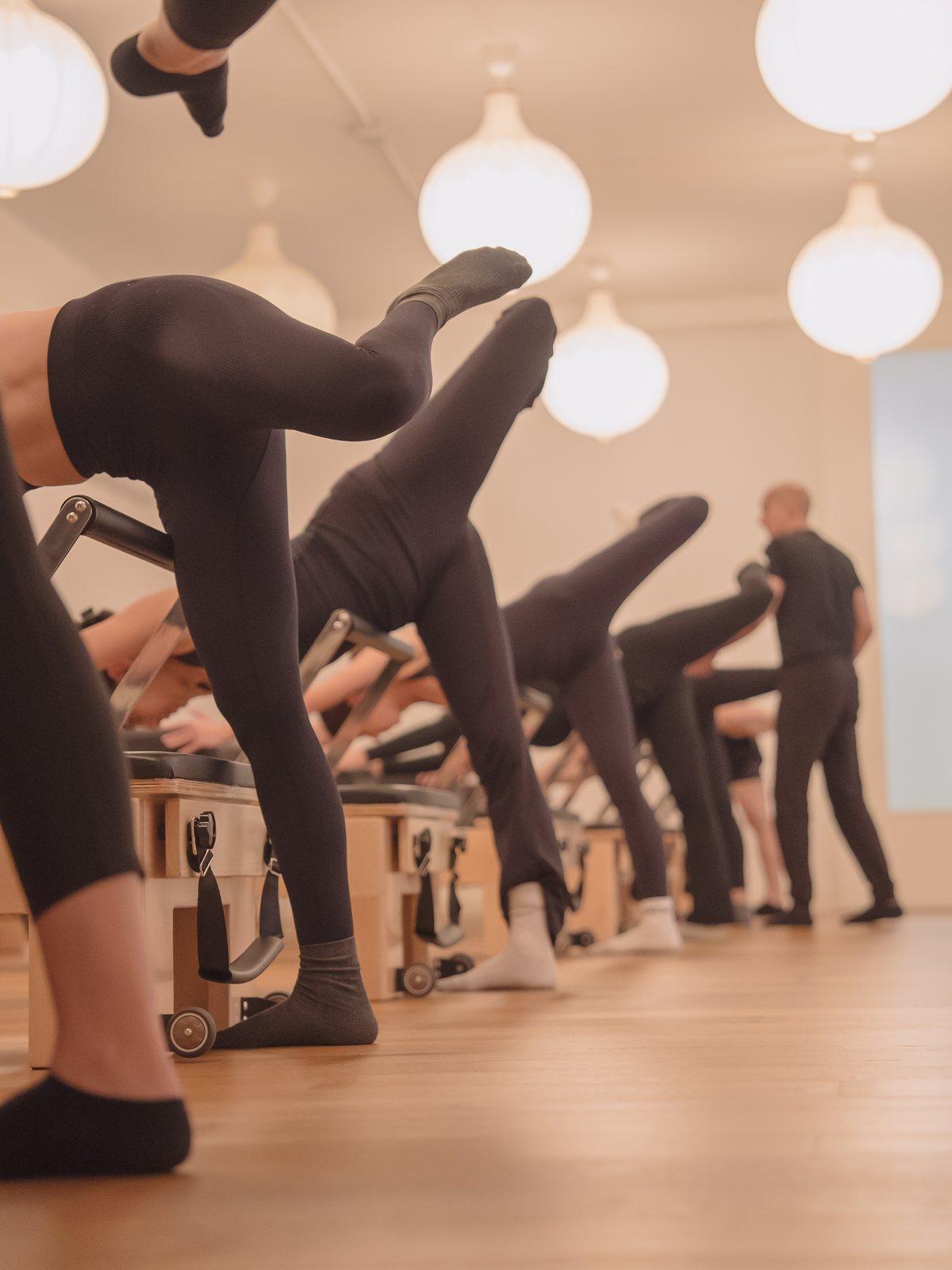
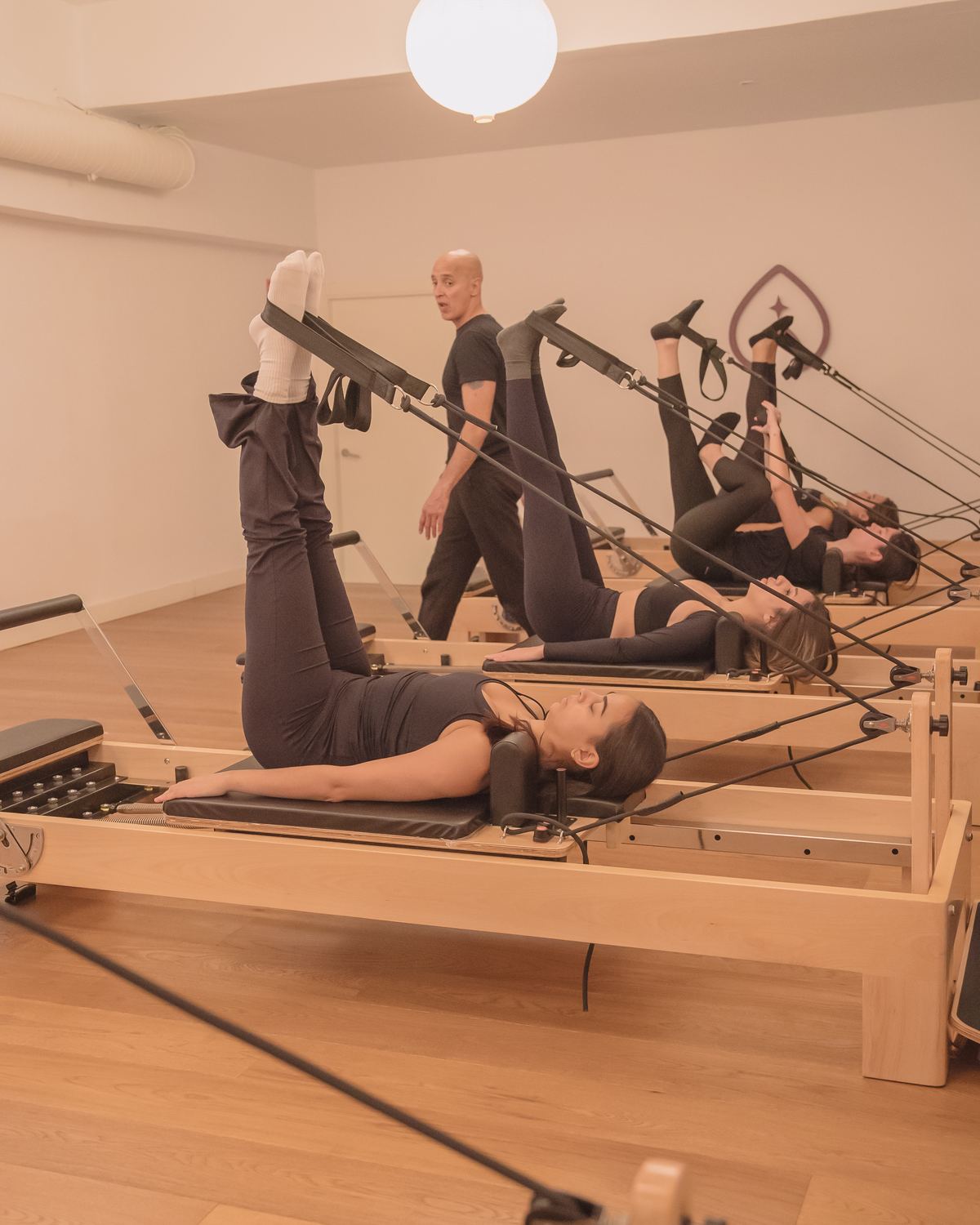
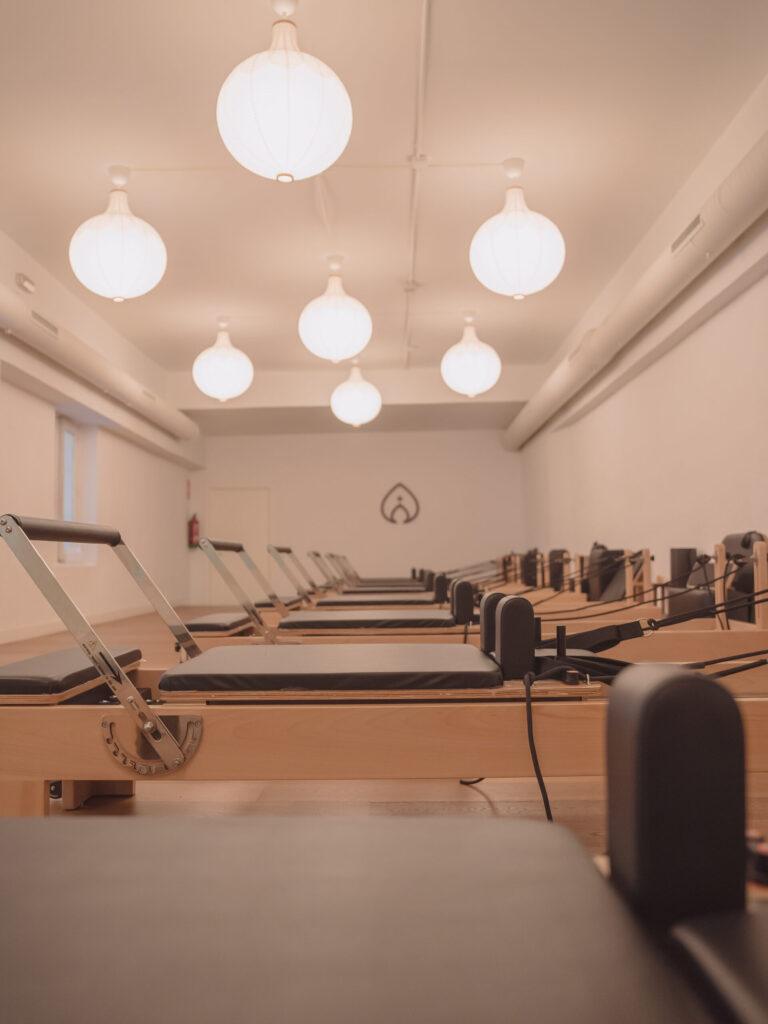
At Pinar Pilates, in the heart of the Salamanca district (Calle del Pinar 8, 28006 Madrid), we have spent years working with professionals who need an exercise that works with their pace of life, not against it. Groups of a maximum of 8 people, more than 40 classes a week and 4.9 out of 5 on Google with more than 490 reviews.
These are the 7 reasons why the Reformer has become the favourite exercise of office workers.
1. It Corrects the Posture the Desk Destroys
Office posture has a recognisable pattern: forward head, shoulders rounded forward, increased thoracic kyphosis (the “hump” in the upper back), shortened hip flexors and inactive glutes. Physiotherapists call it “upper and lower crossed syndrome”, and it is the direct result of spending hours sitting.
The Reformer works exactly the muscles that weaken with a sedentary life. Exercises such as Chest Expansion and Pulling Straps strengthen the scapular retractors and the thoracic extensors, which are the muscles responsible for keeping the shoulders back and the chest open. Series such as Footwork and Bridging reactivate the glutes and stabilise the pelvis.
The difference from other types of exercise is that the Reformer lets you work against controlled resistance (the springs) in positions that challenge the sedentary posture: lying down, kneeling, standing on the platform. It is not only about stretching what is shortened, but about strengthening what is weakened. After 4 to 6 weeks of regular practice (2 to 3 sessions a week), most students notice a visible improvement in their posture, both on the Reformer and sitting in front of the computer.
If you want to go deeper into how the Reformer improves your posture, see our complete guide to Reformer Pilates in Madrid.
2. It Relieves Back and Neck Pain
Lumbar and cervical pain is the number one complaint among office workers. The VII National Survey of Working Conditions from the INSST confirms it: musculoskeletal disorders are the leading cause of sick leave in Spain, and the lower back and neck are the most frequent locations.
The Reformer tackles this pain on three fronts:
Spinal decompression. Exercises such as Long Spine Stretch and Elephant generate gentle axial traction that slightly separates the vertebrae, reducing pressure on the intervertebral discs. For someone who has spent 8 hours compressing their spine in a chair, this lengthening is immediately perceptible.
Deep core strengthening. The transversus abdominis, the lumbar multifidus and the pelvic floor muscles are the spine’s natural stabilisers. Sedentary life switches them off. The Reformer reactivates them in every exercise, since the controlled instability of the carriage forces the body to stabilise the spine constantly.
Release of neck tension. Series such as Arm Work with the straps and scapular mobilisation exercises work directly on the upper trapezius, the scalenes and the suboccipital muscles, which are exactly the areas that tighten with prolonged computer use.
A meta-analysis by Tagliaferri et al. (2023), published in the Journal of Bodywork and Movement Therapies, analysed 19 randomised controlled trials and concluded that Pilates significantly reduces low back pain compared with no exercise and with generic exercise. If you already suffer from back pain, we recommend reading our specific article on Pilates for back pain in Madrid.
3. It Fits Perfectly into a Busy Schedule
This is a practical but decisive point. Most exercise programmes require 60 to 90 minutes between warm-up, training, stretching and shower. Add the journey to the gym and 2 hours easily disappear. For someone who works 9 or 10 hours a day, that is not sustainable.
A Reformer class at Pinar Pilates lasts 50 minutes. It includes warm-up, full-body work (strength, flexibility, stability, breathing) and cool-down. You do not need to warm up beforehand or stretch afterwards: it is all built into the session.
At Pinar Pilates we offer more than 40 classes a week spread across morning, midday and evening slots. The studio is at Calle del Pinar 8, in the heart of Salamanca, on the María de Molina and Castellana office axis, with Gregorio Marañón metro five minutes’ walk away.
Our price plans are designed for professionals:
- 4 classes a month (1 a week): 100 euros/month
- 8 classes a month (2 a week): 150 euros/month
- 12 classes a month (3 a week): 200 euros/month
- Unlimited: 250 euros/month
- Single class: 30 euros
See the full class schedule to find your slot.
4. Low Impact, High Results
After a whole day at work, the last thing you need is an exercise that leaves you so wrecked you cannot perform the next day. CrossFit can be brutal. Running on tarmac loads the joints. The conventional gym produces muscle soreness that interferes with your working day.
Reformer Pilates is low impact: no jumps, no heavy loads on the spine, no sudden movements. The resistance comes from the springs, which are calibrated to your level. But “low impact” does not mean “easy”. A well-led class works the whole body: legs, core, arms, back, glutes. The difference is that it does so in a controlled, progressive way, without hammering the joints.
The result: you tone up, gain functional strength, improve flexibility and wake up fine the next day. You can do Pilates on a Tuesday and perform perfectly at the office on Wednesday. You will not be limping into a meeting.
To understand the differences from conventional training, you may be interested in our article on Reformer Pilates vs mat Pilates.
5. It Works as a Natural Stress Reliever
Work stress does not only wear you out mentally. It shows in the body: muscle tension, poor digestion, insomnia, headaches. The Reformer acts on stress through three concrete mechanisms.
Diaphragmatic breathing. Every exercise is performed with a specific breathing pattern. Lateral costal breathing activates the vagus nerve and stimulates the parasympathetic nervous system, responsible for calm and recovery. In 50 minutes of class, you perform between 200 and 300 controlled breathing cycles, which reduces heart rate and lowers cortisol levels.
Enforced concentration. The Reformer demands that you coordinate breathing, movement and postural control at the same time. You cannot think about the pending email while controlling the resistance of the springs. This enforced concentration works like an active meditation that interrupts the cycle of mental rumination.
Digital disconnection. At Pinar Pilates, your phone stays outside the room. For 50 minutes, no screens, no notifications, no digital stimuli. For someone who spends the whole day connected, this pause is deeply restorative.
A meta-analysis by Fleming and Herring (2018), published in Complementary Therapies in Medicine, brought together eight controlled trials and found that Pilates practice significantly reduces anxiety symptoms, depressive symptoms and feelings of fatigue, as well as increasing feelings of energy. If stress is your main concern, we recommend reading our full article on Reformer Pilates to relieve work stress.
6. You Do Not Need Previous Experience
This is probably the biggest barrier for office workers who have not exercised in years: “I’m not fit”, “I’ve never done Pilates”, “I’m embarrassed that I don’t know what to do”. We understand. But the Reformer is, precisely, one of the most accessible forms of exercise there is.
The machine adapts to you, not the other way round. The springs are adjusted to give more or less resistance according to your level. The instructor adapts each exercise to your current capacity. If you cannot do a full exercise, there are progressions and modifications so you work at the right level without getting frustrated or injured.
At Pinar Pilates, groups of a maximum of 8 people allow the instructor to give individual attention to each student. You will not get lost in a crowded class. And for those starting from scratch, we offer the first class at 50% off, where you learn how the Reformer works, the basic principles of the technique and the breathing patterns. From there, you join the regular classes with confidence.
It does not matter whether your last physical activity was 6 months ago or 6 years ago. The Reformer meets you where you are. If you want to know what to expect on your first visit, see our article on your first Reformer Pilates class.
7. The Results Show in Your Working Day
This is the definitive reason. Reformer Pilates does not only give you a stronger or more flexible body. It gives you better performance at work. The benefits transfer directly to your working day.
More energy. Moderate exercise improves cardiovascular efficiency and tissue oxygenation. After 3 to 4 weeks of regular practice, mid-afternoon fatigue is noticeably reduced. You reach the end of the day with more fuel in the tank.
Better concentration. Activation of the parasympathetic nervous system and reduced cortisol improve sustained attention. A meta-analysis of 80 randomised controlled trials (Ludyga et al., 2020, Nature Human Behaviour) concluded that sustained exercise improves cognitive function, with a small but consistent effect not limited to any one domain.
Less pain. If your back, neck or shoulders no longer hurt, your ability to work without distraction improves automatically. Low-level chronic pain is one of the biggest productivity thieves, and the Reformer tackles it directly.
Better sleep. Regular exercise regulates the circadian rhythm and improves deep sleep quality. Sleeping well is the foundation of everything: energy, concentration, mood, performance.
Better stress management. With regular practice, you learn to use controlled breathing as a tool outside the studio. In the middle of a tense meeting or before a presentation, the breathing patterns you have trained on the Reformer help you lower your arousal and stay calm.
Ideal Times for Professionals at Pinar Pilates
Timing is one of the decisive factors. That is why at Pinar Pilates we offer more than 40 classes a week in slots designed for professionals.
Before Work (7:30 – 9:30)
The favourite slot of early risers. You arrive at the office with your body activated, your posture corrected and your mind clear. Several studies indicate that morning exercise improves concentration and decision-making for the following 4 to 6 hours. If your day starts at 9:00 or 9:30, a class at 7:30 lets you shower at the studio and arrive on time.
At Lunchtime (14:00 – 16:00, depending on the day)
Ideal for those who work in Salamanca, Recoletos or La Castellana and can get away for an hour at midday. Instead of eating a sandwich in front of the computer, 50 minutes on the Reformer give you a clean break between the morning and the afternoon. You go back to work with renewed energy and the morning’s tension released.
After the Office (17:00 – 20:50)
The most in-demand slot. The after-work class works as a transition ritual: you walk in with the day’s accumulated stress and walk out ready to enjoy your evening. Exercise at this time also improves sleep quality, as long as you leave at least 2 hours between the class and bedtime.
See the full schedule and book your place.
Frequently Asked Questions
Can I come to class in office clothes?
It is not ideal. We recommend bringing comfortable, fitted clothing (leggings, a close-fitting top) so the instructor can see your alignment. If you come straight from work, you can get changed at the studio. We use grip socks (not trainers), so you do not need to carry extra footwear.
Are 2 classes a week enough?
For most office workers, 2 sessions a week is the ideal starting point. At this frequency you will already notice improved posture, reduced pain and more energy within 3 to 4 weeks. If you want faster or deeper results, 3 sessions a week speed up the changes. Our 8 classes a month plan (150 euros) covers 2 weekly sessions, and the 12-class plan (200 euros) covers 3.
Will I get muscle soreness that stops me working the next day?
In the first 2 or 3 classes you may notice some mild muscle discomfort, especially in the core and glutes, since these are muscles that have probably been inactive for a while. But it is not comparable to the soreness from conventional strength training. The Reformer works with controlled movements and lengthening, which generates much less muscle inflammation. From the fourth class onwards, soreness practically disappears.
What is the difference between the Reformer and the conventional gym?
The gym focuses on isolated muscle strengthening with external loads (weights, machines). The Reformer works the body as an integrated unit: strength, flexibility, stability, breathing and postural control in every exercise. For an office worker, the Reformer has the advantage of correcting the postural imbalances the gym does not address (and sometimes makes worse). The breathing and concentration component also turns every session into a stress reliever, something lifting weights does not offer.
Can I start if I have a back injury?
It depends on the injury. The Reformer is low impact and many orthopaedic specialists and physiotherapists recommend it as rehabilitation exercise. However, if you have an active injury (acute herniated disc, symptomatic protrusion, recent surgery), consult your doctor first. At Pinar Pilates we adapt classes to each student, but we need to know your situation to do so safely.
Ready to try? Book your first class at 50% off and discover how 50 minutes on the Reformer can change the way you feel at the office.
Pinar Pilates. Calle del Pinar 8, 28006 Madrid. Salamanca district. Phone: +34 611 994 729.
Pinar Pilates · Salamanca district, Madrid
Your first reformer class, €15
Groups of 8 people maximum, specialist instructors and more than 40 classes a week. Your first class is half price.
Book my first classCalle del Pinar 8, Madrid · Questions? Message us on WhatsApp