Important medical notice: a herniated disc is a condition that requires medical diagnosis and follow-up. This article is for information only and does not replace an assessment by your orthopaedic surgeon, neurosurgeon or rehabilitation doctor. Before starting Pilates or any exercise programme with a diagnosed herniated disc, you need explicit medical clearance. Every herniation is different in location, size and symptoms, and what works for one patient may not be right for another. The exercises described here are a guide and must be adapted to your specific case under the supervision of a qualified instructor who knows your diagnosis.
“Can I do Pilates with a herniated disc?” It is one of the questions we hear most often at Pinar Pilates. The short answer is: yes, in most cases, with the right adaptations and your doctor’s approval. The long answer is this article.
Scientific evidence: Pilates and herniated discs
- A 6-week clinical Pilates programme proved to be an effective and safe method for reducing pain and functional disability in patients with lumbar disc herniation, while also improving flexibility and muscular endurance.
Source: Taşpınar G et al. (2023). Journal of Comparative Effectiveness Research, 12(1):e220144. PMID 36453667. - An integrative review concluded that the Pilates method, as part of a physiotherapy programme, improves quality of life in patients with lumbar disc herniation.
Source: Marinho PDM et al. (2022). Research, Society and Development, 11(11):e184111133372. DOI 10.33448/rsd-v11i11.33372. - A meta-analysis of 8 randomised clinical trials (611 patients) concluded that exercise therapy improves pain, disability and quality of life in lumbar disc herniation compared with controls, by strengthening the core and lumbar stability.
Source: Du S et al. (2025). Frontiers in Medicine, 12:1531637. PMID 40224631.
What a Herniated Disc Is and Why It Affects So Many People
Anatomy of the Intervertebral Disc
Intervertebral discs are the structures that sit between each pair of vertebrae in the spine. They are made up of a fibrous outer ring (annulus fibrosus) and a gel-like inner core (nucleus pulposus). Their job is to absorb shock, distribute loads and allow movement between the vertebrae.
A herniated disc occurs when the fibrous ring tears and part of the nucleus pushes outwards, where it can compress nearby nerve roots or the spinal cord. This can cause local pain, radiating pain (sciatica if lumbar, brachialgia if cervical), tingling, numbness or muscle weakness.
Prevalence and Risk Factors
The prevalence of symptomatic disc herniation in the general population is between 1% and 3%, while in 5% to 15% of patients with low back pain a herniated disc is the cause. A telling fact: between 20% and 28% of asymptomatic people (with no pain) show disc herniations on MRI, according to Fundación CASER.
The main risk factors include: a sedentary lifestyle, repetitive loading of the spine (jobs that involve lifting weights, long hours driving or holding awkward postures), excess weight, smoking (which reduces blood supply to the disc) and genetic predisposition. The most affected age group is between 30 and 50.
Main Symptoms
Symptoms vary depending on where the herniation is. In lumbar herniations (the most common, especially L4-L5 and L5-S1): pain in the lower back, pain radiating down the leg (sciatica), tingling in the foot or leg, weakness when walking. In cervical herniations: neck pain, radiation into the arm, tingling in the fingers, weakness in the hand.
Not all herniations cause symptoms. Many are partially or fully reabsorbed over time. Conservative (non-surgical) treatment is the first-line approach in most cases.
Can You Do Reformer Pilates with a Herniated Disc?
Key answer: Yes, in most cases you can do Reformer Pilates with a herniated disc, on three conditions: explicit medical clearance, an instructor who knows your diagnosis, and gradual progression. A controlled trial (Büyükturan et al., 2023) showed that clinical Pilates is safe and effective for patients with lumbar disc herniation, with no adverse effects reported.
Yes, with clear conditions:
First condition: medical clearance. Your orthopaedic or rehabilitation doctor must know your diagnosis (location, size, whether there is nerve involvement) and approve controlled exercise. If you have progressive neurological deficit (worsening loss of strength, bladder or bowel changes), exercise is not the priority.
Second condition: an informed instructor. The instructor must know your specific diagnosis to adapt each exercise. A posterolateral L5-S1 herniation is not the same as a central C5-C6 herniation.
Third condition: gradual progression. You start with basic exercises in unloaded positions and progress slowly according to how your body responds.
Büyükturan et al. (2023), in a randomised controlled trial published in the Journal of Comparative Effectiveness Research, divided 54 patients with lumbar disc herniation into a clinical Pilates group (3 sessions a week for 6 weeks) and a control group. The Pilates group achieved notably greater reductions in pain and functional disability, along with improvements in flexibility, static and dynamic muscular endurance and, in part, quality of life. No adverse effects were reported.
Benefits of Reformer Pilates for People with a Herniated Disc
Key answer: The main benefits of Reformer Pilates for a herniated disc are: strengthening without impact (unloaded work), spinal decompression through traction exercises, stabilisation of the affected segment (activation of the transversus abdominis and multifidus), and re-education of compensatory movement patterns.
Strengthening Without Impact
The Reformer lets you strengthen the muscles that stabilise the spine without compressive loads. Working lying down (on your back or front), the spine is unloaded. The springs provide resistance without gravity acting directly on the discs. This is key for people with a herniated disc, where axial compression is the main mechanism that makes things worse.
Spinal Decompression
Axial traction exercises on the Reformer (where the carriage glides and gently separates the vertebrae) reduce pressure inside the disc. Many students report immediate relief during these exercises, especially those with radiating pain. Although the decompression is temporary during the session, the cumulative effect session after session contributes to recovery.
Stabilising the Affected Segment
A herniated disc usually occurs at a spinal segment that has lost stability. The transversus abdominis and the multifidus are the main stabilisers of the lumbar segments. Reformer Pilates activates them constantly and progressively, creating a muscular corset that protects the herniated disc from movements that could aggravate the injury.
Better Motor Control
Many people with a herniated disc develop compensatory movement patterns: they avoid certain movements, over-tighten some muscles and switch off others. Reformer Pilates, with its focus on precision and control, re-educates these patterns. It teaches the body to move in a way that protects the disc without limiting function.
Recommended Exercises and Exercises to Avoid
Key answer: With a herniated disc, the recommended Reformer exercises are: Footwork (lying down, spine unloaded), gentle Pelvic Curl, Supine Leg Series with light springs and gentle Prone Extension. You should avoid: loaded spinal flexion (roll up/roll down), rotations against resistance, and any exercise that reproduces pain radiating into the legs or arms.
Recommended Exercises
Footwork. Lying on your back, feet on the bar. Push out and return with control. The spine is fully supported and unloaded. Strengthens legs and glutes without loading the lower back. Safe for virtually any type of lumbar herniation.
Gentle Pelvic Curl. Lying on your back, peel the pelvis off the carriage vertebra by vertebra to a moderate height (without forcing maximum lumbar extension). Activates glutes and multifidus. Adapted by limiting the range of movement if there is pain.
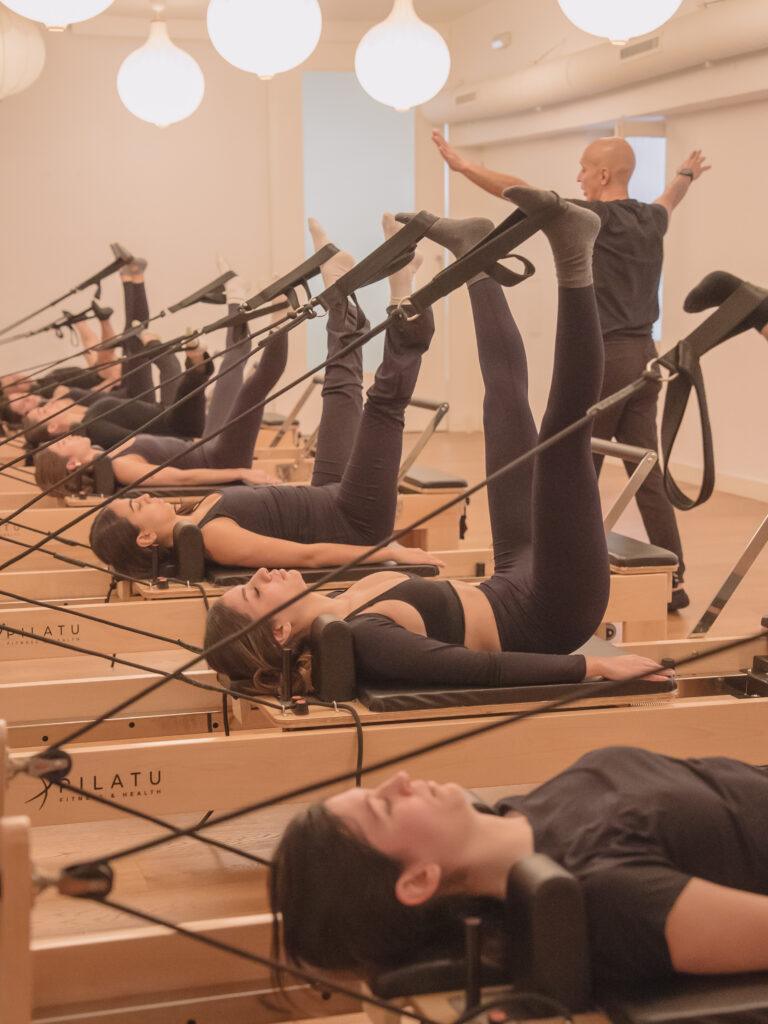
Supine Leg Series with light resistance. Lying on your back, feet in the straps. Leg extensions and flexions keeping the spine in neutral. Light springs assist the movement. The challenge is keeping the pelvis stable, which activates the transversus without compressing the disc.
Gentle Prone Extension. Lying face down, gently lift the chest. Strengthens the spinal extensors and the multifidus. Many posterior disc herniations (the most common) respond well to gentle extension because it moves the disc material away from the nerve root (the McKenzie principle).
Modified Mermaid. Side stretch of the trunk with a controlled range of movement. Improves mobility without flexing or rotating the spine under load.
Exercises to Avoid (or to Modify Substantially)
Loaded spinal flexion. “Roll up” or “roll down” type exercises against resistance increase pressure inside the disc and can push the herniated material backwards. They are replaced with abdominal activation exercises in a neutral position.
Rotations against resistance. Trunk twists against the spring resistance generate shear forces on the disc. They are avoided in the early stages and introduced very gradually (and only if they cause no symptoms) in advanced stages.
Exercises combining deep hip flexion and load. Positions that combine maximum hip flexion with axial load (such as some variations of Short Spine) are modified or avoided, because they increase pressure on the lumbar discs.
Exercises that reproduce radiating pain. Any exercise that causes tingling, numbness or pain radiating into the leg or arm must be stopped immediately and replaced with an alternative.
How We Adapt Classes at Pinar Pilates
At Pinar Pilates, at Calle del Pinar 8, 28006 Madrid, we regularly work with students who have a diagnosed herniated disc. Our approach includes:
Communication with your medical team. If you bring us a report from your orthopaedic surgeon or physiotherapist, we can fine-tune the programme more precisely. Knowing the exact location of the herniation, the degree of nerve involvement and your doctor’s recommendations lets us select the most suitable exercises.
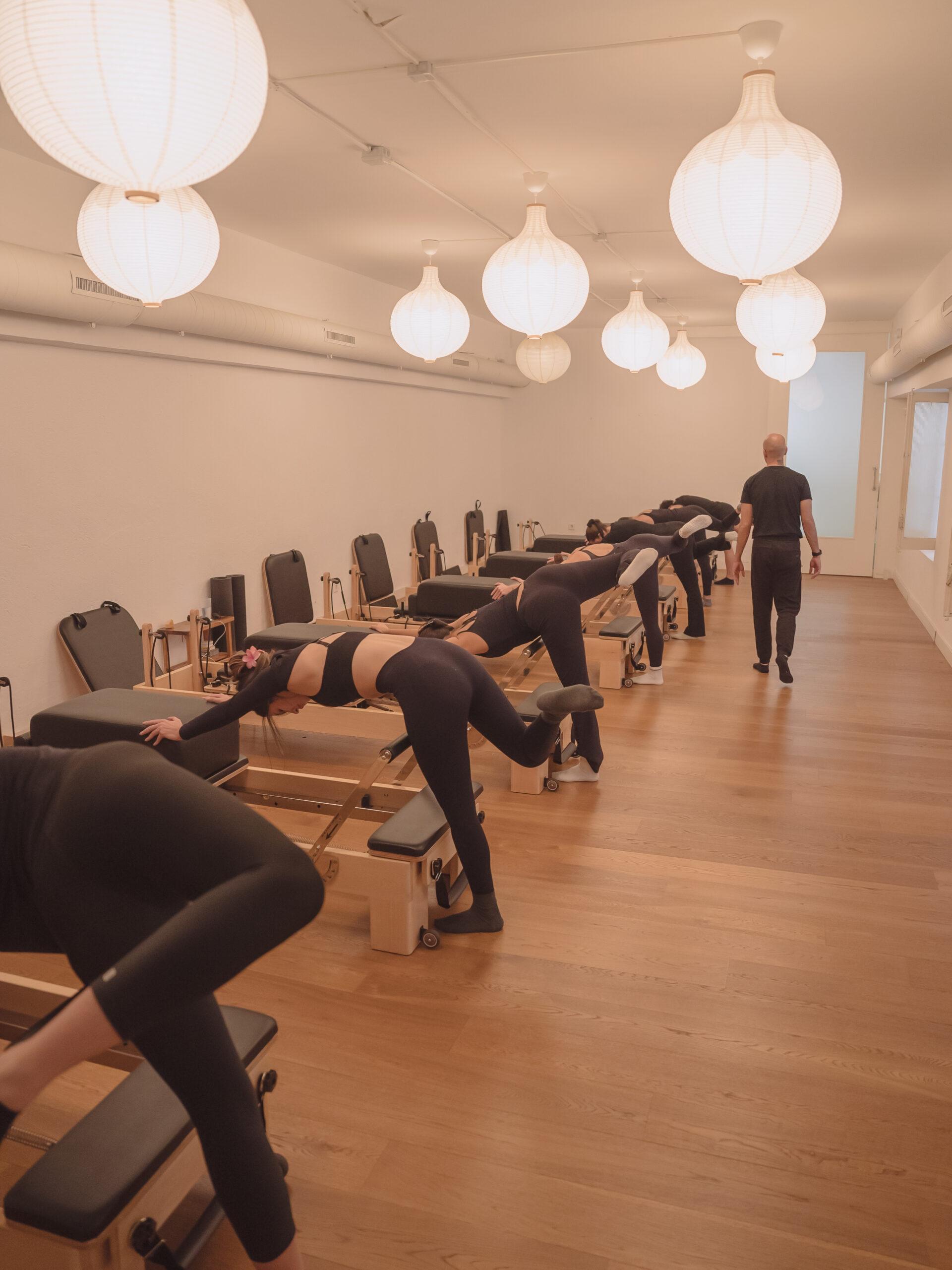
Groups of 8 people maximum. With no more than 8 students per class, the instructor can watch how you perform each movement, correct your posture and make sure you are not doing anything that could aggravate your herniation. This supervision is especially important in your case.
Progressive resistance. We start with light springs and fully unloaded positions. As your muscles get stronger and your symptoms improve, we gradually increase complexity and resistance. Your body sets the pace, not a rigid protocol.
Trained instructors. Our team is trained in spinal conditions and knows the difference between safe exercises and those contraindicated for each type of herniation. They know when to modify, when to substitute and when to stop.
Pinar Pilates is rated 4.9 out of 5 on Google with more than 490 reviews. We offer more than 40 classes a week, with prices from €100 a month (4 classes) up to the unlimited plan at €250 a month.
Frequently Asked Questions
Do I need medical clearance to do Pilates with a herniated disc?
Yes. It is a requirement we take seriously. Your doctor must confirm there is no contraindication to controlled exercise. If you have progressive neurological deficit or an indication for surgery, medical treatment comes first. Once your doctor approves the practice, we can adapt the classes to your situation.
Is Reformer Pilates safe with a herniated disc?
The study by Büyükturan et al. (2023) showed that clinical Pilates is safe and effective for patients with lumbar disc herniation, with no adverse events reported. The key lies in exercise selection (avoiding loaded flexion and rotation), qualified supervision and gradual progression. Because the Reformer allows you to work unloaded and with controlled resistance, it is one of the safest forms of exercise for this condition.
What can I expect in my first classes?
The first sessions focus on basic exercises in a supine position (lying on your back): Footwork, gentle Pelvic Curl and leg work with the straps. Resistance will be light and the pace slow. The aim is for your body to adapt to controlled movement without triggering symptoms. After 2 to 3 weeks, if the response is positive, the range of exercises is expanded.
Can I do Pilates after herniated disc surgery?
Yes, but your surgeon decides when to start. After a discectomy or microdiscectomy, the period of movement restriction is usually 4 to 8 weeks. Once your doctor clears you to return to exercise, Reformer Pilates is one of the best options for post-surgical rehabilitation, because it lets you strengthen progressively and without load.
Do you have a herniated disc and want to start moving safely? Check with your doctor and, with their approval, book your first class at 50% off at Pinar Pilates. We will explain how the Reformer works and adapt every exercise to your situation.
Call us on +34 611 994 729 if you would like to ask anything before booking. We will be happy to help.
You may also be interested in: Pilates for Low Back Pain in Madrid, Pilates for Back Pain and Reformer Pilates for Pain: The Complete Guide
Pinar Pilates · Salamanca district, Madrid
Your first reformer class, €15
Groups of 8 people maximum, specialist instructors and more than 40 classes a week. Your first class is half price.
Book my first classCalle del Pinar 8, Madrid · Questions? Message us on WhatsApp