Important note: this article is for information purposes and does not replace medical diagnosis or treatment. If you suffer from acute low back pain radiating to the legs, accompanied by loss of strength, altered sensation or problems with bladder or bowel control, go to A&E or consult your doctor before starting any exercise programme. The exercises described here are indicative and must be adapted to each case under qualified supervision.
Chronic low back pain affects 18.3% of the Spanish population, according to the European Health Survey in Spain (2020). It is the leading cause of chronic pain in the country and one of the main reasons for sick leave. If you live in Madrid and your lower back complains every time you get up from a chair, tie your shoes or finish a long working day, you are not alone. But nor are you condemned to live with the pain.
Reformer Pilates has been shown in multiple scientific studies to be one of the most effective ways of reducing chronic low back pain. It is not about “stretching your back” or doing sit-ups. It is about strengthening the deep muscles that stabilise your spine, improving the mobility of joints that have lost range and teaching your body to move in a way that protects, rather than damages, your lower back.
Scientific evidence: Pilates and low back pain
- Pilates reduces lumbar disability by −4.73 points on the RMDQ index (95% CI: −5.45 to −4.01), above the 3 points considered a clinically relevant improvement, and the effect was maintained six months after the programme ended.
Source: Gao C et al. (2023). BMC Musculoskeletal Disorders. PMC10164513. - On the ODI disability scale, Pilates produced a significant improvement of −4.35 points (95% CI: −5.77 to −2.94; p < 0.00001) across 19 clinical trials.
Source: Lin HT et al. (2023). Int J Environ Res Public Health, 20(4):2850. - Pilates was the most effective exercise according to SUCRA analysis: a 93% probability of being the best for reducing pain and 98% for reducing disability, among all exercise modalities.
Source: Fernández-Rodríguez R et al. (2022). JOSPT, 52(8):505-521. - In subacute low back pain, 8 weeks of supervised Pilates reduced pain and disability more than a home exercise programme, and the advantage was maintained at 3 months.
Source: Asik HK and Sahbaz T (2025). Irish Journal of Medical Science, 194(3):949-956. PMID 40183915.
Why Low Back Pain Is an Epidemic among Office Workers
The Problem with Sitting
When you sit, the pressure on the lumbar discs increases by between 40% and 90% compared with standing, depending on your posture. If the chair does not have good lumbar support and you tend to round your back (something almost all of us do after a few minutes), intradiscal pressure shoots up. Repeat this 8 hours a day, 5 days a week, for years, and the result is a worn disc, weakened muscles and pain that becomes chronic.
75% of office workers report some degree of back pain, according to a study published in Applied Ergonomics (Bontrup et al., 2019). The lower back and the neck are the most frequent locations.
A Core That Does Not Work
The “core” is not the visible abdominals. It is a cylinder of deep muscles formed by the transversus abdominis (at the front), the multifidus (at the back), the pelvic floor (below) and the diaphragm (above). This cylinder acts as a natural corset that stabilises the lumbar spine during everyday movements.
In people with chronic low back pain, these muscles are inhibited. They do not activate in time, they do not activate strongly enough, or they simply do not activate. Studies by Hodges and Richardson (1996), published in Spine, showed that the transversus abdominis activates late in people with low back pain, leaving the spine unprotected at the most vulnerable moments.
Compressed Discs and Stiff Joints
Lack of movement does not only weaken the muscles. The intervertebral discs, which have no blood supply of their own, depend on movement for nourishment (a process called imbibition). Without movement, they dehydrate and lose their cushioning capacity. The facet joints become stiff, and the spine loses the segmental mobility it needs to distribute loads evenly.
How Reformer Pilates Protects Your Lower Back
Key answer: Reformer Pilates protects the lower back by strengthening the transversus abdominis (the main lumbar stabiliser), improving hip and spinal mobility, and re-educating movement patterns. By working lying down against spring resistance, it removes axial compression from the intervertebral discs.
Strengthening the Transversus Abdominis
The transversus abdominis is the most important muscle for lumbar stability, and Reformer Pilates activates it constantly. Every exercise begins with a conscious activation of the centre (“scooping” or “hollowing”), and the variable resistance of the springs forces you to maintain that activation throughout the movement.
Mendonça et al. (2023), in a systematic review published in Healthcare, analysed eight randomised controlled trials and confirmed that Pilates improves activation of the transversus abdominis and the lumbar multifidus in patients with chronic low back pain. Patients who practised Pilates on the Reformer maintained that improvement in the long term.
Pelvic and Lumbar Mobility
The pelvis is the base of the lumbar spine. If it is locked (common in sedentary people), the lumbar spine compensates with excessive movement in some segments and stiffness in others. The Reformer includes specific pelvic mobility exercises (anterior tilt, posterior tilt, lateral tilts) that restore fluidity to this area.
Spinal Decompression
The Reformer allows axial traction exercises in which the carriage slides, gently separating the vertebrae. This decompression reduces pressure on the intervertebral discs and relieves compression of the nerve roots, providing relief that many patients notice during the session itself.
Neutral Posture as a Fundamental Principle
Every Pilates exercise is performed seeking the “neutral position” of the spine: respecting the natural curves without exaggerating or flattening them. Training in neutral teaches your body to maintain that optimal alignment during daily activities, protecting the lower back automatically.
The Cochrane review by Yamato et al. (2015) analysed 10 trials with 510 participants and concluded that Pilates is superior to minimal intervention for reducing low back pain and disability, with an excellent safety profile.
Patti et al. (2024), in Disability and Rehabilitation, published a meta-analysis of 36 articles (19 included in the quantitative analysis) which confirmed that Pilates significantly reduces low back pain compared with no exercise and with non-specific exercise.
5 Reformer Exercises for Low Back Pain
These exercises are part of the usual repertoire of our classes at Pinar Pilates for students with low back pain. They are always adapted in resistance and complexity.
1. Footwork
Position: lying on your back on the carriage, feet on the bar, head and shoulders supported.
Execution: push the bar with your feet, extending your legs and sliding the carriage. Return, controlling the movement. It is practised in different foot positions (heels, toes, Pilates V position).
Why it helps: it strengthens the legs and glutes with the spine fully supported and unloaded. It activates the core reflexively without generating direct pressure on the lumbar discs. It is the safest warm-up exercise for people with low back pain.
2. Pelvic Curl
Position: lying on your back, feet on the bar, knees bent.
Execution: peel the pelvis off vertebra by vertebra until you form a straight line from the shoulders to the knees. Hold at the top for 2 seconds. Lower, articulating the spine from the thoracic vertebrae down to the sacrum.
Why it helps: it strengthens the glutes (frequently inhibited in low back pain), activates the multifidus directly and improves segmental spinal mobility. The vertebra-by-vertebra articulation is therapeutic for stiff segments.
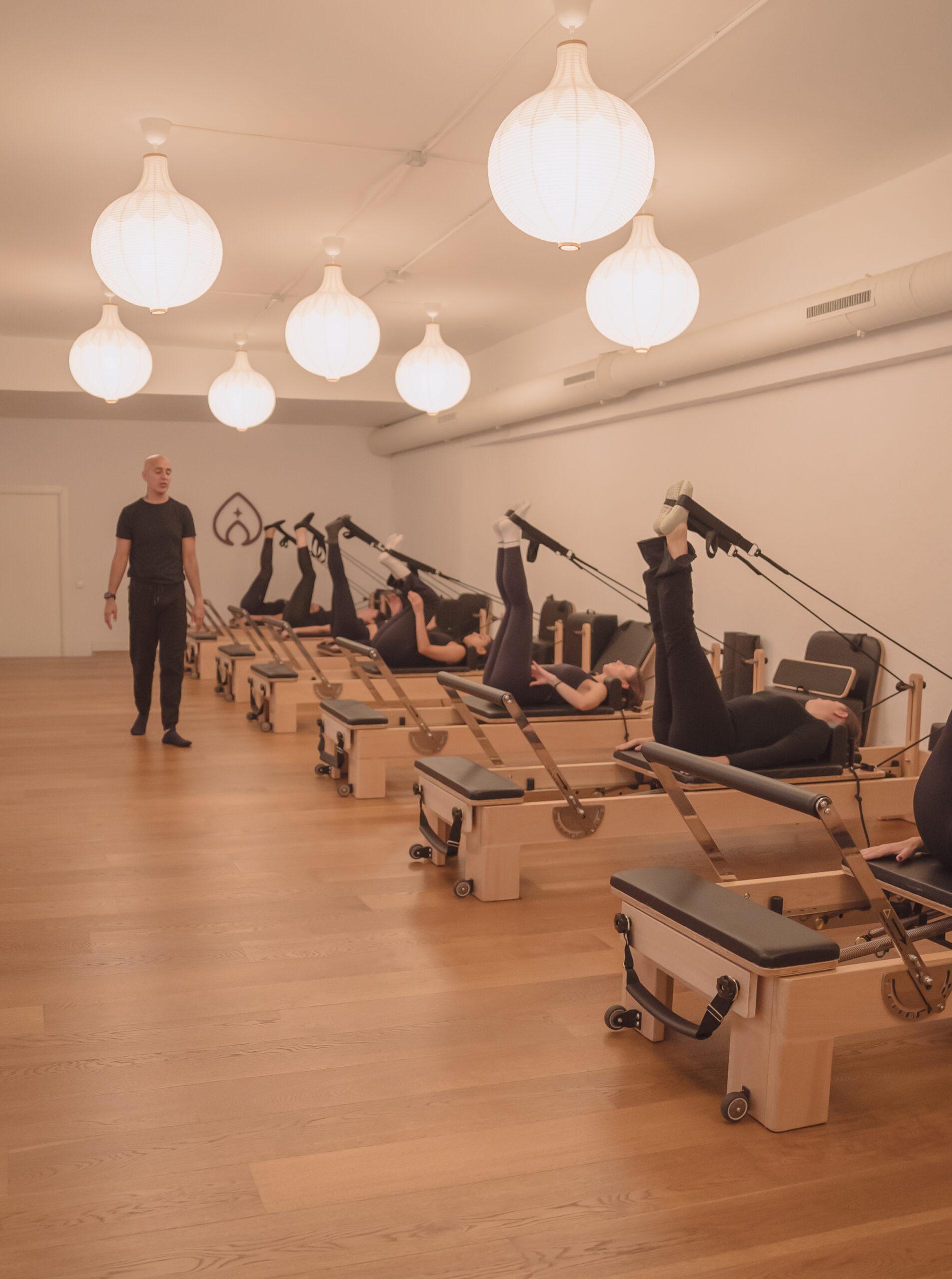
3. Supine Leg Series
Position: lying on your back, feet in the straps (with foot loops), legs in “tabletop” (knees at 90 degrees).
Execution: extend and bend the legs against the resistance of the springs, keeping the lumbar spine in a neutral position. Progress from bilateral extensions to alternating movements and leg circles.
Why it helps: the challenge is to keep the pelvis stable while the legs move. This activates the transversus abdominis and the multifidus intensely without loading the lumbar spine. The springs provide assistance that makes the exercise accessible even for people with active pain.
4. Knee Stretch Round (Round-Back Knee Stretch)
Position: kneeling on the carriage, hands on the bar, back in flexion (“C” shape).
Execution: push the carriage back with the knees while keeping the C shape in the spine. Return by pulling the carriage towards the bar using the abdominals.
Why it helps: this exercise is a powerful activator of the transversus and rectus abdominis. The controlled lumbar flexion position stretches the multifidus and mobilises the lumbar area, while the spring resistance demands intense, sustained abdominal work.
5. Mermaid
Position: sitting sideways on the carriage, one hand on the bar, legs in mermaid position.
Execution: push the bar sideways, stretching the whole side of the trunk. The opposite arm rises, following the line of the stretch. Return with control.
Why it helps: it stretches the lateral trunk muscles (quadratus lumborum, obliques, intercostals), which are frequently shortened and asymmetrical in people with low back pain. It improves lateral spinal mobility and rib expansion. It is one of the exercises that provides the most immediate relief.
Common Mistakes That Make Low Back Pain Worse
Key answer: The most common mistakes that make low back pain worse are: prolonged complete rest (current evidence advises against it), wearing a lumbar support belt permanently (it weakens the stabilising muscles), doing high-impact exercise without preparation, and holding the same posture for hours without active breaks.
Doing Nothing and Waiting for It to Pass
For decades, complete rest was the medical recommendation for low back pain. Current evidence says the opposite. Prolonged rest weakens the muscles, increases stiffness and perpetuates the pain cycle. International clinical guidelines recommend maintaining controlled physical activity as the first line of treatment for chronic low back pain.
Doing Impact Exercise Too Soon
Running, jumping or lifting heavy weights with an unstable, painful lower back is not the solution. These exercises generate high compressive loads on the discs and facet joints. The Reformer offers a low-load alternative that strengthens before it demands, something the conventional gym rarely considers.
Not Strengthening the Core
Many people with low back pain focus on stretching or massage. These tools provide temporary relief, but they do not address the cause: a weak core that does not stabilise the spine. Without strengthening, the pain comes back. Reformer Pilates combines mobility, stretching and strengthening in every session, addressing all three dimensions of the problem.
Your Plan at Pinar Pilates to Relieve Low Back Pain
At Pinar Pilates, located at Calle del Pinar 8, 28006 Madrid, we address low back pain with a structured approach:
More than 490 people have rated their experience at Pinar Pilates on Google, with an average of 4.9 out of 5.
Initial assessment. Before your first class, we want to know your history, your diagnosis (if you have one), your limitations and your goals. If you have medical or physiotherapy reports, bring them.
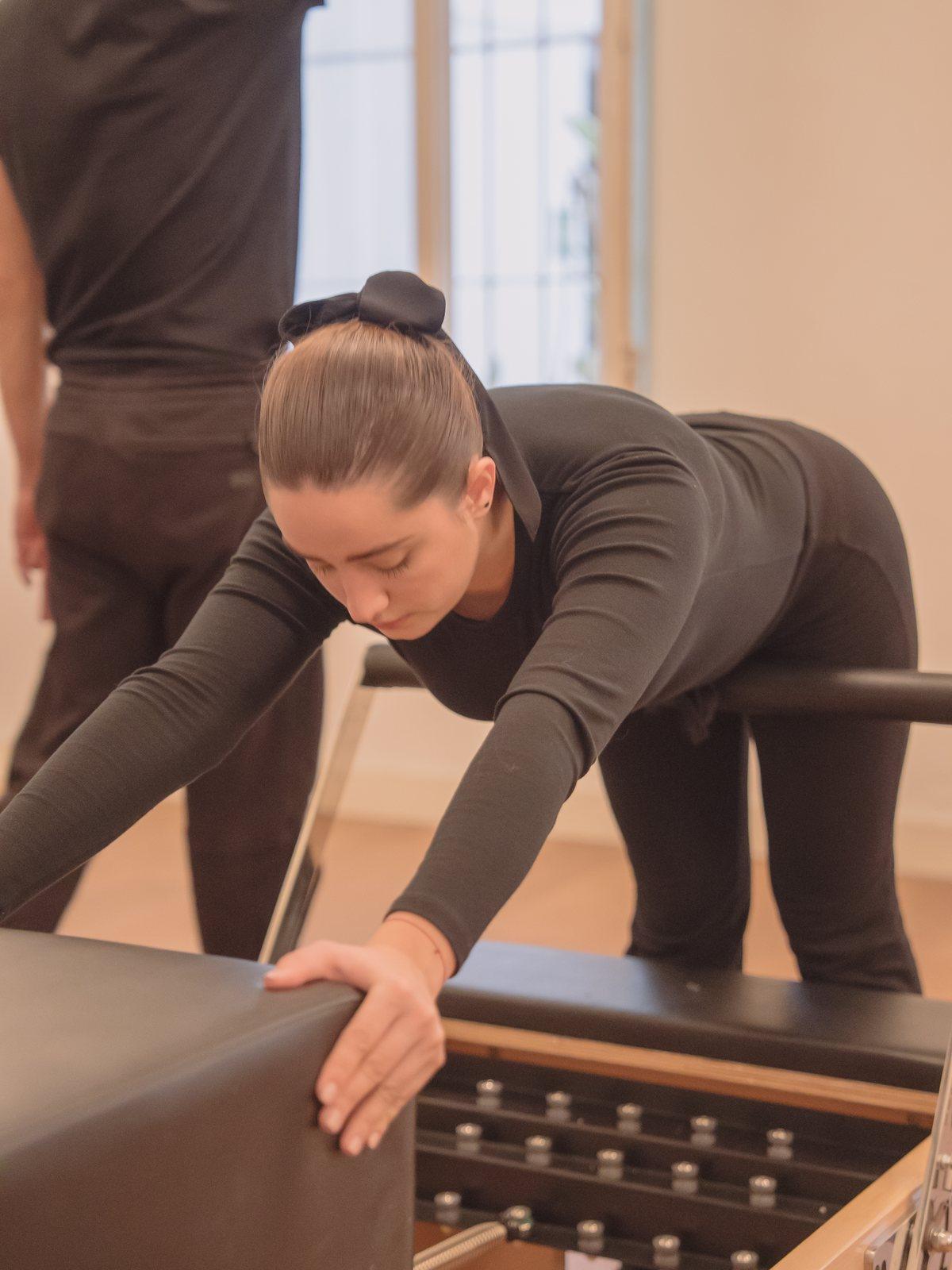
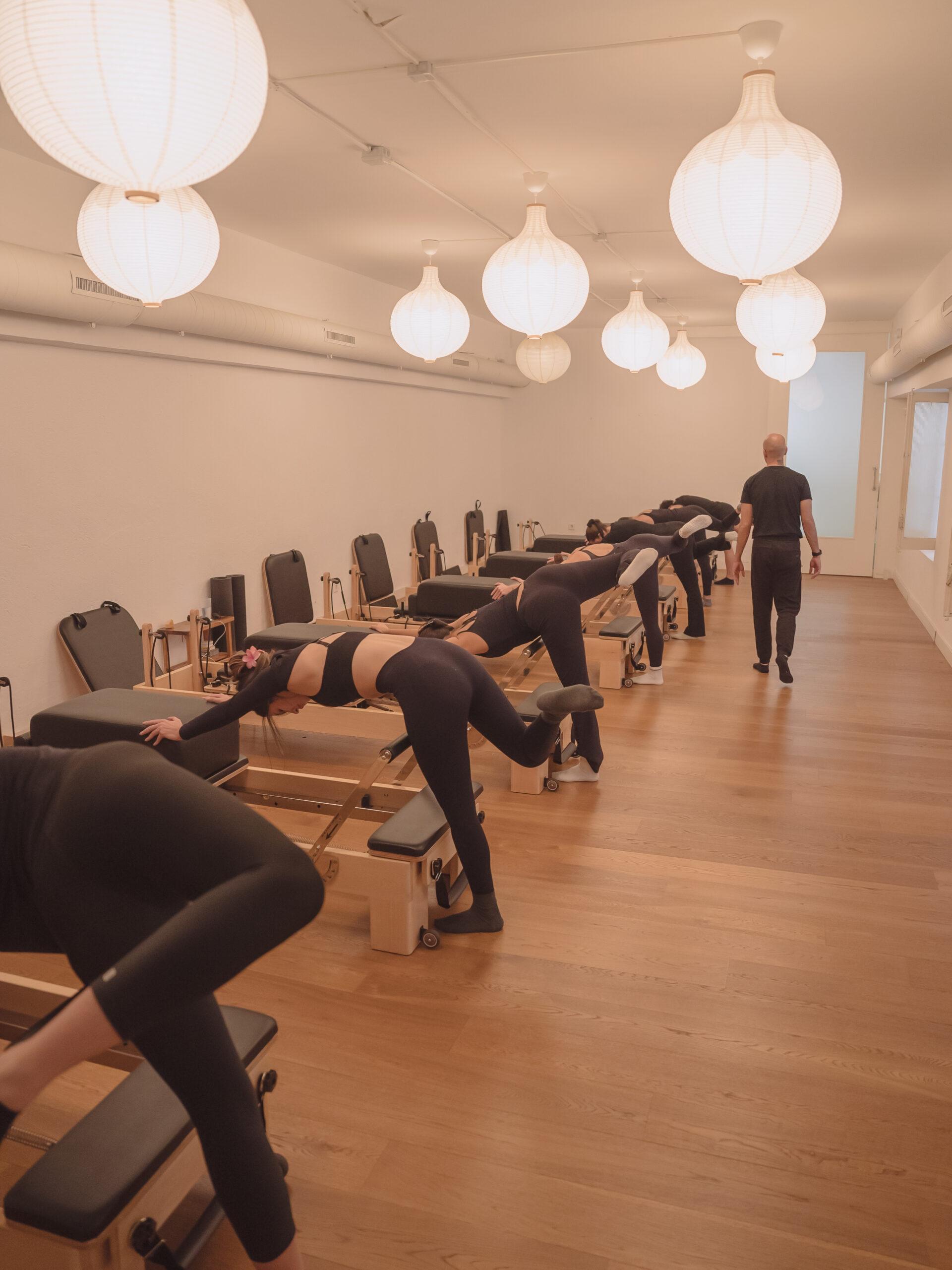
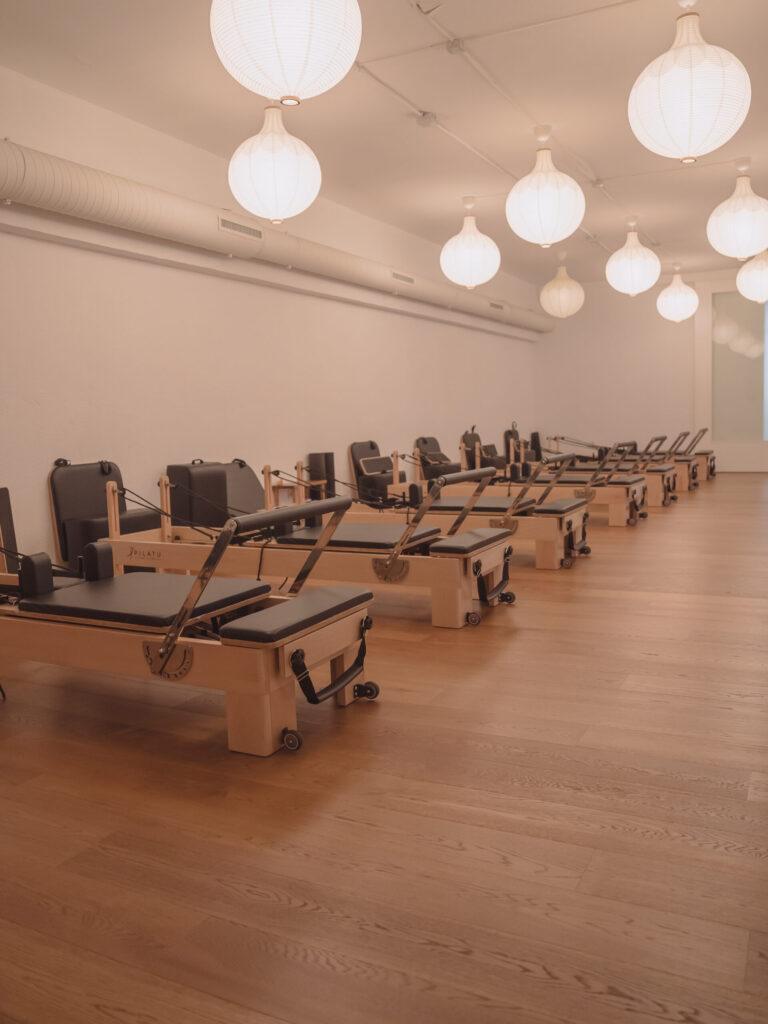
Personalised adaptation. Our instructors adjust the resistance of the springs, modify the exercises and offer alternatives according to your level of pain and your capacity. With groups of a maximum of 8 people per class, supervision is real.
Recommended frequency. For active low back pain, we recommend starting with 2 sessions a week. Most studies showing the effectiveness of Pilates for low back pain used this frequency as a minimum. Miyamoto et al. (2016), in Physical Therapy, showed that 2 weekly Pilates sessions produce significant improvements in pain and disability compared with the control group.
Progression. As the pain decreases and core strength increases (usually from 4 to 6 weeks), the complexity of the exercises advances. The goal is not only to eliminate the pain, but to build a muscular base that prevents relapses.
With more than 40 classes a week and prices from 100 euros a month (4 classes) to the unlimited plan at 250 euros a month, finding a plan that fits your budget and schedule is easy. You can start with your first class at 50% off for only 15 euros to try with no commitment.
Frequently Asked Questions
Can I do Reformer Pilates if I have active low back pain?
Yes, as long as you have ruled out serious conditions with your doctor (fractures, tumours, cauda equina syndrome). The Reformer allows you to work in unloaded positions and with controlled resistance, which makes it safe for people with active low back pain. The key is to start with basic exercises, light resistance and qualified supervision.
Is Pilates better than going to the gym for low back pain?
The network meta-analysis by Fernández-Rodríguez et al. (2022), published in the Journal of Orthopaedic & Sports Physical Therapy, compared Pilates, strength exercise, core work and mind-body therapies for chronic low back pain. Pilates ranked among the most effective options. The advantage of the Reformer over the conventional gym is that it allows you to strengthen unloaded, with precise control of resistance and with constant postural supervision.
How long will it take me to improve?
Studies show measurable changes in pain and function from 4 to 6 weeks with 2 sessions a week. Many students report reduced muscle tension after the first sessions, although structural changes (real core strengthening, improved motor control) require a minimum of 6 to 8 weeks of consistent practice.
Can Reformer Pilates prevent low back pain relapses?
Yes. The study by Patti et al. (2024) showed that the improvements obtained with Pilates are maintained over time. Continued practice of 1 to 2 sessions a week after the initial phase is enough to maintain core strength and prevent relapses. Chronic low back pain tends to be recurrent, and regular exercise is the best prevention tool.
Ready to strengthen your core and relieve your low back pain? Book your first class with 50% off at Pinar Pilates. If you have never practised Pilates, do not worry: our instructors will guide you step by step from the very first moment.
Call us on +34 611 994 729 if you need guidance on which plan is best for you.
You may also be interested in: Pilates for Back Pain in Madrid, Pilates for Neck Pain and Reformer Pilates for Herniated Discs
Pinar Pilates · Salamanca district, Madrid
Your first reformer class, €15
Groups of 8 people maximum, specialist instructors and more than 40 classes a week. Your first class is half price.
Book my first classCalle del Pinar 8, Madrid · Questions? Message us on WhatsApp