They are two of the most widely practised disciplines in the world. They share a mindful approach to movement, they work body and mind, and they are practised in calm spaces far from the noise of conventional gyms. But that is where the similarities end. Pilates and yoga have different origins, different philosophies, opposite breathing techniques and physical goals that do not entirely coincide.
If you are trying to decide between Pilates or yoga, this comparison will help you. We are not going to tell you that one is better than the other. What we will do is explain the real differences so you can choose with good judgement.
Origins and History: 5,000 Years versus 100
Yoga: an Ancient Practice
Yoga was born in India more than 5,000 years ago. The first references appear in the Vedas, the sacred texts of Hinduism, and its development was consolidated in Patanjali’s Yoga Sutras (2nd century BC), which describe a system of eight limbs (Ashtanga) ranging from ethical conduct to deep meditation.
The physical postures (asanas) are only one of those eight limbs. Original yoga was a complete spiritual practice that included meditation, breathing (pranayama), concentration, moral discipline and the search for union between the individual and the universal. The word “yoga” comes from the Sanskrit “yuj”, meaning to unite or connect.
Over the centuries, yoga branched into multiple styles: Hatha (the most classic and unhurried), Vinyasa (flowing sequences synchronised with the breath), Ashtanga (fixed series of postures with progressive intensity), Iyengar (emphasis on alignment with the use of props), Bikram (26 postures in a room at 40 degrees), Yin (passive postures held for minutes) and Kundalini (focused on energy and meditation).
Pilates: a 20th-Century Method
Pilates was created by one specific person: Joseph Hubertus Pilates, born in Germany in 1883. A sickly child, he devoted his life to studying the human body and developed a system of exercises he called “Contrology”. During the First World War, while interned in a prison camp on the Isle of Man, Pilates designed the first exercise apparatus using springs from hospital beds to rehabilitate wounded soldiers.
In 1926 he emigrated to New York and opened his studio together with his wife Clara. His method attracted dancers from the New York City Ballet, boxers, gymnasts and artists. The approach was purely physical and rehabilitative: strengthen the centre of the body (what Pilates called the “powerhouse”), improve posture, correct muscle imbalances and restore functional movement.
Joseph Pilates published two books: Your Health (1934) and Return to Life Through Contrology (1945). There are no sacred texts, no ancient tradition and no spiritual component. Pilates is a method of body training based on biomechanics, anatomy and clinical observation.
Philosophy: Spiritual versus Biomechanical
This is perhaps the deepest difference between the two disciplines, and the one least mentioned in superficial comparisons.
Yoga seeks the union of body, mind and spirit. The physical postures are a tool to prepare the body for meditation. Many yoga classes include moments of reflection, chanting (mantras), visualisations and a philosophy of life that covers food, relationships and one’s attitude to existence. It is not just exercise: it is a way of life.
Pilates seeks conscious control of movement. The mind is engaged to direct every muscle contraction, but the goal is functional: to move better, with more precision, more strength and less pain. There is no chanting, no life philosophy, no spiritual component. The focus is on the quality of movement, on the alignment of the body and on strengthening the centre.
This does not make one better than the other. They simply answer different needs. If you are looking for a practice that embraces body and spirit, yoga has more to offer in that territory. If you are looking for an effective training method focused on specific physical results, Pilates is more direct.
Physical Focus: Flexibility versus Core Strength
Yoga: Flexibility, Balance and Opening
The physical work of yoga revolves around asanas (postures) that are held for several breaths or linked in flowing sequences. The goal is to increase flexibility, improve balance, open the joints and create space in the body.
A typical yoga class prioritises flexibility in the hips, hamstrings, spine and shoulders. Strength develops as a consequence of supporting your own weight in postures such as plank, warrior or inversions, but it is not the main goal.
Pilates: Core Strength, Control and Alignment
Pilates focuses on strengthening the deep muscles of the trunk (transversus abdominis, pelvic floor, multifidus, diaphragm), improving postural alignment and developing conscious muscle control. Every exercise starts from the centre of the body and moves out to the limbs.
Flexibility is worked on, but actively: you stretch while you strengthen, not passively. If you want to know the benefits of Reformer Pilates in detail, we have prepared a specific article.
A study published in the Journal of Bodywork and Movement Therapies (2016) compared the effects of 12 weeks of Pilates versus yoga in adult women and concluded that the Pilates group improved more in abdominal strength and trunk stability, while the yoga group achieved greater gains in general flexibility.
Breathing Techniques: Two Opposite Approaches
Both Pilates and yoga consider breathing a fundamental pillar. But they use it in very different ways.
Breathing in Yoga: Pranayama
Yoga developed a complete system of breathing techniques called pranayama. “Prana” means vital energy and “ayama” means expansion. The best-known techniques are:
- Ujjayi (victorious breath): you inhale and exhale through the nose with a slight constriction in the throat that produces a soft sound. It is the basic breath of Vinyasa and Ashtanga.
- Kapalabhati (breath of fire): rapid, energetic exhalations through the nose with passive inhalations. It is used as a cleansing and activating technique.
- Nadi Shodhana (alternate nostril breathing): you inhale through one nostril and exhale through the other, alternating. It is used to balance the nervous system.
In yoga, breathing is a practice in itself, not just an accompaniment to movement. You always breathe through the nose, both when inhaling and exhaling.
Breathing in Pilates: Lateral Thoracic
Pilates uses lateral thoracic breathing (also called costal or intercostal breathing). You inhale through the nose, expanding the ribs sideways and backwards, without lifting the shoulders or inflating the abdomen. You exhale through the mouth, as if blowing through a straw, activating the deep abdominal muscles.
The purpose is to keep the core active throughout the exercise. If you breathed diaphragmatically (inflating the abdomen on the inhale, as in yoga), you would lose the abdominal activation that Pilates needs to stabilise the spine.
| Aspect | Yoga | Pilates |
|---|---|---|
| Inhalation | Through the nose | Through the nose |
| Exhalation | Through the nose | Through the mouth |
| Main pattern | Diaphragmatic (abdominal) | Lateral thoracic (costal) |
| Goal | Calm the mind, move energy | Activate the core, stabilise the spine |
| Specific techniques | Ujjayi, Kapalabhati, Nadi Shodhana | Lateral costal breathing |
| Role in the practice | A practice in itself | Accompanies and enhances movement |
Equipment: Mat versus Machines
Yoga: Minimalism
Yoga is practised on a mat. Some styles such as Iyengar incorporate props (blocks, straps, blankets, bolsters), but the fundamental practice requires nothing more than your own body and a space to move.
Pilates: Body and Machines
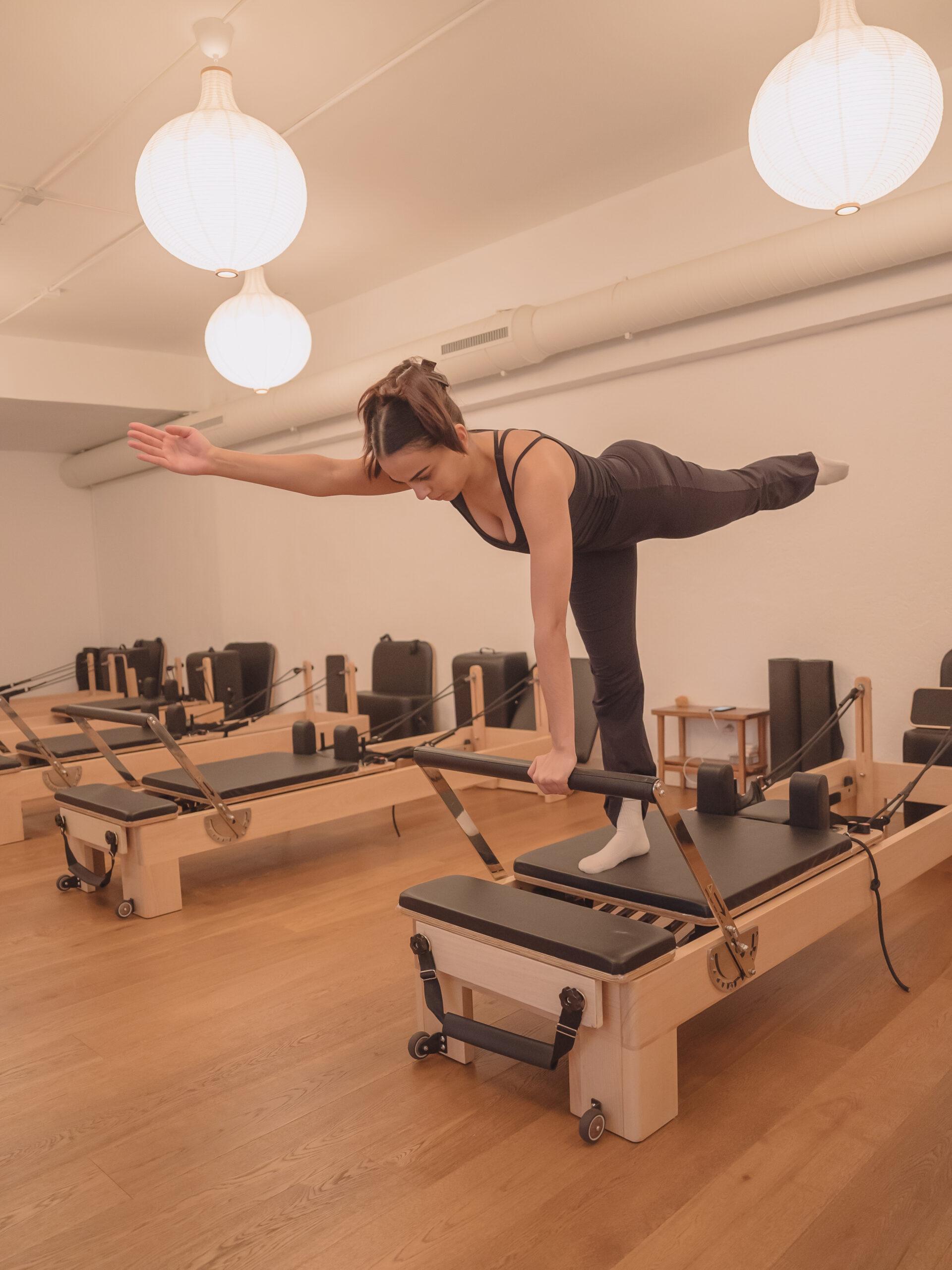
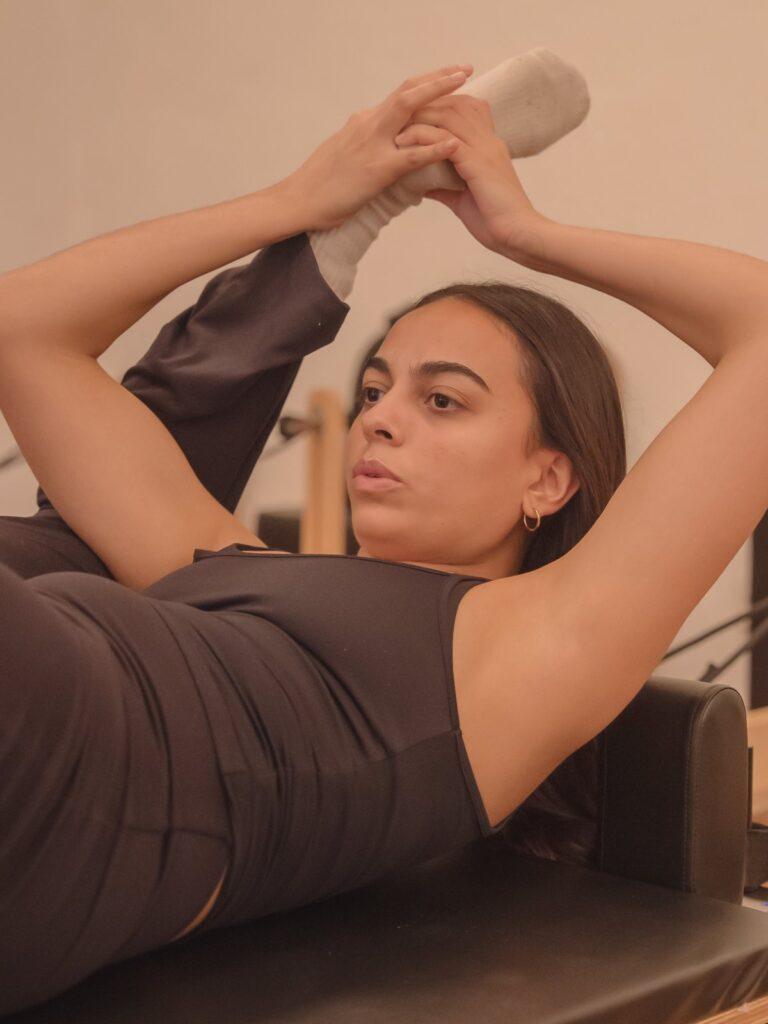
Pilates has two clearly differentiated modalities. Mat Pilates is practised on a mat and, optionally, with props such as resistance bands, balls or rings. Equipment Pilates uses specialised apparatus designed by Joseph Pilates: the Reformer (sliding carriage with springs), the Cadillac (frame with bars and springs), the Wunda Chair (chair with pedal) and the Barrel (cylinder for spinal extensions).
The Reformer is the most popular machine and the one that offers the greatest versatility. If you are not sure exactly how it works, you can read our article on what Reformer Pilates is. The difference between practising Pilates on a mat and doing it on a Reformer is significant: the machine provides variable resistance, proprioceptive feedback and the possibility of working unloaded. We have compared both options in detail in our guide to Reformer Pilates vs mat Pilates.
Class Format: Flow versus Control
A Typical Yoga Class (60-90 minutes)
- Opening (5-10 min): the teacher guides a brief meditation or breathing exercise. Students sit in a comfortable position with their eyes closed.
- Warm-up (10-15 min): gentle movements, spinal twists, light stretches. In Vinyasa, this usually includes several rounds of Sun Salutations.
- Main sequence (30-45 min): standing postures, balance, forward and back bends, twists and inversions. Postures are held for between 3 and 10 breaths (in styles such as Yin, up to 5 minutes).
- Cool-down (5-10 min): gentle postures on the floor.
- Savasana (5-10 min): final relaxation lying on your back, still, with eyes closed. It is considered one of the most important postures.
The group can be large (20-40 people in conventional studios). The teacher demonstrates the postures and guides verbally. Individual correction is limited.
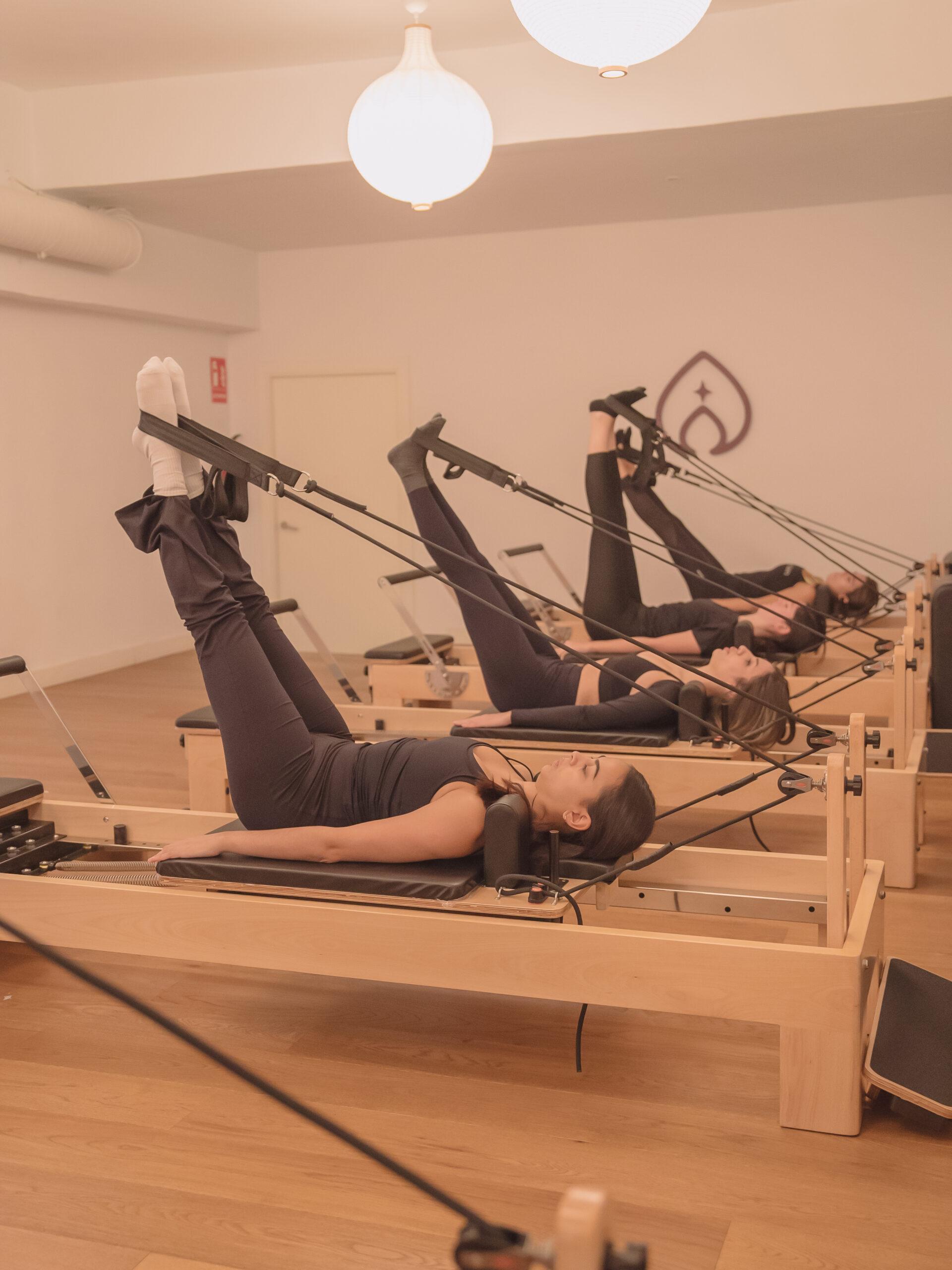
A Typical Reformer Pilates Class (50 minutes)
- Warm-up (5-8 min): joint mobility, core activation, connection with lateral thoracic breathing.
- Main work (35-40 min): a sequence of exercises on the Reformer that works the whole body. Positions alternate (lying, seated, kneeling, standing) and the springs are adjusted according to the exercise and the student’s level.
- Cool-down (5 min): stretches on the machine or on the floor.
Groups are small (at Pinar Pilates, a maximum of 8 people). The instructor watches each student, corrects technique in real time and adapts the springs and progressions individually.
Comparison Table: Pilates vs Yoga
| Criterion | Pilates | Yoga |
|---|---|---|
| Origin | Germany, 20th century (Joseph Pilates) | India, more than 5,000 years ago |
| Philosophy | Biomechanics and movement control | Union of body, mind and spirit |
| Main physical focus | Core strength, control, alignment | Flexibility, balance, opening |
| Breathing | Lateral thoracic (exhale through the mouth) | Pranayama (inhale and exhale through the nose) |
| Spiritual component | No | Yes (meditation, mantras, philosophy) |
| Equipment | Reformer, Cadillac, mat, props | Mat, blocks, straps |
| Typical class length | 50 minutes | 60-90 minutes |
| Usual group size | 6-10 people | 15-40 people |
| Individual supervision | High (an integral part of the method) | Variable (depends on group size) |
| Strength work | Central, with progressive resistance | Secondary, based on body weight |
| Flexibility work | Active (stretch while strengthening) | Priority (passive and active) |
| Meditation | Not part of the method | Essential component |
| Suitability for rehabilitation | High (therapeutic origin) | Moderate (depends on the style and the teacher) |
| Calories burned per session | 200-450 kcal | 150-400 kcal (depending on style) |
Who Yoga Is Best For
Yoga is an excellent choice if you identify with any of these profiles:
If you want to manage stress and anxiety. Yoga integrates meditation, conscious breathing and movement in a way that acts directly on the nervous system. A meta-analysis published in JAMA Internal Medicine (2014) concluded that mindfulness meditation programmes (common in yoga) produce moderate improvements in anxiety, depression and pain.
If you want to improve your flexibility significantly. Yoga works on flexibility as a priority goal. Postures are held for long breaths, which allows a deep stretch of muscles, fascia and connective tissue. If you have limited flexibility and want to change it, yoga is very effective.
If you are interested in a practice with a spiritual dimension. If, beyond physical exercise, you are looking for a philosophy of life, meditation tools and a space for introspection, yoga offers a complete framework that Pilates does not aim to cover.
If you prefer a tighter budget. Group yoga classes are usually cheaper than Reformer Pilates classes, and practising at home requires no special equipment.
Who Pilates Is Best For
Pilates, and in particular Reformer Pilates, suits these profiles better:
If you have back, neck or joint pain. Pilates was born as a rehabilitation method. Working on the Reformer allows you to exercise unloaded (with no compressive load on the spine), with adjustable resistance and under direct supervision. For people with herniated discs, protrusions, chronic low back pain or cervical problems, Reformer Pilates offers a controlled, safe environment.
If you want to strengthen your core and improve your posture. Strength in the centre of the body and postural alignment are the main goal of Pilates. If you sit for many hours, have a thoracic kyphosis or notice that your posture has deteriorated, Pilates attacks the problem at its root.
If you want measurable physical results in a short time. The variable resistance of the springs, small groups with constant correction and the focus on precision of movement mean that results in strength, muscle tone and posture are felt within a few weeks.
If you are an athlete and need to complement your training. Runners, cyclists, padel players, swimmers and people who lift weights find in Reformer Pilates a complement that corrects muscle imbalances, improves core stability and reduces the risk of injury.
If you value personalised attention. In studios like Pinar Pilates, with a maximum of 8 people per class, the instructor knows your body, your limitations and your goals. Every session includes individual corrections and real-time adaptations.
Combining Pilates and Yoga: the Best of Both Worlds
Pilates and yoga are not mutually exclusive. In fact, they complement each other remarkably well because they work on different qualities.
What yoga brings to the Pilates practitioner. Deep passive flexibility (especially in the hips and hamstrings), stress management tools (meditation, breathing), greater body awareness in static postures and an introspective dimension that Pilates does not address.
What Pilates brings to the yoga practitioner. Core strength that improves control in balance postures and inversions, shoulder girdle stability that protects the shoulders in postures such as Chaturanga or Downward Dog, correction of muscle imbalances that can cause injuries in repeated postures, and a more precise understanding of body alignment.
A practical combination. If you have 4 days a week to train, a balanced split could be 2-3 Reformer Pilates sessions and 1-2 yoga sessions. Pilates brings the strength and the structure. Yoga brings the flexibility and the calm. Together, they cover a spectrum of wellbeing that neither discipline reaches on its own.
Many students at Pinar Pilates practise both disciplines. What they tell us is that their yoga practice improved when they added Reformer Pilates: more control in balances, more strength in arm postures and less discomfort in hip-opening postures.
Frequently Asked Questions about Pilates vs Yoga
Which is better, Pilates or yoga, for losing weight?
Both disciplines contribute to weight loss, but neither is an intense cardiovascular exercise. Reformer Pilates burns between 200 and 450 calories per session, depending on the intensity. Yoga varies a lot by style: a Yin class may burn 150 kcal, while a dynamic Vinyasa class can exceed 400 kcal. For weight loss, what makes the difference is consistency, diet and combining it with cardiovascular activity, not the choice between one discipline or the other.
Pilates or yoga for back pain?
For back pain, Pilates has the advantage. Its origin is rehabilitative, working on the Reformer allows you to exercise unloaded and supervision in small groups ensures that every exercise is performed safely. Yoga can help with back pain (especially gentle styles such as Yin or therapeutic yoga), but some deep flexion, extension or twisting postures can aggravate certain problems if they are not properly adapted.
Can you do Pilates and yoga on the same day?
Yes, although doing them back to back is not ideal. If you want to combine them on the same day, leave at least a few hours between them. A good option is Pilates in the morning (when the body needs to activate) and yoga in the late afternoon or evening (when the body needs to release tension and prepare for rest).
Is Pilates harder than yoga?
They are hard in different ways. Pilates demands precise muscle control, constant core activation and coordination with lateral thoracic breathing. Yoga demands flexibility, balance and the ability to hold postures for extended periods. A beginner will find different aspects challenging in each discipline. Neither is inherently harder than the other.
Which gives faster results?
In terms of core strength, muscle tone and postural improvement, Reformer Pilates usually delivers noticeable results sooner (4-6 weeks with 2-3 sessions a week). In terms of flexibility and stress reduction, yoga may show faster results. It depends on which result you are measuring.
Choose with a Trial Class
If you have already tried yoga and want to discover what Reformer Pilates can bring you, the best way is not to read about it. It is to feel it in your own body.
At Pinar Pilates we offer your first Reformer Pilates class with 50% off. Our studio at Calle del Pinar 8, in the Salamanca district, has groups of a maximum of 8 people, instructors who correct every movement and more than 490 Google reviews (average 4.9 out of 5) that back up the experience.
Our regular prices: single class €30, 4 classes a month €100, 8 classes €150, 12 classes €200 and unlimited access €250/month.
Book your first class with 50% off
Would you rather ask a few questions before booking? Call us on +34 611 994 729 or drop by the studio. We will be happy to advise you.
Pinar Pilates · Salamanca district, Madrid
Your first reformer class, €15
Groups of 8 people maximum, specialist instructors and more than 40 classes a week. Your first class is half price.
Book my first classCalle del Pinar 8, Madrid · Questions? Message us on WhatsApp