If you have ever tried to improve your flexibility with static stretching and got mediocre results, it is not your fault. The problem is not you, it is the method. Sitting on the floor and forcing your body forward for 30 seconds produces very limited adaptations. Reformer Pilates works differently, and that makes the difference.
This article explains exactly how the Reformer improves flexibility and joint mobility, which exercises are used for that purpose, how long it takes to notice results and what the science says. No empty promises or euphemisms.
Flexibility and Mobility: Not the Same Thing
Before talking about how to improve them, it helps to understand the difference between flexibility and mobility. Confusing the two concepts leads many people to train inefficiently for years.
Flexibility is the passive capacity of a muscle or muscle group to lengthen. It is what you measure when someone pushes you towards the floor in a stretch: you can go further, but not through your own muscular control.
Joint mobility is the active capacity of a joint to move through its full range of motion with muscular control. It is what you need when you raise your arm above your head without the shoulder compensating with incorrect movements, or when you do a deep squat without your lower back rounding.
The practical difference matters: a person can be very flexible without having good mobility. Someone with hamstrings that stretch effortlessly but without active muscular control cannot translate that passive flexibility into functional movement. And, conversely, someone with little passive flexibility can have excellent functional mobility if they have trained neuromuscular control.
To live better, move without pain and perform in any physical activity, you need both. And Reformer Pilates works on both at the same time, something conventional static stretching cannot do.
Why the Reformer Beats Static Stretching
Static stretching has its place in warm-ups and recovery, but as the main method for gaining flexibility it has obvious limitations. The Reformer overcomes those limitations for three concrete reasons.
Active, Not Passive, Stretching
On the Reformer, the muscles stretch while they work. You do not just relax and wait for gravity to do the job. In exercises such as the Elephant or the Hip Stretch with straps, the muscles are active throughout the range. This produces more lasting adaptations because the nervous system learns to control the muscle along its whole length, not just to tolerate it being stretched passively.
Eccentric Loading
The eccentric phase of an exercise is the one in which the muscle lengthens while generating tension to control the movement. It is the most effective phase for gaining functional flexibility. When on the Reformer you control the return of the carriage against the resistance of the springs, you are doing eccentric work. The hamstrings, hip flexors and back muscles receive systematic eccentric stimuli that improve both their elasticity and their capacity to generate force in lengthened positions.
Spring Assistance across the Range of Motion
The Reformer’s spring system can be used to assist movement in the final degrees of joint range. This allows you to explore ranges of motion that the body, through muscle tension or lack of control, cannot reach on its own. With the support of the spring, the nervous system gets used to those end-range positions and, progressively, stops perceiving them as a threat. The result is a real, controlled expansion of mobility.
How Flexibility Improves by Body Area
The Reformer works on flexibility globally, but there are areas where the changes are especially noticeable.
Hamstrings
The hamstrings are probably the stiffest muscle group in most sedentary adults or office workers. Exercises such as the Elephant, the Arabesque and the strap series stretch them progressively and actively. Improvement in the hamstrings has a direct effect on lumbar posture: when these muscles relax, the pelvis can adopt a more neutral position and the lower back stops being under constant tension.
Hip Flexors
The psoas and the rectus femoris are the forgotten muscles of flexibility. They remain shortened in people who spend hours sitting, and that shortening pulls the pelvis forward, accentuating the lumbar lordosis and contributing to back pain. The Eve’s Lunge exercise on the Reformer, together with the hip stretch series with straps, works these muscles specifically in positions that stretching on a mat cannot replicate as effectively.
Thoracic Spine
Stiffness in the thoracic spine is one of the most frequent causes of neck pain, shoulder pain and kyphosis. The Reformer includes thoracic rotation and extension exercises, such as the Mermaid and seated variations, that mobilise the thoracic area vertebra by vertebra. Improved thoracic mobility has a knock-on effect: when the thoracic spine moves well, the neck works less and the shoulders have more room to raise the arm without compensations.
Shoulders and Shoulder Girdle
Shoulder mobility is limited by stiffness in the joint capsule, tension in the pectoralis minor and lack of control in the scapular stabilisers. The Reformer works the shoulders in every direction, with exercises lying on your back, on all fours and standing, that combine eccentric strength and opening of the joint range. Over time, the shoulders recover the ability to lift, rotate and extend without pain or compensations.
Realistic Timeframes: When You Will Start to Notice Results
Changes in flexibility follow a predictable pattern. Knowing that pattern helps you stay consistent and not give up before the results arrive.
2 weeks: body awareness. In the first sessions, the most obvious change is not physical but neurological. You start to perceive where you hold tension, which areas do not move as they should. Some students notice a slight improvement in range of motion in the very first week, but it is transient. What does stay is the awareness.
4-6 weeks: measurable improvement. With two or three sessions a week for a month, most people begin to notice objective changes. They can reach a little further in stretches, feel less tightness when getting up in the morning and sense that the body moves with less internal resistance.
3 months: significant, stable change. After three months of regular practice, the adaptations in muscle and connective tissue are real and lasting. It is not just a feeling: range of motion has increased measurably. The hamstrings have lengthened, the hip rotates better, the thoracic spine has more mobility. These changes hold even if you skip a week of training.
5 Reformer Exercises Specifically for Flexibility
1. Mermaid
Sitting sideways on the Reformer, with one hand resting on the shoulder block of the carriage and the other extended, the lateral movement of the rib cage stretches the intercostal muscles, the quadratus lumborum and the lateral trunk muscles. It is one of the most effective exercises for gaining mobility in the thoracic spine and the hip. The spring assists the movement at the point of greatest range, allowing you to explore lateral lengthening without forcing.
2. Elephant
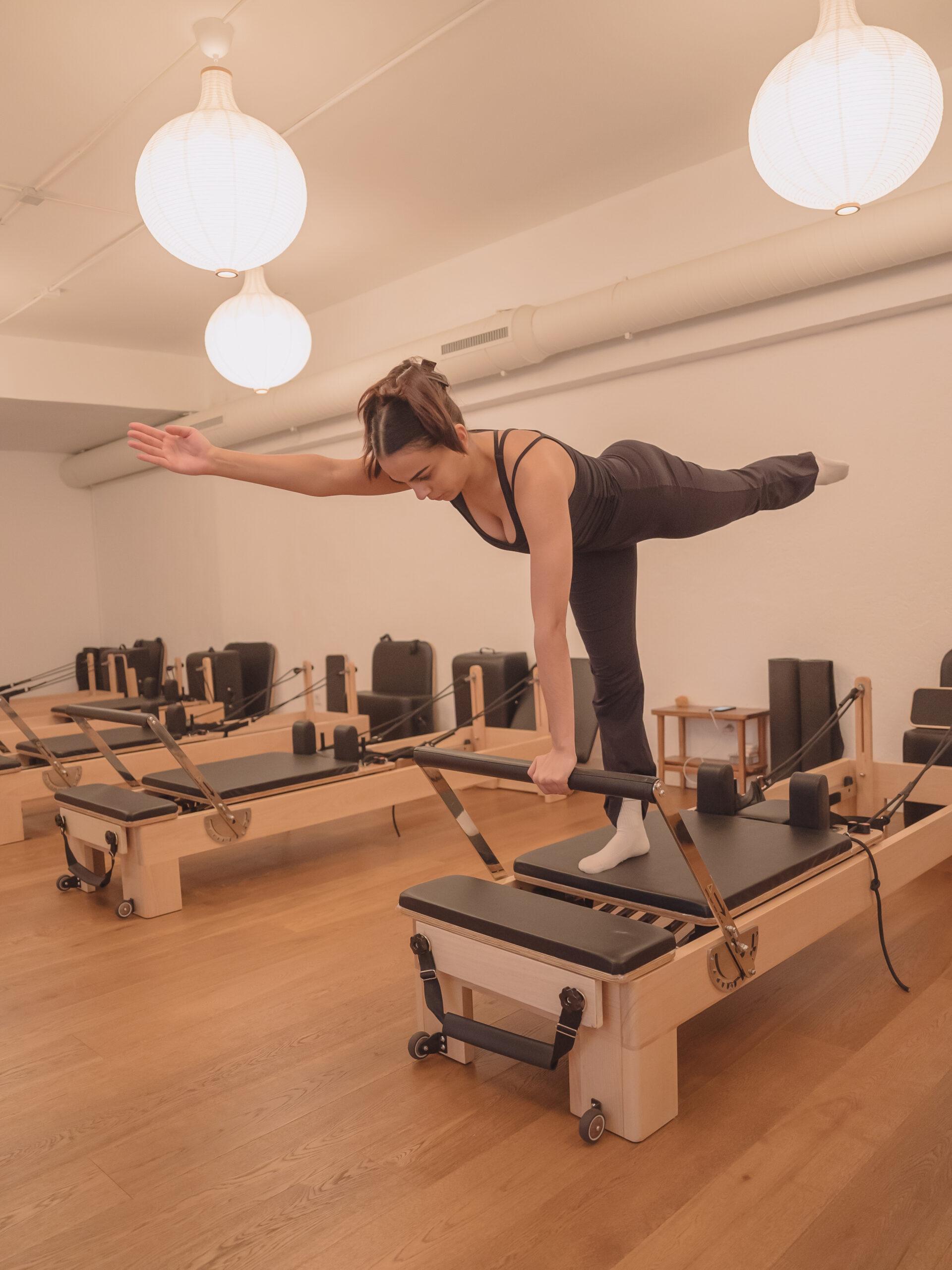
Standing on the Reformer with your hands on the shoulder block of the carriage and your hips raised, the Elephant is the reference exercise for the hamstrings and the lumbar spine. The movement of pushing the carriage with the feet while keeping the hips high creates an active stretch that runs through the whole posterior chain. It is not a passive stretch: the hamstrings work and stretch at the same time.
3. Eve’s Lunge
In a lunge position on the Reformer, with the back foot on the carriage and the front foot on the fixed platform, this exercise progressively stretches the hip flexors on the side of the back foot. Controlling the movement of the carriage lets you regulate the depth of the stretch. It is especially effective for the psoas, which is difficult to isolate in conventional floor stretching.
4. Splits Series
The splits series on the Reformer works hip opening in the frontal plane. You do not need to do a full split to benefit: simply controlling the width of the opening with the spring system activates the adductors eccentrically and stretches the inner thigh. It is an exercise worked on progressively over months and one that produces very visible changes in hip mobility.
5. Hip Stretches with Straps
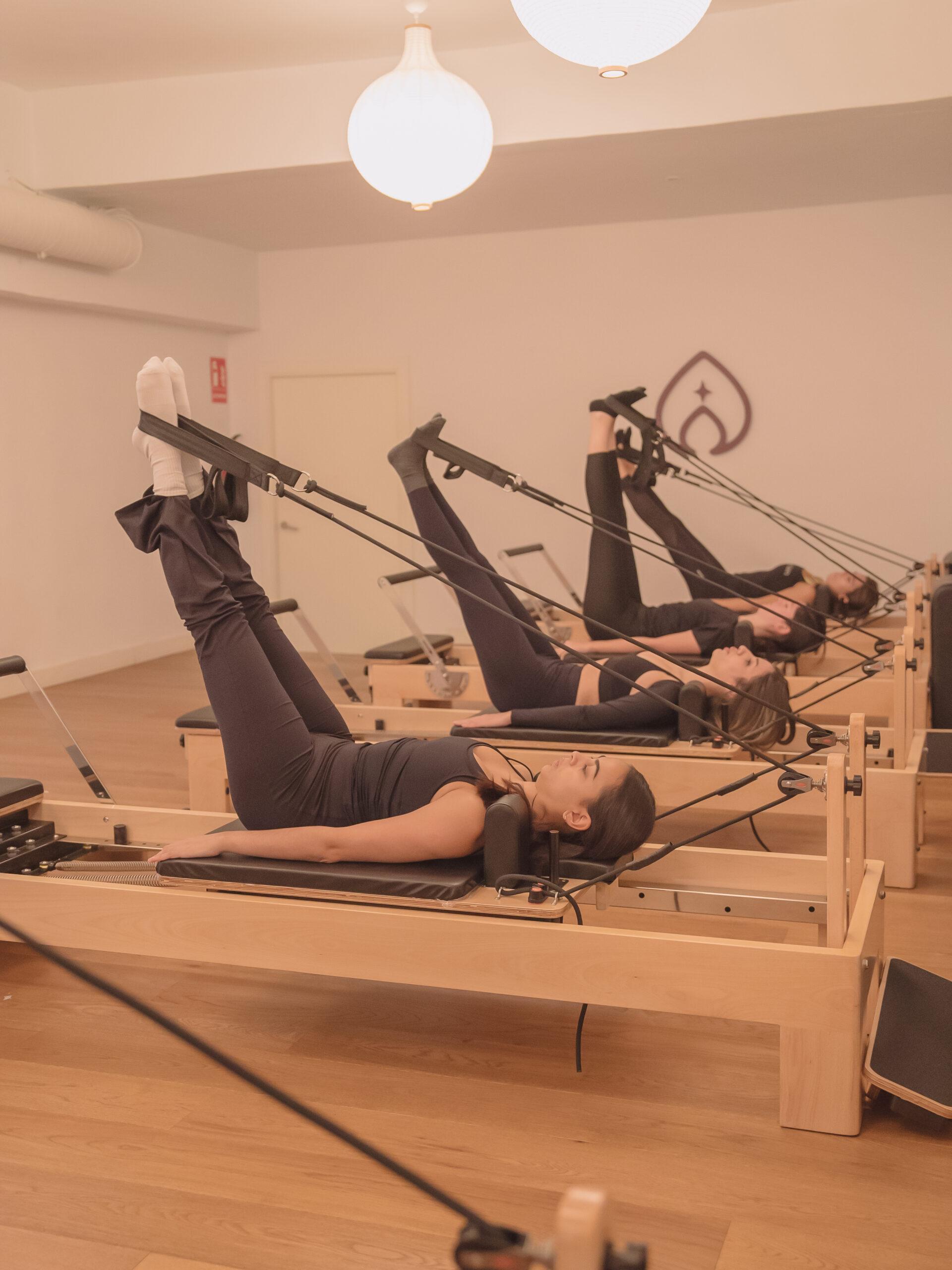
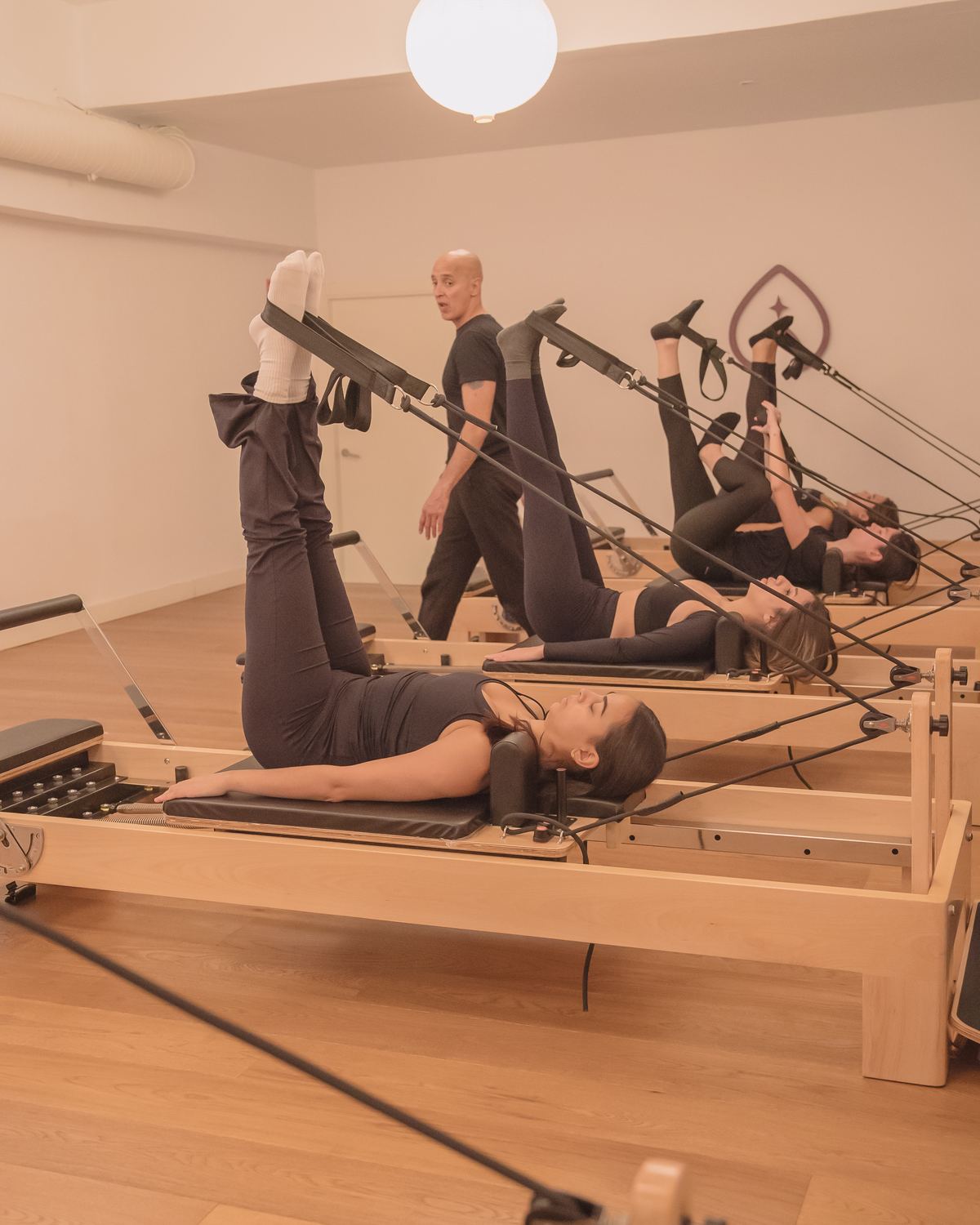
With the Reformer straps around the feet or ankles, lying on the platform, this group of exercises lets you work hip flexibility in multiple planes: flexion, external rotation, internal rotation and extension. The assistance of the strap allows you to reach end-range positions with control, which teaches the nervous system to accept those ranges as safe and functional.
Flexibility Myths Worth Debunking
“I’m not flexible enough to do Pilates”
It is exactly the other way round. Reformer Pilates is especially effective precisely for people with little flexibility, because the spring system allows each exercise to be adapted to each student’s current range of motion. There is no need to reach any predetermined position: each person’s starting point is exactly the right one to begin.
“Stretching has to hurt to be effective”
Pain during stretching is an alarm signal from the nervous system, not an indicator of progress. When you stretch into pain, the body triggers the myotatic reflex, which contracts the muscle to protect it. In other words, pain during stretching produces exactly the opposite of the desired effect. The optimal working range is the feeling of a pull without pain. The Reformer makes it easier to stay in that range because the spring can be adjusted.
“Flexibility declines with age and there’s nothing you can do”
It is true that passive flexibility declines with age due to changes in the connective tissues. But the scientific evidence shows that functional mobility can be maintained and even improved at any age with appropriate training. Studies in people over 60 who practise Pilates regularly show significant improvements in joint range of motion and functional capacity. Age is not a ceiling; it is a different starting point.
Scientific Evidence on Pilates and Flexibility
The scientific literature consistently supports the effects of Pilates on flexibility and joint mobility.
A systematic review by Cruz-Ferreira et al. (2011), published in Archives of Physical Medicine and Rehabilitation, evaluated sixteen trials in healthy people and concluded that there is strong evidence that Pilates improves flexibility and dynamic balance.
A randomised controlled trial by Kloubec (2010), in the Journal of Strength and Conditioning Research, found statistically significant improvements in hamstring flexibility, measured with the sit-and-reach test, after 12 weeks of practice.
Studies on Reformer Pilates specifically, compared with mat work, show an additional advantage in gaining active flexibility thanks to the eccentric-loading component and the assistance of the springs. This is consistent with the physiological mechanisms described above: active, eccentric stretching produces deeper and more lasting adaptations than passive static stretching.
You can explore these and other results in our guide to the benefits of Reformer Pilates, where we analyse the scientific evidence in more detail.
Frequently Asked Questions
How often do I have to practise Pilates to improve my flexibility?
Two sessions a week are enough to see results in flexibility within 4 to 6 weeks. Three sessions a week speed up that process. Below one session a week, progress exists but is slower because the tissues receive fewer adaptation stimuli.
Is Reformer Pilates suitable for people with severe stiffness?
It is especially suitable. Adjusting the resistance of the springs allows you to work within each person’s current range of motion and expand it progressively. At Pinar Pilates, the instructors adapt each exercise to each student’s level. Small groups of a maximum of 8 people guarantee that this adaptation is real and continuous.
Can I combine Reformer Pilates with other forms of flexibility training?
Yes, and in fact it is a recommended combination. Reformer Pilates provides the active, functional component of mobility. Restorative yoga or passive stretching can complement it to work on deep tissue relaxation. The key is not to rely only on passive stretching, but to include the active work the Reformer provides.
Does improving flexibility help reduce back pain?
In many cases, yes. Stiffness in the hamstrings, hip flexors and thoracic spine are factors that contribute directly to lumbar and cervical pain. Improving flexibility and mobility in those areas reduces the tension on the passive structures of the spine. If you want to know more about this topic, see our article on how to improve your posture with Reformer Pilates.
How long do the results last if I stop practising?
Adaptations in connective tissue are maintained for several weeks after stopping training, but gradually diminish if there are no maintenance stimuli. The good news is that the body recovers its previous flexibility levels much faster in a second period of training than in the first, because neuromuscular adaptations are retained for longer than tissue adaptations.
Start Moving Freely at Pinar Pilates
Reformer Pilates is not a promise of instant splits or extreme flexibility. It is a systematic, evidence-backed method for recovering and expanding the range of motion the body can reach when it is worked intelligently. The changes are real, they are measurable and, with consistency, they last.
At Pinar Pilates we work in groups of a maximum of 8 people at our studio in the Salamanca district (Calle del Pinar 8, 28006 Madrid). We have more than 490 Google reviews (average 4.9 out of 5) and more than 40 classes a week adapted to all levels. If you are curious about what the experience is like, you can read our article on what to expect in your first Reformer Pilates class in Madrid.
For any questions, call +34 611 994 729.
Book your first class with 50% off
Pinar Pilates · Salamanca district, Madrid
Your first reformer class, €15
Groups of 8 people maximum, specialist instructors and more than 40 classes a week. Your first class is half price.
Book my first classCalle del Pinar 8, Madrid · Questions? Message us on WhatsApp