Important medical notice: scoliosis is a condition that requires diagnosis and follow-up by an orthopaedic surgeon or rehabilitation doctor. This article is for information only and does not replace a specialist’s assessment. Before starting Pilates or any exercise programme with diagnosed scoliosis, you need medical clearance. Every scoliosis is different in type, location, degree of curvature and the patient’s age, and what works for one person may not be right for another. The exercises described here are a guide and must be adapted to your specific case under the supervision of a qualified instructor who knows your diagnosis.
Scoliosis affects between 2% and 4% of the population, according to the Scoliosis Research Society. Many people live with it without knowing; others discover it in adolescence and carry the worry that their curve will progress. If you have scoliosis and are looking for exercise that strengthens your spine without risk, Reformer Pilates is one of the options with the most clinical support. It does not magically correct the curve, but it can reduce pain, improve muscular symmetry and slow progression in mild to moderate cases.
What Scoliosis Is and How It Affects Your Spine
Scoliosis is a lateral deviation of the spine greater than 10 degrees (measured by the Cobb angle on an X-ray). It is not simply “having a crooked back”: it involves a three-dimensional vertebral rotation that affects the frontal, sagittal and transverse planes. This means the vertebrae not only deviate to one side, but also rotate on their own axis, dragging the ribs with them and altering breathing mechanics.
Idiopathic Scoliosis
It accounts for 80% to 85% of all cases. It is called “idiopathic” because its exact cause is unknown, although it is associated with genetic and growth factors. It appears most often during adolescence (between 10 and 18 years of age) and affects more women than men. It is classified by the severity of the Cobb angle: mild (10 to 25 degrees), moderate (25 to 40 degrees) and severe (more than 40 degrees).
Degenerative Scoliosis
It develops in adulthood, usually from the age of 50, as a consequence of wear of the intervertebral discs and the facet joints. The spine loses segmental stability and deviates progressively. The main symptoms are low back pain, stiffness and, in some cases, spinal stenosis with pain radiating into the legs.
Functional Scoliosis
It is not caused by a structural deformity of the vertebrae, but by muscle imbalances, differences in leg length or sustained asymmetric postures. The spine deviates as a compensation, but the vertebrae are neither rotated nor deformed. It is the form of scoliosis that responds best to exercise, because correcting the underlying imbalance reduces or removes the curve.
How Reformer Pilates Helps People with Scoliosis
Asymmetric Work and Correcting Imbalances
Scoliosis creates an asymmetric muscular pattern: the muscles on the concave side of the curve tend to be shortened and those on the convex side elongated and weakened. The Reformer lets you work each side of the body independently with the straps and the springs. This is key for scoliosis, because a symmetric exercise programme (the same work for both sides) perpetuates the imbalance instead of correcting it.
A trained instructor can adjust the resistance and range of movement differently for each side, selectively strengthening the weak muscles and stretching the shortened ones. This capacity for individualisation is what sets the Reformer apart from other exercise methods.
Segmental Spinal Mobility
Scoliosis reduces the mobility of the vertebral segments involved in the curve. The vertebrae “lock” in their deviated position and the surrounding muscles stiffen to maintain stability. The Reformer facilitates segmental articulation movements (such as the Pelvic Curl, where the spine peels off the carriage vertebra by vertebra) that restore mobility to restricted segments without forcing them.
Strengthening the Deep Core
The transversus abdominis, the multifidus, the pelvic floor and the diaphragm form the spine’s deep stabilisation system. In people with scoliosis, these muscles are often inhibited or fire asymmetrically. Every Reformer exercise demands constant activation of this system to control the movement of the carriage, creating a muscular corset that protects the spine and reduces the load on the deviated segments.
Spinal Decompression
Axial traction exercises on the Reformer (where the carriage glides and gently separates the vertebrae) reduce the pressure on the intervertebral discs and the facet joints. For people with degenerative scoliosis, where asymmetric compression of the discs speeds up wear, this decompression brings relief and slows the progression of deterioration.
Better Breathing Function
The vertebral rotation of scoliosis compresses the hemithorax on the concave side and expands the one on the convex side, which limits breathing capacity. The Reformer lets you work rib expansion in a targeted way, with exercises that open the compressed side and improve breathing mechanics. Many students with scoliosis notice an improvement in their ability to breathe deeply after the first weeks of practice.
What the Scientific Evidence Says
Research on Pilates and scoliosis has grown in recent years. These are the most relevant studies:
Meta-analysis by Gou et al. (2021), published in Medicine. It analysed 10 randomised controlled trials with 359 scoliosis patients. The Pilates group achieved significant reductions in the Cobb angle (SMD = 1.23), the angle of trunk rotation (SMD = 1.37) and pain level (SMD = 2.78), plus improvements in trunk range of movement and quality of life (SMD = 3.05). The authors concluded that Pilates can reduce spinal deformity and improve quality of life, although they warned that the methodological quality of the included studies was variable.
Randomised clinical trial by Başaran Özden and Kuru Çolak (2022), published in the Journal of Health and Allied Sciences NU. It included 34 patients with adolescent idiopathic scoliosis (16 in the Pilates group, 18 in the control group) over 16 sessions. The Pilates group achieved a significant reduction in pain (p < 0.001) and improvements in postural assessment (p < 0.005). The Pilates exercises did not notably change the angle of the deformity, but they did change pain and postural alignment.
Scoping review by Kuru Çolak, Akçay and Apti (2023), published in Spine Deformity. It reviewed 7 studies on Pilates and idiopathic scoliosis. It concluded that Pilates exercises can be applied to reduce asymmetric posture in people with mild scoliosis and a low risk of progression. The level of evidence is limited, but the direction of the results is consistent.
Study by Rrecaj-Malaj et al. (2020), published in Medical Science Monitor Basic Research. It evaluated a combination of Schroth and Pilates exercises over 24 weeks in 69 adolescents with idiopathic scoliosis (Cobb angle between 10 and 45 degrees). The programme reduced the Cobb angle and trunk rotation, and improved chest expansion, flexibility and quality of life.
The general conclusion is that Pilates does not “cure” structural scoliosis, but it does reduce pain, improve asymmetric posture, increase function and can help slow progression in mild to moderate curves. The best results come when it is combined with specialist supervision and adapted to each patient’s type and degree of scoliosis.
6 Reformer Exercises That Help with Scoliosis
These exercises are practised at Pinar Pilates, adapted to each student’s type of curve and degree of scoliosis. All of them require supervision by an instructor who knows your diagnosis.
1. Asymmetric Mermaid
Position: seated sideways on the carriage, one hand on the bar, the other on the carriage. Legs in the mermaid position.
Execution: push the bar sideways, sliding the carriage and stretching the whole side of the trunk. The work is done with different resistance and range of movement on each side: more stretch on the concave (shortened) side of the curve and more strengthening on the convex (weakened) side.
Why it helps with scoliosis: it is the most direct Reformer exercise for addressing lateral asymmetry. It stretches the shortened muscles on the concave side (quadratus lumborum, obliques, intercostals) and strengthens the convex side. It improves rib expansion of the compressed hemithorax. It is one of the exercises that brings the most immediate relief to people with scoliosis.
2. Single-Leg Footwork
Position: lying on your back on the carriage, one foot on the bar and the other raised or resting on the other leg.
Execution: push the bar with one foot, extending the leg while keeping the pelvis level. The spring resistance is adjusted for each side according to the student’s imbalance. Both legs are alternated.
Why it helps with scoliosis: scoliosis usually creates a difference in strength and activation between the two legs and the two sides of the pelvis. Working unilaterally makes it possible to even out that difference. The spine stays supported and unloaded, and the challenge of keeping the pelvis level with a single foot activates the deep stabilisers in an asymmetric, corrective way.
3. Pelvic Curl with Correction
Position: lying on your back, feet on the bar, knees bent.
Execution: peel the pelvis off vertebra by vertebra, paying special attention to keeping both sides of the pelvis at the same height. The instructor can give tactile or visual cues so the student can feel whether one side rises before the other. The descent is done by articulating the spine segment by segment.
Why it helps with scoliosis: segmental articulation restores mobility to the vertebral segments locked by the curve. The conscious work of levelling the pelvis retrains the asymmetric activation pattern of the glutes and the multifidus. It strengthens the deep stabilising muscles of the lumbar spine without compressive load.
4. Supine Arm Series with Rotational Correction
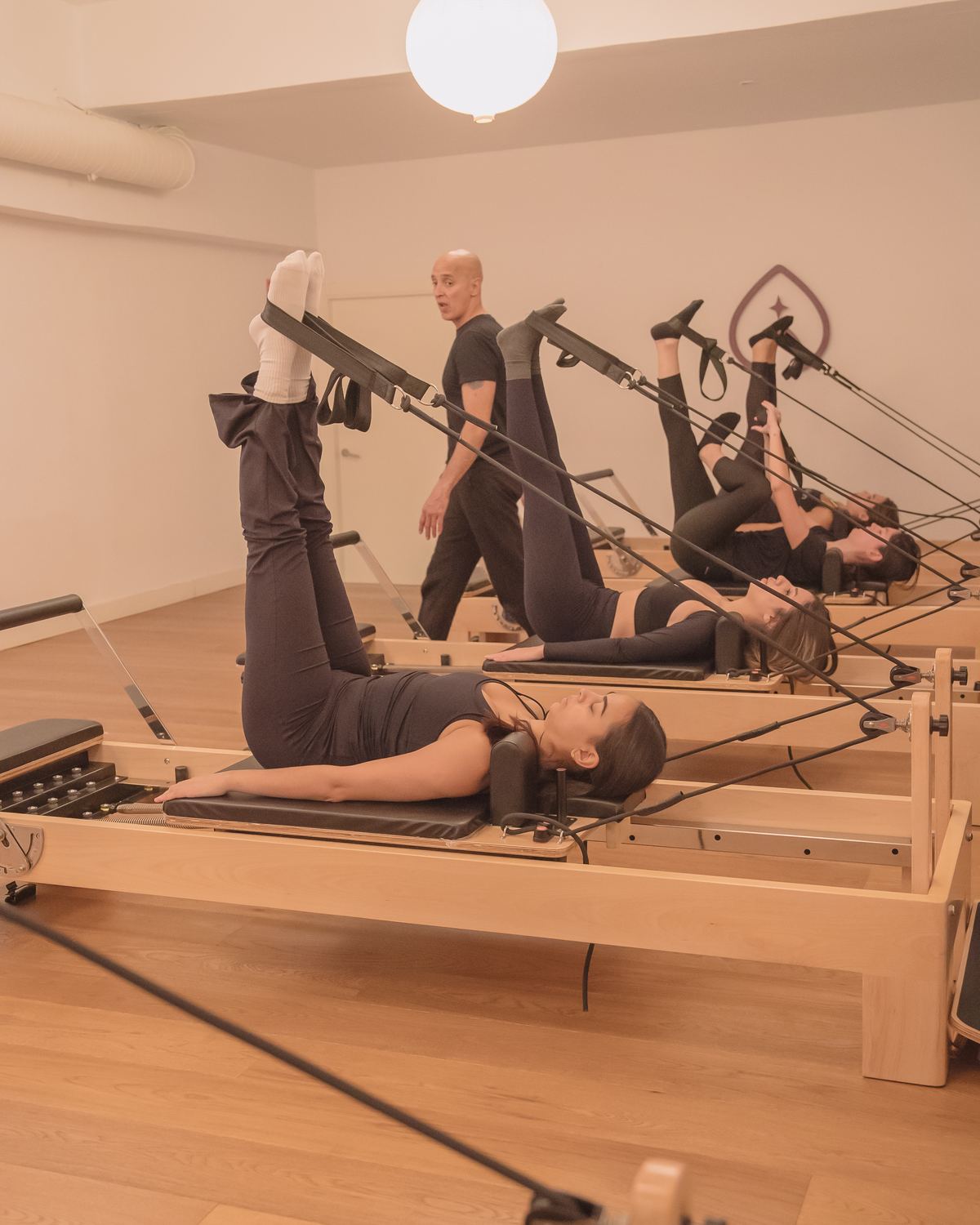
Position: lying on your back on the carriage, a strap in each hand, arms extended towards the ceiling.
Execution: perform arm-opening movements (circles, opening) keeping the trunk symmetrical on the carriage. The instructor adjusts the spring resistance asymmetrically if necessary: more resistance on the side where the muscles are weak, less on the shortened side. De-rotation of the trunk is worked consciously.
Why it helps with scoliosis: it addresses vertebral rotation, the three-dimensional component of scoliosis that is most often overlooked. Arm movements against asymmetric resistance generate corrective de-rotation forces on the trunk. It strengthens the scapular stabilisers differentially, which improves the alignment of the shoulder girdle.
5. Modified Swan
Position: lying face down on the carriage, hands on the bar, arms extended.
Execution: push the bar, sliding the carriage forward while lifting the chest and extending the thoracic spine. The range is limited to a gentle extension, without forcing the lower back. The gaze follows the natural line of the extension.
Why it helps with scoliosis: it strengthens the spinal extensors and the scapular stabilisers, which are usually weakened in people with scoliosis (especially in thoracic curves). Controlled thoracic extension opens the rib cage and improves breathing function. The Reformer lets you dose the resistance so the exercise is safe even in moderate curves.
6. Scooter with Pelvic Control
Position: standing with one foot on the carriage and the other on the platform. Hands on the bar, trunk stable.
Execution: push the carriage back by extending the hip while keeping the pelvis level and the trunk free of rotation. Each side is worked separately, adjusting the resistance as needed.
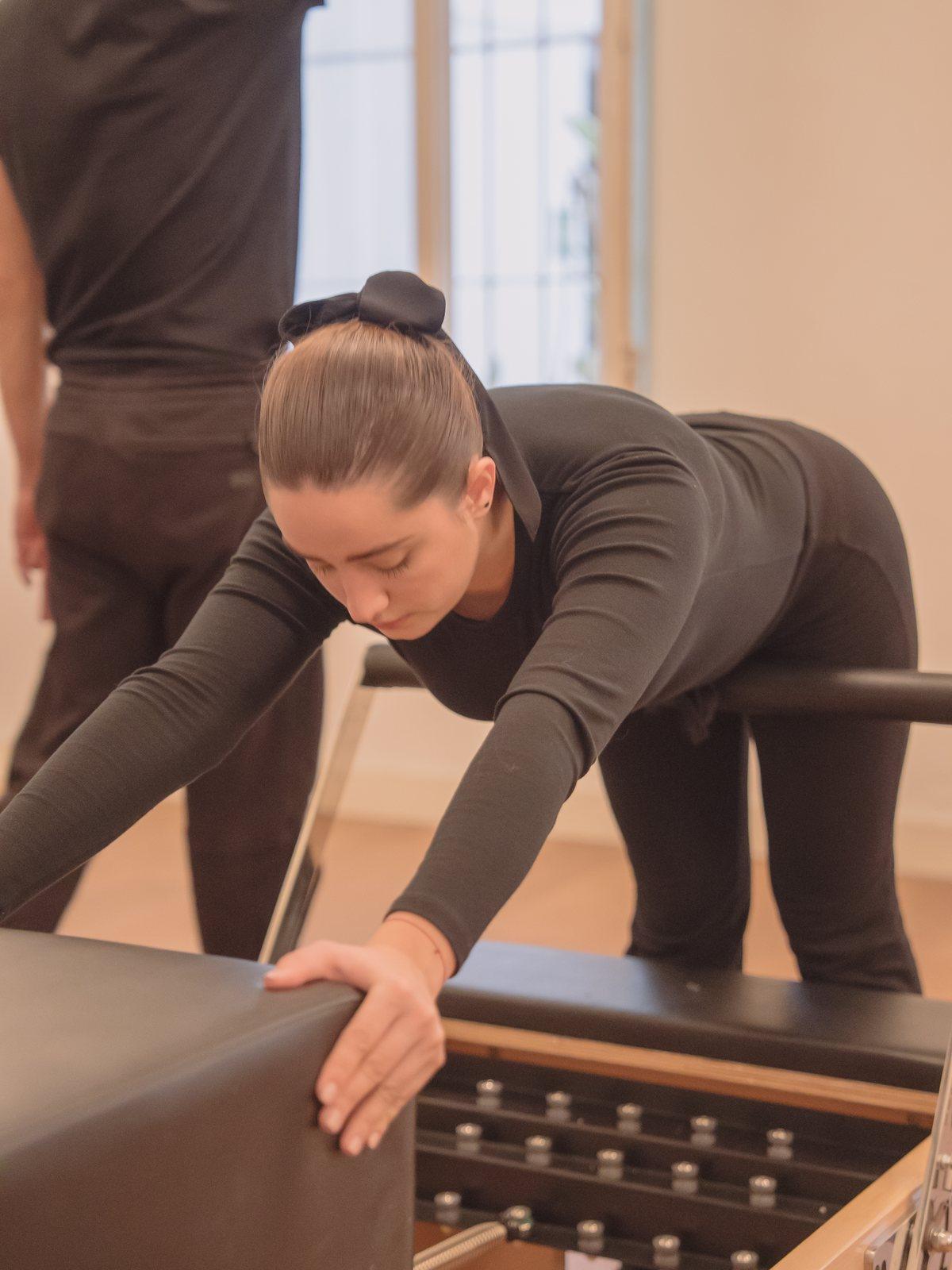
Why it helps with scoliosis: it is a functional exercise that integrates core stabilisation, hip strength and pelvic control in a loaded (standing) position. It detects and corrects the compensations that scoliosis creates in walking and in everyday activities. The difference in control between the two sides is usually obvious from the first session, and its progression is a direct indicator of improvement.
When Pilates Is NOT Appropriate for Scoliosis
Reformer Pilates is a valuable tool, but it is not suitable in every case of scoliosis.
Severe scoliosis (Cobb angle above 45-50 degrees). Severe curves may require treatment with an orthopaedic brace or surgical assessment. Exercise alone is not enough to contain a curve of this magnitude, and some movements could worsen the asymmetry if not performed under the specialist supervision of a physiotherapist trained in scoliosis.
The immediate post-surgical period. After spinal fusion surgery (arthrodesis), the spine needs a consolidation period that varies between 3 and 12 months depending on the extent of the operation. Pilates can be an excellent option for later rehabilitation, but the start date is decided exclusively by the surgeon. The fused segments do not move, so the programme must be adapted to work the mobility and strength of the adjacent segments.
Scoliosis with progressive neurological deficit. If the curve is compressing the spinal cord or the nerve roots and causing progressive muscle weakness, bladder or bowel changes or loss of sensation, the priority is urgent medical treatment, not exercise.
Scoliosis during active growth without medical follow-up. In adolescents who are still growing, scoliosis can progress quickly. Pilates can be part of the treatment, but it must be complemented with regular X-ray monitoring and, if necessary, an orthopaedic brace. It does not replace medical supervision.
Intense acute pain. If the scoliosis is causing an episode of severe acute pain, the first step is medical assessment and pain control. Once the episode has stabilised, a progressive Pilates programme can begin.
How We Work with Scoliosis at Pinar Pilates
At Pinar Pilates, at Calle del Pinar 8, 28006 Madrid, we regularly work with students who have diagnosed scoliosis. Our approach is based on:
An informed initial assessment. Before your first class, we need to know your diagnosis: type of scoliosis, location of the curve, degree of the Cobb angle and any recommendation from your orthopaedic surgeon or physiotherapist. If you bring us a report or an X-ray, we can design the adaptations more precisely.
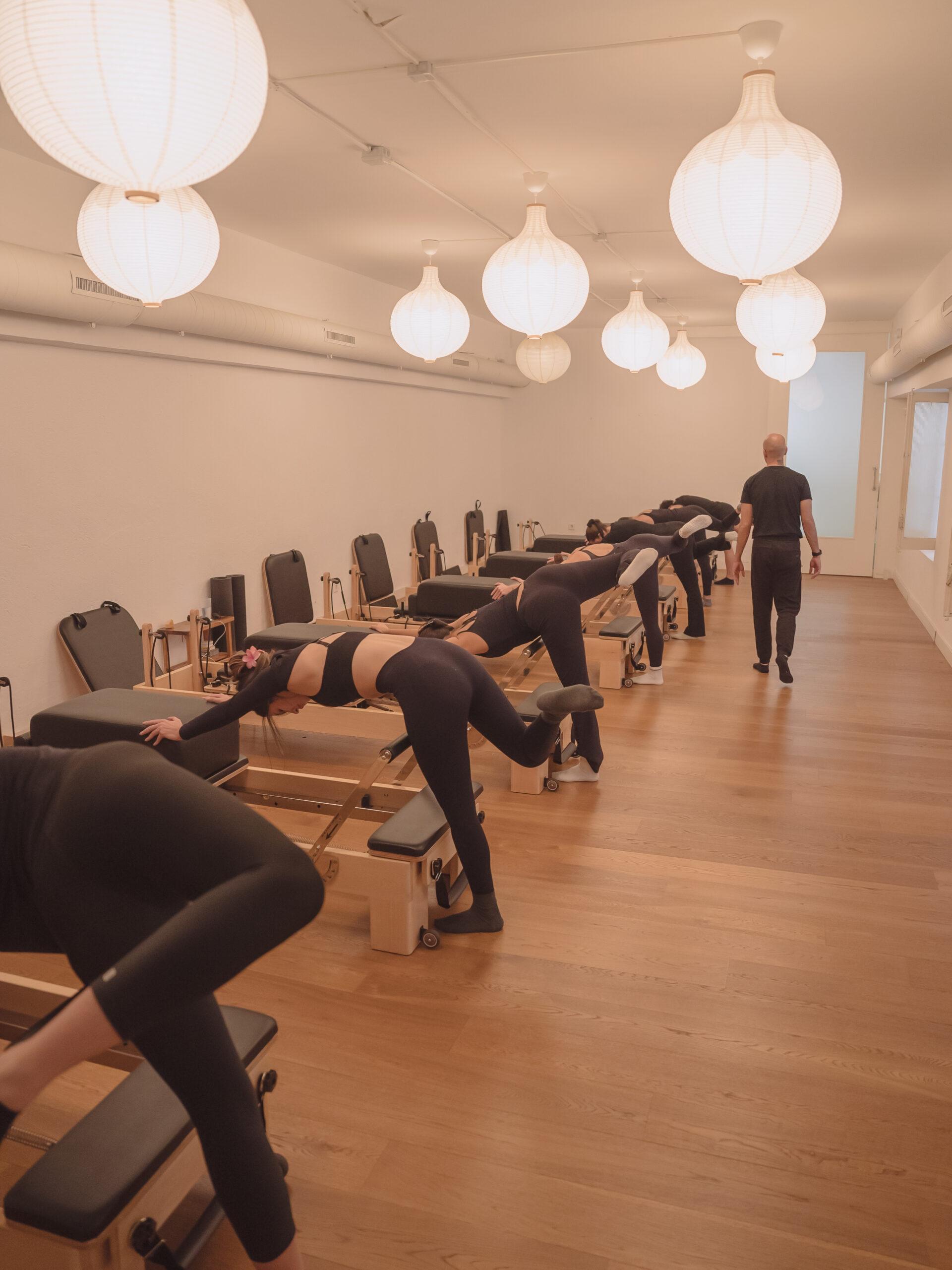
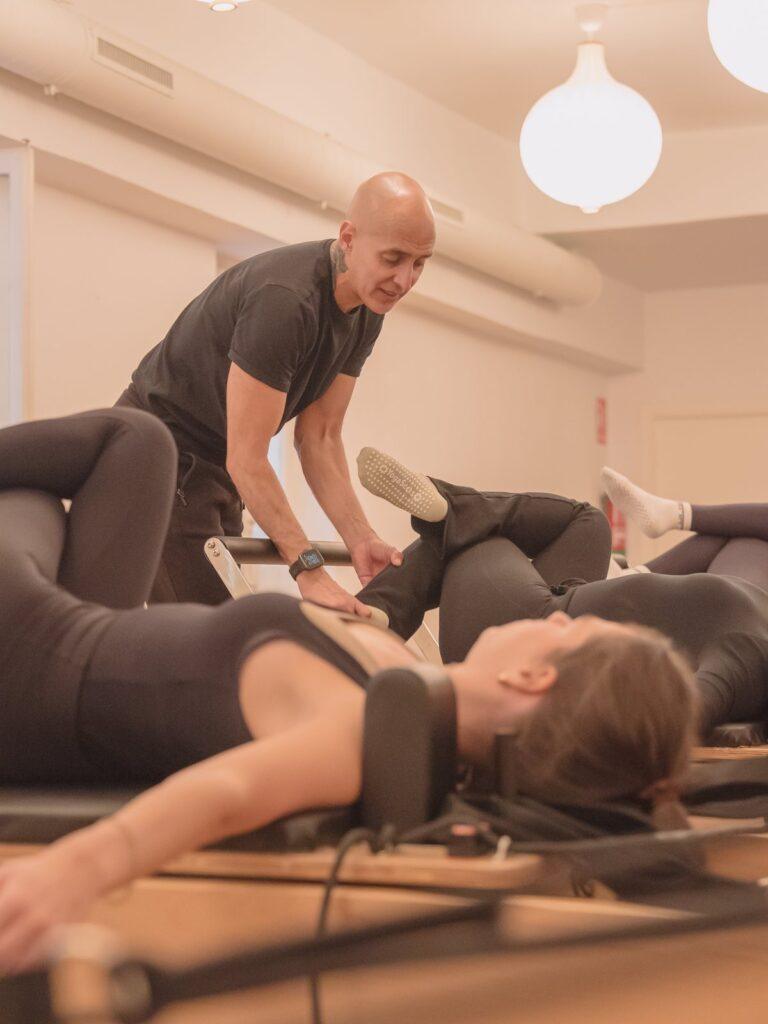
Groups of 8 people maximum. With no more than 8 students per class, the instructor can watch how you perform each movement, correct asymmetries in real time and adjust the spring resistance for each side of your body. This individual supervision is especially important when working with an asymmetric condition such as scoliosis.
Progressive adaptation. The first sessions focus on basic exercises that assess your movement pattern: where there is stiffness, where there is weakness, how your pelvis behaves, how your chest breathes. From that dynamic assessment, asymmetric work is introduced gradually.
A complement, not a substitute. We see Pilates as a complement to medical treatment. We do not replace the orthopaedic surgeon or the physiotherapist. If your doctor prescribes a brace, we respect it. If they set movement restrictions, we follow them. Our role is to maximise the benefits of exercise within the limits your condition sets.
Pinar Pilates is rated 4.9 out of 5 on Google with more than 490 reviews. We offer more than 40 classes a week, with prices from €100 a month (4 classes) up to the unlimited plan at €250 a month.
We help you choose a class
Have scoliosis and not sure which class to choose?
Start with a Basic level class if you have never done reformer Pilates, or Multilevel if you have tried it before. Groups are 8 people max and the teacher adapts every exercise to your body and your level, so let them know what is going on before you start. Your first class is 50% off.
Would you rather we advised you? Message us on WhatsApp at +34 611 994 729 or email hola@pinarpilates.com, tell us what is going on and we will recommend the class that suits you best.
If you have an injury or pain that has not been assessed yet, check with your doctor or physiotherapist first and always follow their advice: our recommendation is only about which class to choose and does not replace their judgement.
Frequently Asked Questions
Can Pilates correct scoliosis?
Pilates does not correct structural scoliosis (where the vertebrae are rotated and deformed). What it can do, according to the meta-analysis by Gou et al. (2021), is reduce the Cobb angle in mild curves, decrease pain, improve asymmetric posture and increase quality of life. In functional scoliosis (caused by muscle imbalances), the results can be more significant, because correcting the cause of the imbalance reduces the curve.
Do I need medical clearance to do Pilates with scoliosis?
Yes. Your orthopaedic surgeon must know your type of scoliosis, the degree of curvature and whether there is a risk of progression. With that information, they can approve the practice and set the relevant limitations. This is especially important in adolescents who are still growing, where scoliosis can progress quickly.
How often should I practise?
The studies showing positive results used programmes of 2 to 3 sessions a week for a minimum of 8 to 16 weeks. To maintain the benefits in the long term, 2 sessions a week are enough. One session a week can preserve the gains achieved, but it is not enough to produce significant changes at the start.
Is Reformer Pilates better than mat Pilates for scoliosis?
The Reformer offers concrete advantages for scoliosis: it allows asymmetric work with different resistance for each side, it provides mechanical feedback on alignment (if the pelvis is uneven, the carriage moves unevenly) and it enables traction and decompression exercises that are not possible on the mat. For an asymmetric condition such as scoliosis, that capacity for individualisation makes a significant difference.
Can I do Pilates if I wear an orthopaedic brace?
Yes, in most cases. Many adolescents with scoliosis combine wearing the brace with Pilates sessions, removing it during class. The exercise strengthens the muscles that support the spine when the brace is off and improves tolerance of the brace. Your orthopaedic surgeon must approve this combination.
Do you have scoliosis and want to start strengthening your spine safely? Check with your doctor and, with their approval, book your first class at 50% off at Pinar Pilates. We will assess your case, adapt the exercises to your curve and guide you through every movement.
Call us on +34 611 994 729 if you would like to ask anything before booking. We will be happy to help.
You may also be interested in: Pilates for Back Pain in Madrid, Improving Posture with Reformer Pilates and Reformer Pilates with a Herniated Disc.
Pinar Pilates · Salamanca district, Madrid
Your first reformer class, €15
Groups of 8 people maximum, specialist instructors and more than 40 classes a week. Your first class is half price.
Book my first classCalle del Pinar 8, Madrid · Questions? Message us on WhatsApp