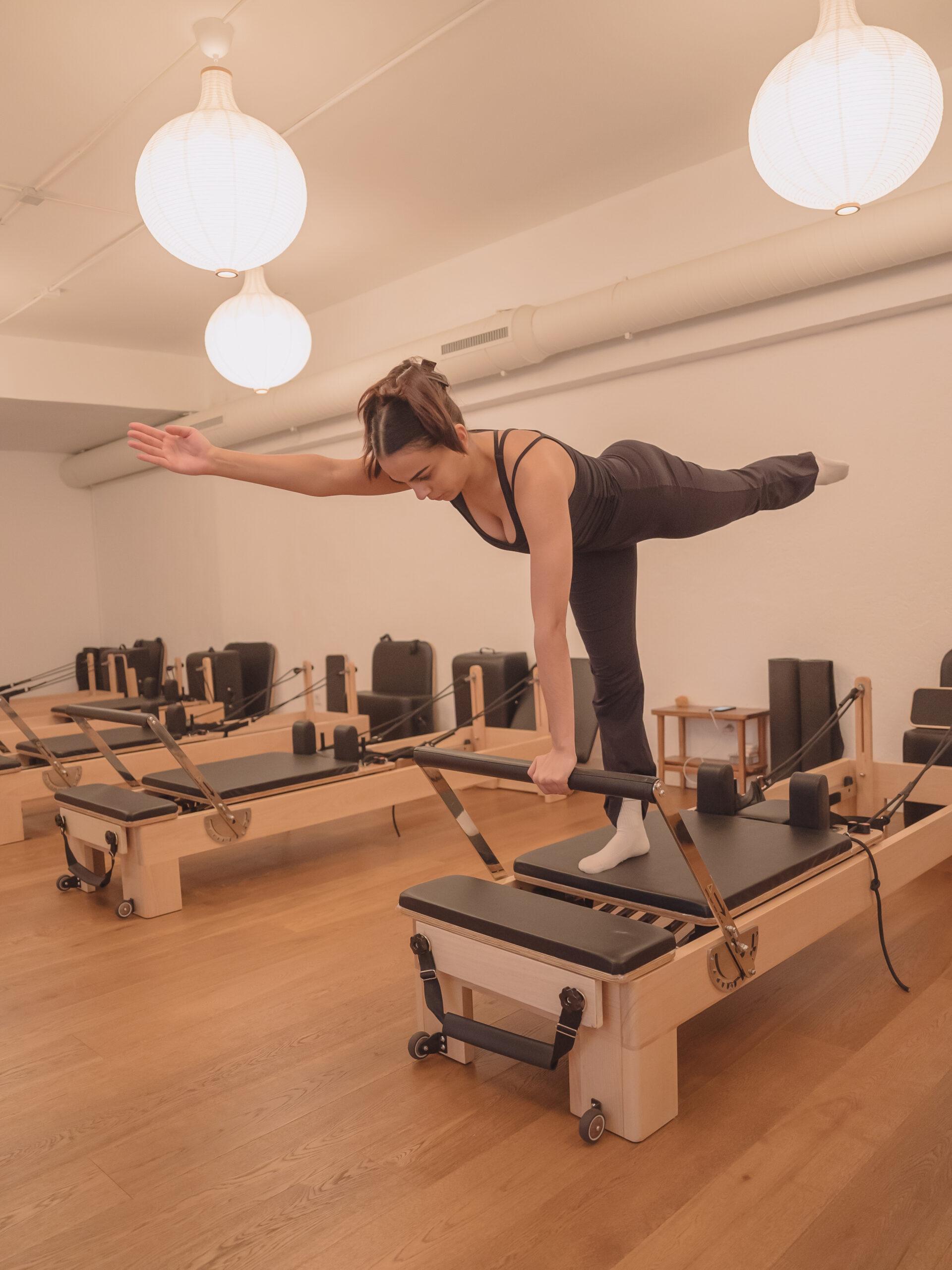
There is a widespread idea worth dismantling from the outset: that after 50 the body no longer responds to exercise the same way, and that the best thing is “not to push it”. Science says exactly the opposite. After 50, exercise becomes more important, not less. And Reformer Pilates in particular is one of the most complete and safest tools for keeping strength, balance and independence over the years.
If you are over 50 and thinking about starting, or if you have been hesitating for a while, this article is for you. Here you will find out why your body needs this kind of movement now more than ever, what the science says, which exercises are especially useful and how it works in practice at Pinar Pilates.
Why Exercise Becomes More Important After 50
From the age of 50, the body goes through a series of physiological changes that, if not addressed, speed up over time. Their intensity is not inevitable. They can be modified. But that requires action.
Sarcopenia: loss of muscle mass
Sarcopenia is the progressive loss of muscle mass and strength associated with ageing. It starts to become noticeable from the age of 40-50 and can reach a 3% to 8% loss of muscle mass per decade if nothing is done about it, according to data published in Current Opinion in Clinical Nutrition and Metabolic Care (Doherty, 2003). The consequences are concrete: less strength for everyday tasks, more fatigue, a higher risk of falls and loss of independence.
Resistance exercise, such as Reformer Pilates, is the only stimulus capable of reversing this trend.
Loss of bone density
From 50 onwards, and especially after the menopause in women, bone density declines at an accelerated rate. This increases the risk of fractures from minimal impacts. Moderate loaded exercise stimulates bone remodelling. Reformer Pilates, working against spring resistance and body weight, provides that necessary mechanical stimulus without the impact of higher-risk sports. If you have diagnosed osteoporosis or risk factors, you can read more about how the reformer adapts in our article on Reformer Pilates and osteoporosis.
Declining balance and risk of falls
Falls are the leading cause of traumatic injury in people over 65 in Spain, according to the Ministry of Health. Balance depends on three systems that age at different rates: the vestibular, the visual and the proprioceptive. Pilates specifically trains proprioception, the body’s ability to know where it is in space, which translates into real, measurable improvements in balance and a lower risk of falls.
Joint stiffness and loss of mobility
With the years, connective tissues lose elasticity. Joint mobility decreases, making everyday activities such as bending down, turning your head or climbing stairs more of an effort. The mobility work built into Reformer Pilates, performed within a controlled range and with the assistance of the spring system, lets you recover and maintain that mobility safely.
Why the Reformer Is Especially Suitable for the Over-50s
There are many ways to exercise. What makes Reformer Pilates particularly suitable for people over 50 is not only what it trains, but how it trains it.
Assisted resistance, not only resisted. The reformer springs can act in both directions: as resistance and as assistance. This means that if a movement is hard to complete, the spring can help you do it with correct form, something impossible with free weights or conventional machines.
Horizontal position in many exercises. Much of the work on the reformer is done lying down or reclining. This reduces the impact on the weight-bearing joints, especially the knees, hips and lumbar spine, and lets you work with intensity without the discomfort that a loaded standing position would cause.
Precisely adjustable resistance. The reformer springs allow the resistance to be adjusted very precisely, which makes it possible to start with very light loads and progress gradually and safely.
Low joint impact. Unlike running, aerobics or racket sports, Reformer Pilates generates no repetitive impacts on the joints. This makes it especially suitable for people with mild or moderate osteoarthritis, knee or hip problems, or who simply want to look after their joints in the long term.
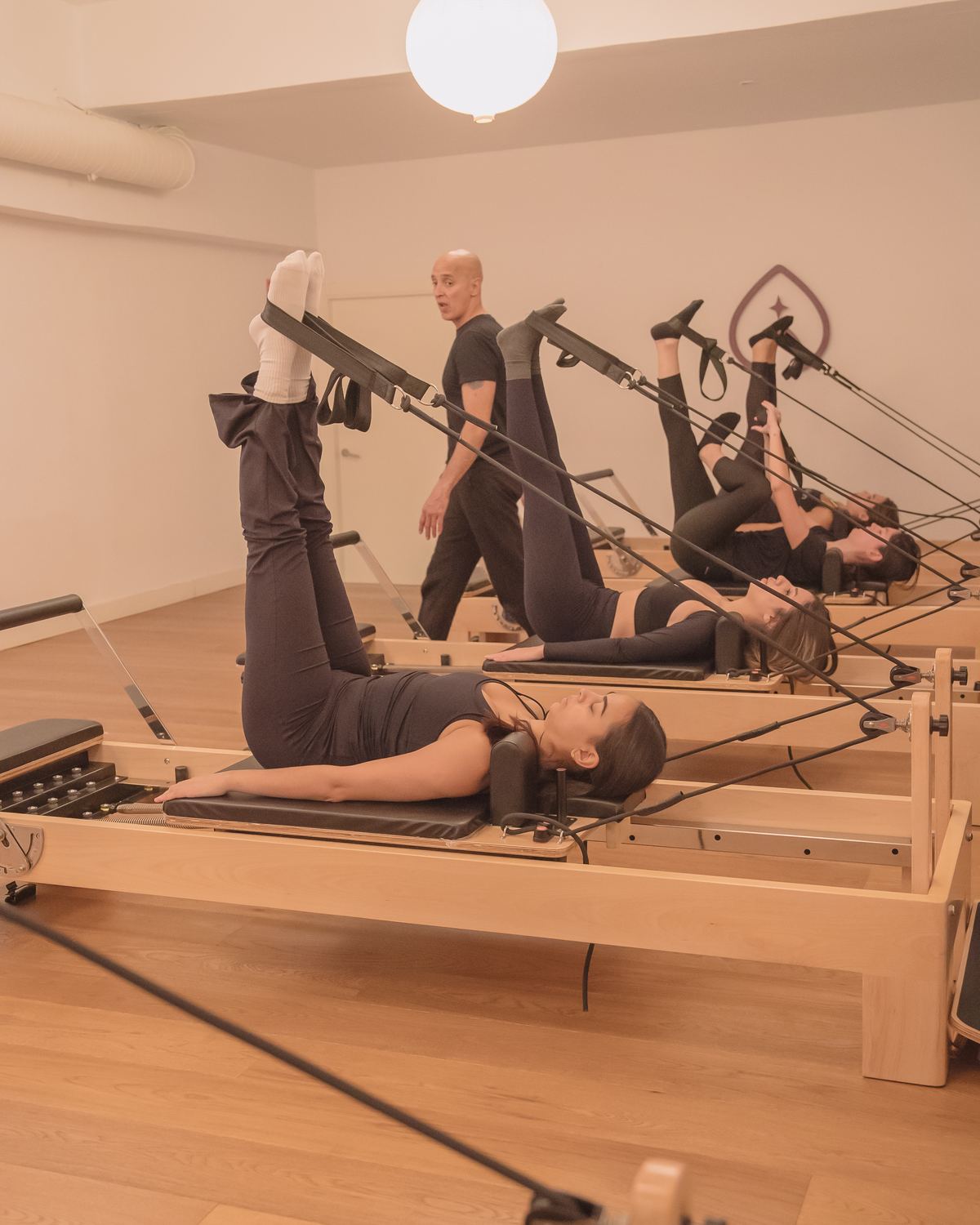
Constant supervision and adaptation. In small groups, like those we offer at Pinar Pilates (8 people maximum per class), the instructor can attend to each student’s technique, something that does not happen in crowded classes.
What the Science Says about Pilates in the Over-50s
The scientific evidence on the benefits of Pilates for older people is solid and growing.
A meta-analysis published in PLOS ONE (Bueno de Souza et al., 2018) analysed 10 randomised controlled trials in older people and concluded that Pilates produces significant improvements in dynamic and static balance, with effects comparable or superior to other exercise programmes.
A systematic review published in Ageing Research Reviews (Patti et al., 2021) reviewed 28 studies on Pilates in older adults and concluded that Pilates produces statistically significant improvements in muscle strength, flexibility, balance, gait and perceived quality of life, with a very favourable safety profile.
Specifically on fall prevention, Irez et al. (2011) published in the Journal of Sports Science and Medicine a study of women over 65 in which a 12-week Pilates programme produced significant improvements in balance, flexibility and reaction time, all factors directly related to the risk of falls.
5 Reformer Exercises Especially Beneficial for the Over-50s
These exercises are regulars in our classes and are especially useful for this age group. All of them can be modified according to each person’s level and needs.
1. Footwork
Lying on the carriage with the feet on the footbar, you extend and bend the legs against the resistance of the springs. It is the foundation exercise of the reformer and works the quads, hamstrings, glutes and calves safely and with control. Because it is done horizontally, it removes the axial load on the knees and the spine. It strengthens the leg muscles with no risk of impact.
2. Leg Circles
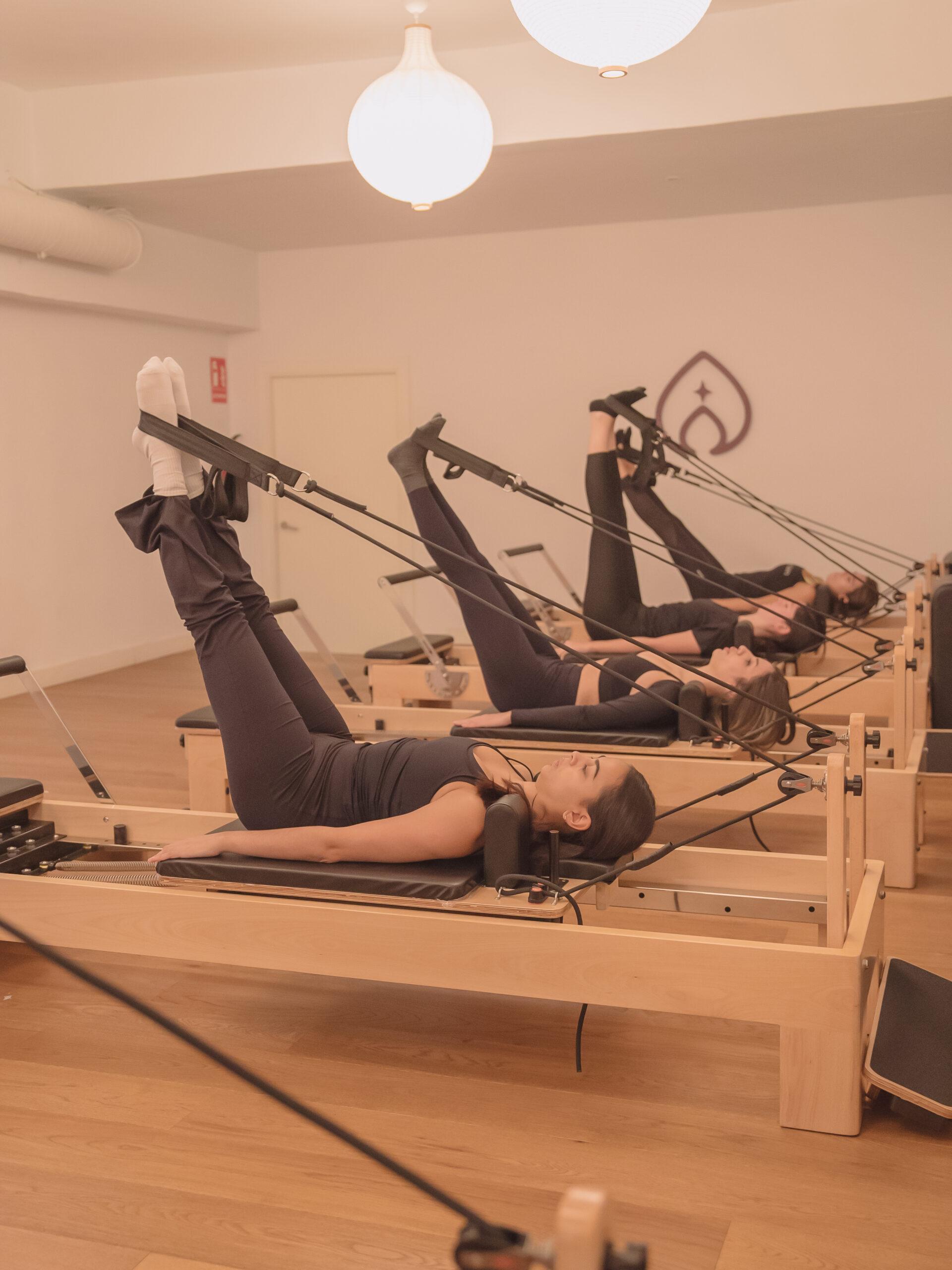
With the legs in the reformer straps, you draw controlled circles that move the hip joint through its full range. This exercise improves hip mobility, works the stabilising muscles of the core and helps maintain joint lubrication. It is especially valuable for people with stiff hips or who spend many hours sitting.
3. Long Spine Massage
A spinal mobility exercise that works the spine segment by segment, with the springs helping the movement. It reduces intervertebral stiffness, improves body awareness and is highly valued by students with built-up lower or mid-back tension.
4. Side Lying Series
Lying on your side on the carriage, with the feet in the straps, you work the abductor and rotator muscles of the hip. This area is critical for pelvic stability and fall prevention. It is a moderate-intensity exercise that adapts easily to each student’s level.
5. Seated Row
Seated on the carriage with the feet on the footbar and the hands in the straps, you perform pulling movements that work the upper back muscles, biceps and rhomboids. This exercise counters the rounded, forward-stooped posture that becomes more pronounced with age and compromises both appearance and breathing function.
Specific Benefits for the Over-50s That Go Beyond the Body
Preventing falls and keeping your independence
The main threat to independence in later life is not a specific illness, but the combination of muscle weakness and balance problems that lead to falls. Reformer Pilates works on both factors systematically. Improving leg strength and core stability translates into greater confidence walking, climbing stairs or getting up from a chair.
Cognitive benefits
Physical exercise has well-documented neuroprotective effects. A study published in Frontiers in Aging Neuroscience (2021) showed that Pilates improves executive function, working memory and attention in older adults. The concentration that Reformer Pilates demands, where breathing, movement and alignment have to be coordinated at the same time, may contribute to these cognitive benefits in a specific way.
Social connection and emotional wellbeing
Small-group classes, like those taught at Pinar Pilates, are not only training sessions. They are a regular meeting place with people who share similar interests. Social connection is one of the most important wellbeing factors in the second half of life, and the format of group classes with a maximum of 8 students encourages genuine relationships between participants.
Answers to the Most Common Fears
“I’m over 60, it’s too late to start”
There is no age limit for starting Reformer Pilates. The studies cited above include participants up to 80 years old and show significant improvements across all groups. What matters is not the age you start, but starting at the right level and progressing gradually.
“I’m not flexible, I won’t manage the exercises”
Flexibility is a result of training, not a prerequisite. The reformer lets each exercise be done within the range of movement available to each person. Nobody expects you to arrive flexible: the aim is for you to gain flexibility little by little.
“I’ve never exercised regularly”
Many of our students over 50 start with no previous exercise history at all. Reformer Pilates is particularly suitable for beginners because the spring resistance can be set very low and the movements are learned progressively. If starting from scratch worries you, our article on Pilates on machines for beginners can help you understand what to expect.
“I have back or joint problems”
That is precisely why Reformer Pilates can be a good option. The horizontal position, the adjustable resistance and the instructor’s supervision allow safe work in the presence of many physical limitations. It is important to tell your instructor about any previous medical condition and, if in doubt, check with your doctor before starting. You can review the contraindications of Reformer Pilates for a clear picture of when it is not appropriate.
How It Works at Pinar Pilates for People Over 50
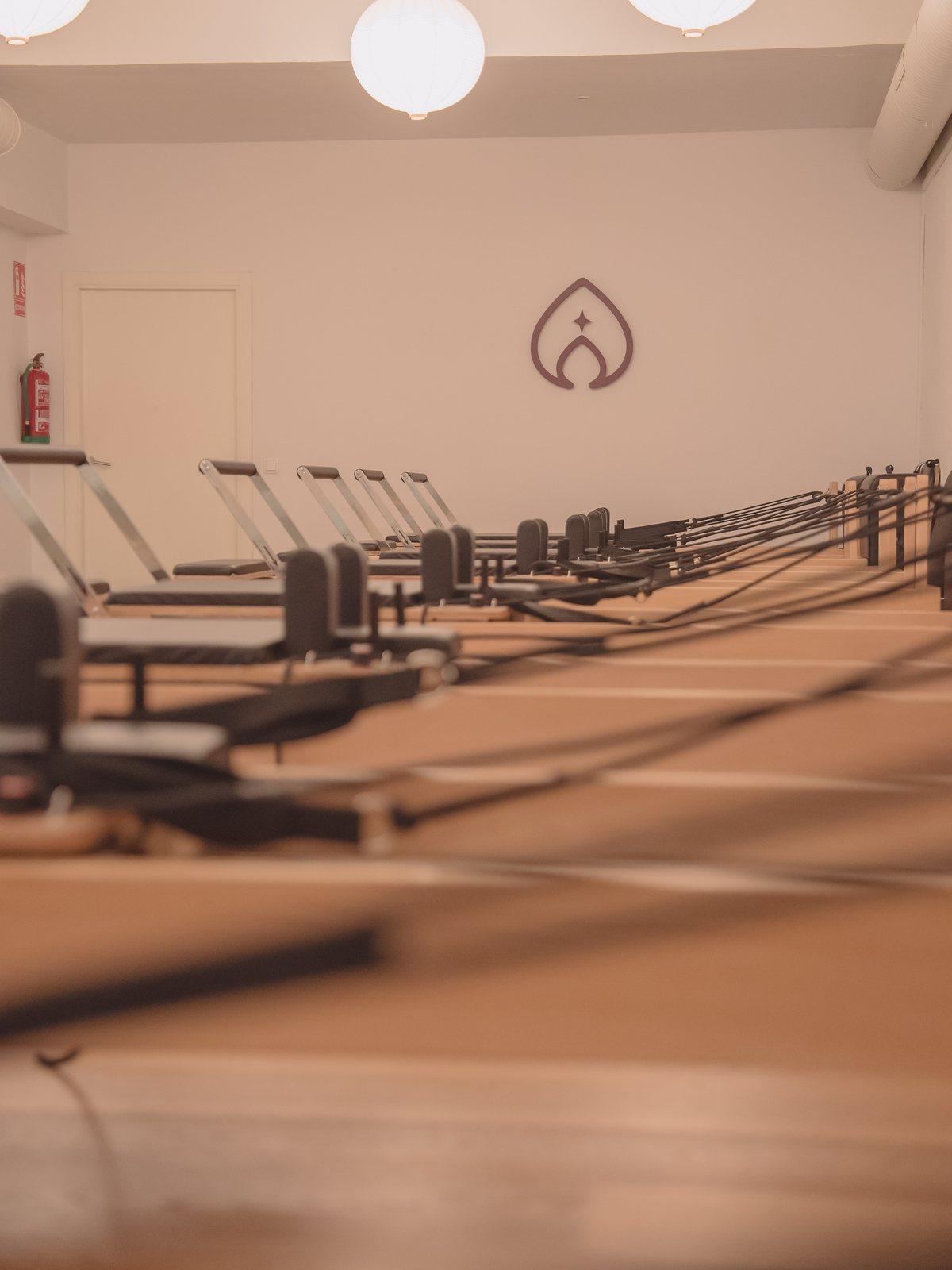
At Pinar Pilates, in the Salamanca district, we work with a model designed so that every student gets real attention, not token attention.
Classes have a maximum of 8 people. This is no small detail: it means the instructor can see your technique at all times, correct in real time and adapt the exercises if something is not working for you that day. There is no “crowded class where nobody watches you” format.
Our team of instructors, made up of Giuliana Di Giovanni, Gabriela Seminara, Camila T, Montserrat Sierra and Abel Gomez, has experience with students of every level and age, including people who have never exercised regularly or who arrive with specific physical conditions.
We offer more than 40 classes a week at different times, which makes it easy to find a slot that fits your routine. And if you do not know where to start, the first class is 50% off precisely so you can try it with no commitment.
The benefits of Reformer Pilates are real and backed by science. But the only way to know whether it is right for you is to experience it for yourself.
Prices:
– Single class: €30
– 4-class plan: €100
– 8-class plan: €150
– 12-class plan: €200
– Unlimited plan: €250/month
– First class: €15 (50% off)
Frequently Asked Questions about Reformer Pilates for the Over-50s
How often should I practise Reformer Pilates to see results?
Most of the studies showing significant improvements in balance, strength and mobility in older adults use programmes of 2 to 3 sessions a week for a minimum of 8-12 weeks. At that frequency, changes are noticeable within a few weeks. Once a month is not enough to produce physiological adaptations; once a week brings benefits but at a slower pace. Ideally, start with two sessions a week and adjust according to how you respond.
Is Reformer Pilates safe if I have osteoarthritis in my knees or hips?
In most cases, yes. The horizontal position and adjustable resistance let you work the muscles around the joint without overloading the affected joints. In fact, strengthening the muscles surrounding an arthritic joint is one of the recommended treatment strategies for reducing pain and improving function. It is key to tell your instructor about your condition and, if in doubt, to check first with your orthopaedic specialist or rheumatologist.
Can I do Reformer Pilates if I have had a recent fracture or a joint replacement?
It depends on the type of fracture, the time elapsed and your doctor’s instructions. In general, Reformer Pilates can be reintroduced gradually once your doctor gives the go-ahead, since impact is minimal and the resistance is fully adjustable. The important thing is to let the studio know so the instructor can adapt the exercises from day one.
How is a Pilates class for older people different from a standard class?
At Pinar Pilates we do not separate classes by age: there are classes by level and focus classes open to all levels. Basic and multilevel classes are perfectly suitable for people over 50 with no previous experience. What varies is the pace, the choice of exercises and the level of assistance from the instructor. With groups of 8 people maximum, the personalisation is real whether or not there is a “senior class” label.
Can Reformer Pilates help with hot flushes and other menopause symptoms?
Regular physical exercise has documented effects on reducing the frequency and intensity of hot flushes, according to a review published in Menopause (Daley et al., 2015). Exercise also helps regulate mood, improve sleep and maintain body weight, all factors affected by the menopause. Reformer Pilates, being low-impact and highly effective for the muscles, is an especially suitable option during this stage.
Where to Start
The time to start is now. Not when you are “more flexible”, not when you “feel better”, not “after the summer”. The body responds to exercise at any age, but the time you lose cannot be recovered.
At Pinar Pilates, at Calle del Pinar 8, 28006 Madrid (Salamanca district), you will find classes with a maximum of 8 people, instructors with real experience of students of every level and age, and an atmosphere where nobody will judge you for starting from scratch.
More than 490 Google reviews (average 4.9 out of 5) are not a marketing figure: they are the experience of real people who have found in this studio the place to keep looking after themselves.
For any questions beforehand, you can call us on +34 611 994 729. We will be happy to answer your questions and help you find the timetable that suits you best.
Book your first class at 50% off
Pinar Pilates · Salamanca district, Madrid
Your first reformer class, €15
Groups of 8 people maximum, specialist instructors and more than 40 classes a week. Your first class is half price.
Book my first classCalle del Pinar 8, Madrid · Questions? Message us on WhatsApp