Important medical notice: this article is for information purposes only and in no case replaces the judgement of a doctor, orthopaedic specialist, physiotherapist or other healthcare professional. Before starting any Pilates or exercise programme during or after an injury, it is essential that you have express medical authorisation. Every injury, every body and every recovery process is different. What works for one person may be contraindicated for another, even with similar diagnoses. Always consult your specialist before taking any step.
When an injury takes you out of exercise, the inevitable question is: when and how can I go back? Physiotherapy helps you recover basic movement, but between being discharged by the physiotherapist and resuming your usual activity there is a gap that many people navigate without clear guidance. The Reformer fills that gap better than almost any other tool available. Not as a substitute for physiotherapy, but as an intelligent bridge between clinical treatment and a fully active life.
At Pinar Pilates, in the Salamanca district, we work with students at different stages of recovery: from people who have just been discharged after surgery to athletes managing recurrent muscle injuries. This article explains why the Reformer works so well in rehabilitation, which injuries it has the greatest impact on and how the work is adapted to each phase of the process.
The 4 Phases of Rehabilitation and the Role of the Reformer in Each
Recovery from an injury is not linear, but it does follow a recognisable sequence. Knowing which phase you are in helps you understand what kind of work is appropriate and what is not.
Phase 1: Acute (0 to 7-10 days)
This is the period immediately after the injury or surgery. The tissue is inflamed, the pain is intense and the main goal is to protect the area, control the inflammation and avoid complete disuse. In this phase, the Reformer does not come into play. The work is the exclusive domain of the physiotherapist, who applies manual techniques, electrotherapy and controlled passive mobilisations.
Phase 2: Subacute (weeks 1 to 4-6, depending on the injury)
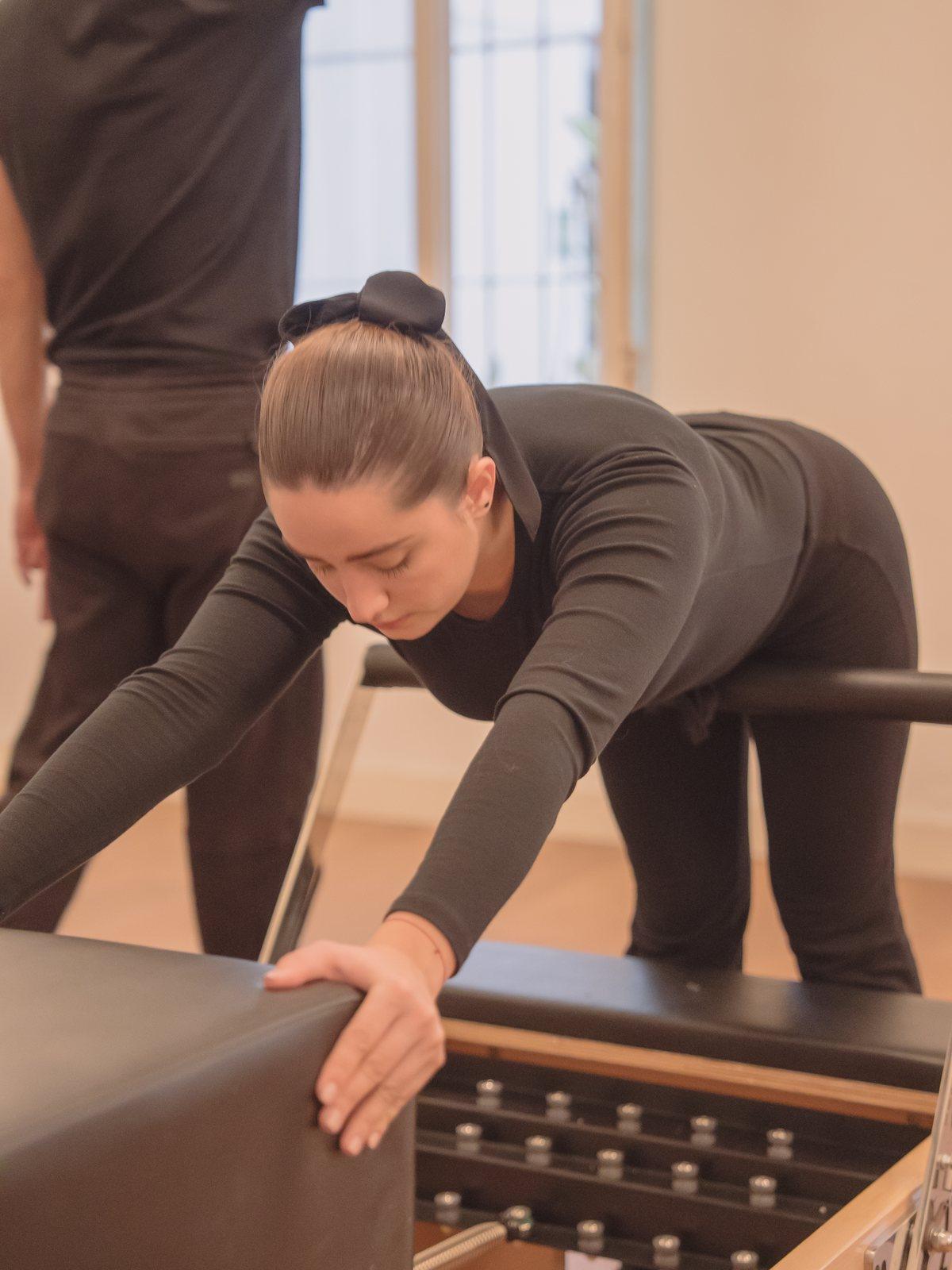
The inflammation subsides, the tissue begins to heal and the goal is to recover range of motion without overloading the structures under repair. Here the Reformer can start to contribute, always with coordination between the physiotherapist and the Pilates instructor. The exercises are low resistance, restricted range and in a horizontal position, which reduces the gravitational load on the affected joint. Movement assisted by the Reformer springs allows work without the active effort that would be premature at this stage.
Phase 3: Strengthening (weeks 4-6 onwards)
The tissue has healed enough to tolerate progressive load. The goal now is to recover muscle strength, joint stability, proprioception and motor control. The Reformer shines in this phase: the adjustable resistance allows precise, safe progression, with small increments that free-weight exercise cannot offer. Open- and closed-chain work, stabilisation exercises and the integration of functional movement patterns are the core of this stage.
Phase 4: Return to Activity
The final goal is to recover the functional capacity you had before the injury: going back to sport, to physical work or simply to everyday activities without fear of relapse. Here the Reformer serves to consolidate strength, work on specific endurance and retrain the movement patterns that were altered by the injury. This phase can last weeks or months, depending on the level of physical demand the person wants to return to.
Common Injuries Where the Reformer Speeds Up Recovery
Knee Surgery: Ligaments and Meniscus
Knee injuries are among the most common in athletes and active people. After an anterior cruciate ligament (ACL) reconstruction or a meniscectomy, the quadriceps rapidly loses strength through neuromuscular inhibition. The Reformer allows the quadriceps to be worked in a horizontal position with the Leg Press, adjusting the resistance to the exact level the joint tolerates at any given moment. The lying position reduces joint load compared with standing exercises, which makes it possible to start strengthening earlier without putting the healing tissue at risk. If you want to go deeper into knee work on the Reformer, you can read our article on knee pain.
Hip Surgery: Replacement and Arthroscopy
After a hip arthroplasty or arthroscopy, the main challenge is to recover gluteus medius function and re-establish pelvic stability without forcing the joint. The Reformer allows unloaded hip abduction and extension work, with minimal resistance at the start. The supine or side-lying position removes gravitational load and allows the periarticular muscles to be isolated before moving on to weight-bearing exercises. Standing work on the sliding carriage (Reformer standing work) is introduced once the joint tolerates full body weight.
Shoulder Surgery: Rotator Cuff and Dislocations
The rotator cuff is an injury that, operated on or not, requires meticulous muscular rehabilitation. The scapular stabilising muscles (serratus anterior, lower trapezius, rhomboids) need to be retrained in coordination with the shoulder rotators. The Reformer allows the upper limb to be worked with low resistance in positions that do not compromise the glenohumeral joint, progressing gradually to pushing and pulling exercises in standing. You can find more information in our article on shoulder pain.
Ankle and Knee Sprains
After a sprain, even a moderate one, the joint’s proprioception is altered: the brain loses reliable information about joint position and the muscle reacts late to changes in terrain. The Reformer offers a controlled platform for retraining proprioception with no risk of relapse. The footbar and the moving carriage create graduated instability that challenges the balance systems progressively and safely.
Healed Fractures and Muscle Injuries
A healed fracture can leave the limb with muscle atrophy, joint stiffness and fear of movement. The Reformer makes it easier to recover mobility and strength in an environment where the student feels safe: the carriage glides smoothly, the resistance is constant and predictable, and at no point is there a risk of falling. Muscle injuries (tears, fibre ruptures) also benefit from the Reformer’s ability to work the muscle through partial ranges with controlled eccentric load, which is the most effective stimulus for muscle tissue regeneration.
Spinal Injuries: Herniated Discs and Low Back Pain
People who have been through a herniated disc treated conservatively or surgically are often afraid to load the spine. The Reformer allows work in a horizontal position with the spine in neutral, without the axial compression that standing exercise involves. Our article on herniated discs explains in detail how the work is adapted to this specific diagnosis.
Why the Reformer Beats Floor Exercise for Rehabilitation
This is a question that deserves a clear answer, because many healthcare professionals still recommend “mat Pilates” without distinguishing between modalities. The differences are relevant in the context of rehabilitation:
Adjustable, progressive resistance. The Reformer springs offer between 1 and 5 levels of resistance that can be combined with each other. This makes it possible to start with minimal loads and progress in fine increments, something impossible with body weight on the floor, where the load is fixed.
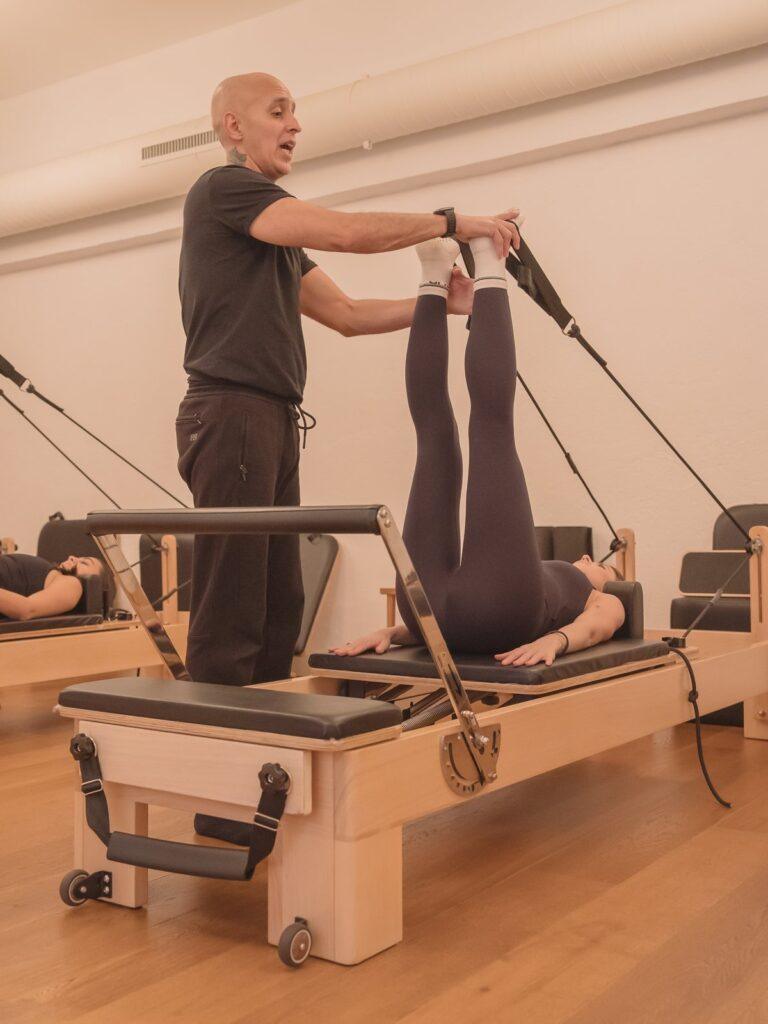
Assisted movement. In early phases, the springs can act as assistance rather than resistance: they help the student complete the range of motion when the muscles are not yet strong enough to do it actively. This speeds up the recovery of mobility without overloading the tissue.
Horizontal position. Most Reformer work is done lying on the back or side, which removes gravitational load from the affected joint. For knees, hips and spines in recovery, this difference is key.
Controlled environment. The Reformer has physical limits to movement: the carriage cannot go beyond certain points, the feet rest on a stable bar and the straps offer tactile references. This reduces the risk of unwanted sudden movements and gives confidence to people who are afraid to move after an injury.
Precise unilateral work. It is possible to work only the affected limb, compare strength between the two sides and detect compensations. In floor exercise, the healthy side tends to compensate for the weak one, masking the real deficit.
How a Pilates Instructor Adapts the Work for Rehabilitation
A trained Pilates instructor does not diagnose or prescribe treatment. But they can adapt the exercises of the method to each student’s specific situation, always within the framework set by the physiotherapist or doctor responsible for the case.
At Pinar Pilates, when a student arrives in a rehabilitation phase, the adaptation process includes the following steps:
Gathering clinical information. The instructor needs to know the diagnosis, the type of intervention performed (if there was surgery), the doctor’s or physiotherapist’s current restrictions, and the time elapsed since the injury. Without this information, it is not possible to work safely.
Selecting appropriate exercises. Not all Reformer exercises are suitable in every phase. The instructor removes movements that involve contraindicated load, rotation or range of motion, and selects those that allow the target muscles to be worked without compromising the recovering area.
Modifying positions and resistance. The same exercise can be made more or less demanding by changing the body position, the number of active springs or the permitted range of motion. The instructor works with these variables to place the student in the optimal zone: challenging enough to progress, safe enough not to overload.
Gradual, symptom-based progression. In rehabilitation, progression is not guided by weeks on the calendar, but by the body’s response. If the student reports pain during or after the session, we take a step back. If the response is good, we move forward. The instructor records the evolution and reports any relevant change to the physiotherapist.
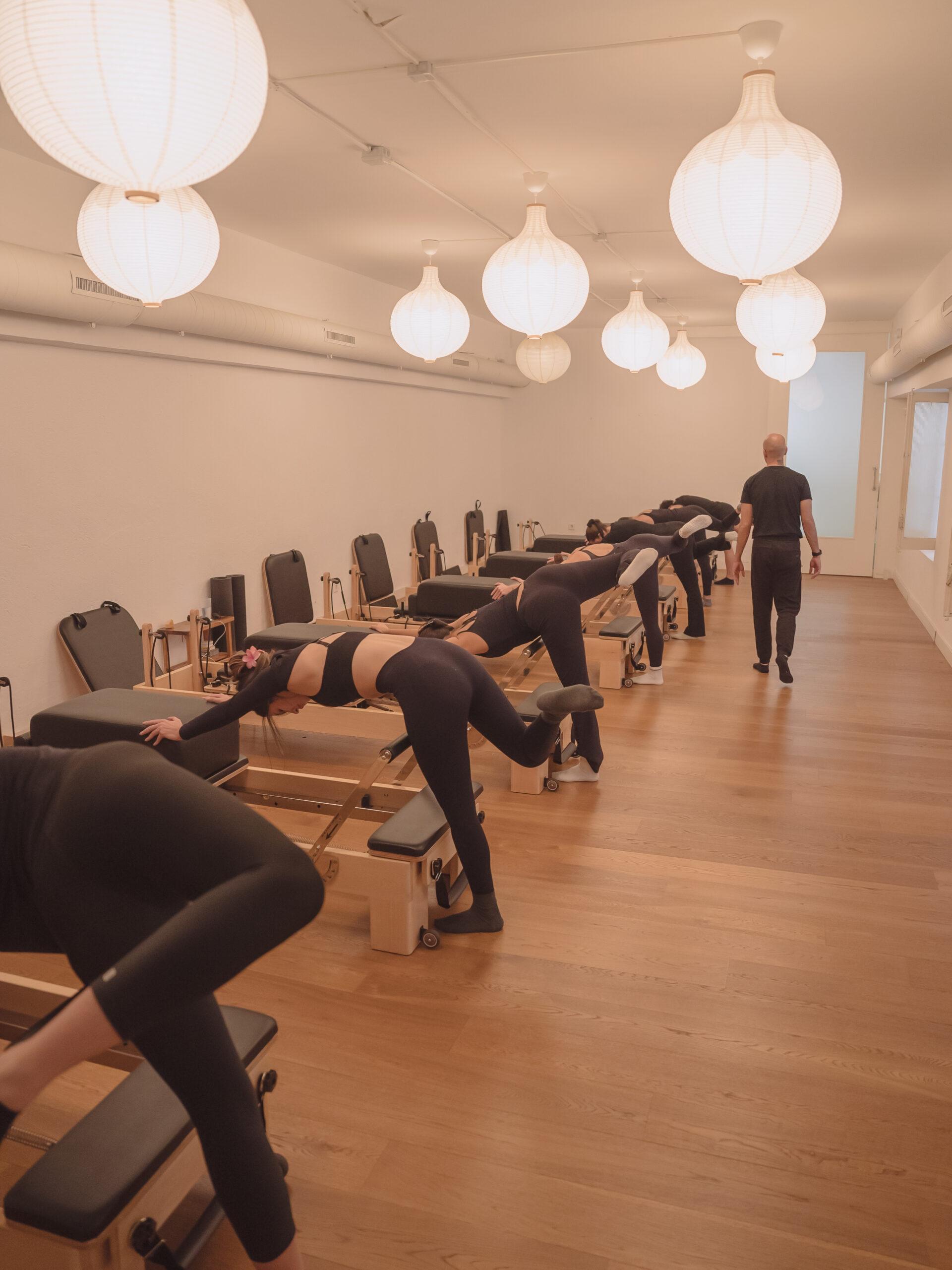
Small classes for more attention. In groups of a maximum of 8 people, like those we offer at Pinar Pilates, the instructor can maintain real supervision of each student throughout the session, something impossible in larger classes.
Collaboration between Physiotherapist and Pilates Instructor
Optimal rehabilitation is not the work of a single professional. Physiotherapy and Reformer Pilates are complementary, not competitors. The physiotherapist manages the acute phase, treats the damaged tissue and sets the limits of safe movement. The Pilates instructor takes over when strength, motor control and functional patterns need to be recovered, within the clinical framework defined by the physio.
This collaboration works best when there is direct communication between the two professionals. Ideally, the student brings a report from their physiotherapist with the current restrictions and the goals of the phase they are in. In some cases, it is useful for the instructor and the physiotherapist to speak directly to coordinate the approach. If your physiotherapist has doubts about whether the Reformer is suitable at your current stage, they can contact us directly on +34 611 994 729 with any questions.
If you are unsure whether Reformer Pilates is suitable for your situation, also see our article on contraindications of Reformer Pilates.
Frequently Asked Questions about Reformer Pilates and Rehabilitation
How long after surgery can I start on the Reformer?
There is no single answer. It depends on the type of surgery, how the post-operative period has gone and what your surgeon or physiotherapist says. In general terms, most post-surgical processes allow Reformer work to begin between 4 and 8 weeks after the operation, but there are cases that start earlier and cases that need more time. Medical authorisation is essential before taking any step.
Can I do Reformer Pilates if I still have pain?
It depends on the type and intensity of the pain. Mild, diffuse pain (2-3 out of 10) that does not increase with movement may be compatible with supervised Reformer work. Sharp, localised pain that increases with movement is a sign that it is not yet the time. Under no circumstances should you force movement through pain. The instructor should always know before the session starts.
Do I need a medical report to sign up for a rehabilitation class?
It is not a legal requirement, but it is highly recommended. Without information about your diagnosis and current restrictions, the instructor cannot adapt the work safely. The more information you have from your doctor or physiotherapist, the better we can help you.
Does Reformer Pilates replace physiotherapy?
No. Physiotherapy and Reformer Pilates have different goals and tools. Physiotherapy treats the damaged tissue, controls inflammation and restores basic movement. The Reformer comes into play to recover strength, stability and functional movement patterns once the physiotherapist has given the go-ahead. They are complementary.
Can I take a normal Reformer Pilates class while recovering from an injury?
In general, it is not the most appropriate option. General classes are designed for people without movement restrictions, and some exercises may be counterproductive in your situation. Ideally you would work in specific rehabilitation classes or in sessions where the instructor is aware of your process and adapts each exercise to your current stage. At Pinar Pilates, with groups of a maximum of 8 people, this level of personalisation is possible.
If you are recovering from an injury and want to know whether the Reformer can help you, the first step is simple: talk to your physiotherapist or doctor, get their go-ahead and then get in touch with us. Our team, made up of Giuliana Di Giovanni, Gabriela Seminara, Camila T, Montserrat Sierra and Abel Gomez, has experience working with students at different stages of rehabilitation and can adapt the work to your situation.
You can read all about what the experience at our studio is like in the article on the first Reformer Pilates class in Madrid.
Pinar Pilates is at Calle del Pinar 8, Madrid (Salamanca district). We offer more than 40 classes a week in groups of a maximum of 8 people, with prices from 30 euros for a single class and a first class at 15 euros (50% off).
For any questions about whether the Reformer is suitable for your recovery process, call us on +34 611 994 729. We will be happy to guide you with no obligation.
Book your first class with 50% off
More than 490 people have rated their experience at Pinar Pilates on Google, with an average of 4.9 out of 5.
Pinar Pilates · Salamanca district, Madrid
Your first reformer class, €15
Groups of 8 people maximum, specialist instructors and more than 40 classes a week. Your first class is half price.
Book my first classCalle del Pinar 8, Madrid · Questions? Message us on WhatsApp