Important notice: this article is for information only and does not replace medical diagnosis or specialist treatment. If you have acute shoulder pain, have suffered a recent injury, have had surgery or have intense inflammation, see your doctor, orthopaedic surgeon or physiotherapist before starting any exercise programme. The exercises described here are a guide and must be adapted to each case under the supervision of a qualified instructor.
Shoulder pain is the third most common musculoskeletal complaint in primary care in Spain, behind only low back and neck pain. According to data from the European Journal of Physical and Rehabilitation Medicine, the global prevalence of shoulder pain ranges from 7% to 34% of the adult population, peaking in people aged 45 to 65. And yet it is one of the parts of the body we rehabilitate worst: the usual protocol is limited to anti-inflammatories, rest and, at best, some physiotherapy.
Reformer Pilates offers a different approach. It does not replace the physiotherapist, but it works as a complement: it strengthens the stabilising muscles, restores range of movement without overloading the injured structures and corrects the postural imbalances that, in many cases, are the origin of the problem.
The Most Common Shoulder Conditions
Before talking about exercises, it helps to understand which kinds of condition can benefit from Reformer work and which need a different approach.
Rotator Cuff Tendinitis
The rotator cuff is made up of four muscles (supraspinatus, infraspinatus, teres minor and subscapularis) that wrap around the head of the humerus and keep it centred in the socket. Supraspinatus tendinitis is the most common: it causes pain when lifting the arm between 60 and 120 degrees (the so-called painful arc), when sleeping on the affected side and during overhead movements.
The cause is usually a combination of accumulated overload, altered shoulder-blade posture and weakness of the external rotators. The Reformer can address all three factors directly.
Frozen Shoulder or Adhesive Capsulitis
Adhesive capsulitis is characterised by a progressive, painful loss of shoulder mobility in every plane, due to retraction and fibrosis of the joint capsule. It most often affects people between 40 and 60, women and people with diabetes. The process evolves in three phases: freezing (intense pain), frozen (predominantly stiffness) and thawing (gradual recovery).
In the frozen and thawing phases, gentle, controlled work on the Reformer can help recover joint range without causing the micro-injuries that forced stretching produces.
Subacromial Syndrome
The subacromial space is the gap between the head of the humerus and the acromion (part of the shoulder blade). When that space narrows, the tendons and the bursa that pass through it are compressed with every lift of the arm. The result is pain, inflammation and, over time, possible tendon deterioration.
Posture is a decisive factor: when the shoulders project forward and the shoulder blades separate and rotate downwards (abducted, downwardly rotated scapulae), the subacromial space is mechanically reduced. Strengthening the scapular retractors and the external rotators is the key to conservative treatment.
Shoulder Instability
Instability can be traumatic in origin (a previous dislocation) or atraumatic (ligament hyperlaxity). In both cases, the goal is to strengthen the muscles that make up for the insufficiency of the passive system (capsule, ligaments). The Reformer is especially useful here because it lets you work with progressive, controlled resistance, starting from positions of minimal mechanical demand.
Why the Reformer Is Especially Useful in Shoulder Rehabilitation
The Reformer has three characteristics that make it especially suitable for working a painful shoulder.
Spring-assisted resistance. Unlike free-weight work, where the load is fixed and gravitational, the Reformer springs provide progressive resistance throughout the movement. This makes it possible to start with very little load, fine-tune the intensity and ensure the muscle works under real control. In the early phase of rehabilitation, this is decisive.
Positions without direct gravitational load. Many shoulder exercises on the Reformer are done lying on the back (supine) or on the front (prone), positions in which the arm does not have to fight gravity at its most vulnerable point. This lets you work range of movement without the risk of impingement that exists in an upright position.
Control of range of movement. The straps, the carriage and the supports of the Reformer act as natural limiters of the movement. The instructor can precisely grade how far the movement goes, preventing the student from entering the joint angles where the injured tissue is overloaded.
A clinical trial published in the Journal of Bodywork and Movement Therapies (Dunleavy et al., 2019) showed that a twelve-week Pilates programme produced significant improvements in pain, function and quality of life in patients with chronic shoulder pain, with results comparable to those of a conventional physiotherapy programme. A meta-analysis published in PLOS ONE (Wells et al., 2014), which included twelve randomised controlled trials, concluded that Pilates consistently reduces pain and improves musculoskeletal function in different areas of the body.
6 Reformer Exercises for the Shoulder
The following exercises are the ones we use most often at Pinar Pilates with students who have shoulder discomfort or conditions. All of them can be modified depending on the phase of recovery and the type of condition. Supervision by a qualified instructor is essential to perform them safely.
1. Arm Work with Straps (Lying Down)
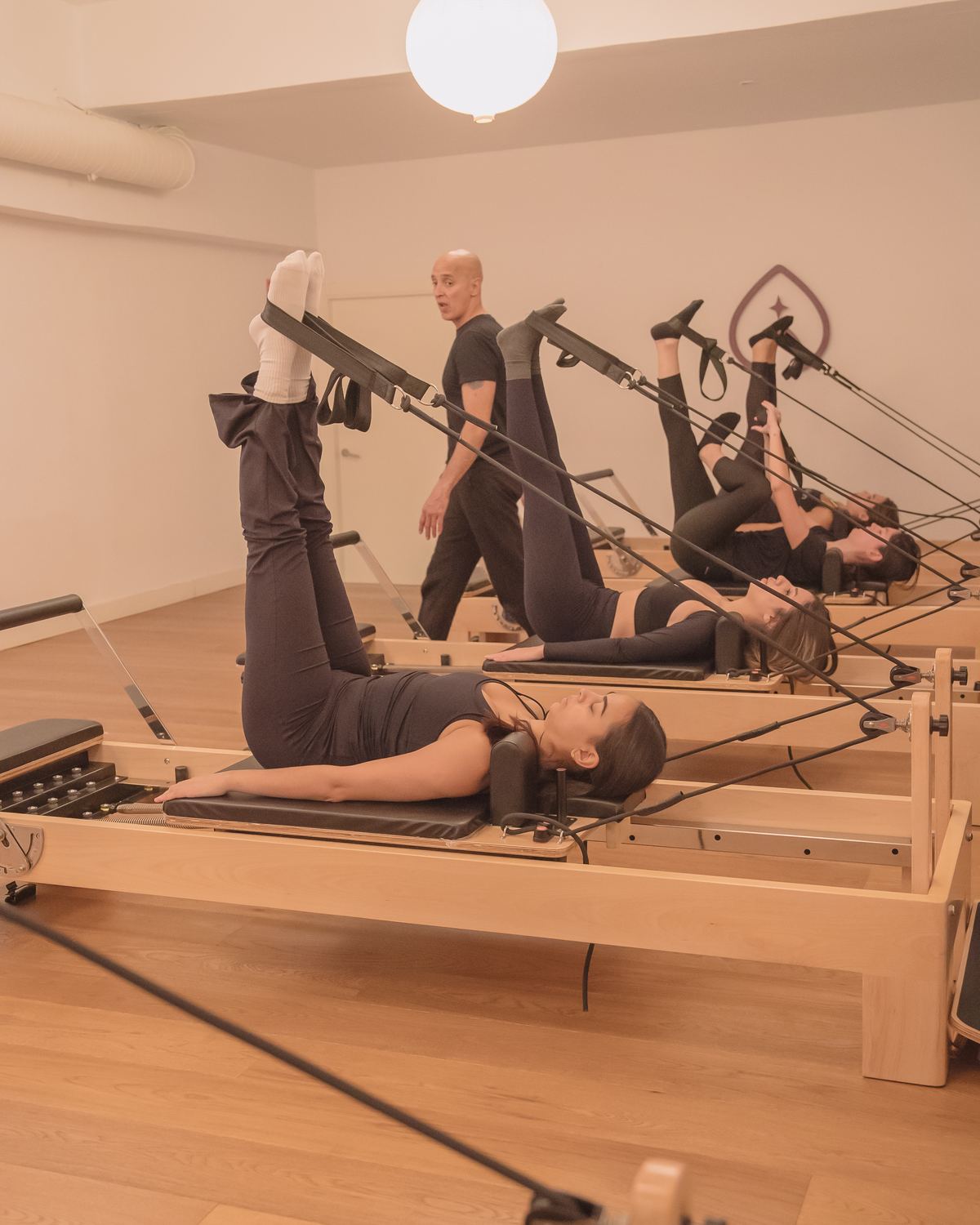
Lying on the back with the feet on the footbar, the student holds the Reformer straps with the arms extended by the sides. From that position, they flex the shoulder, bringing the arms up towards the ceiling, without going past the point of pain and keeping the shoulder blades actively resting on the carriage.
This exercise activates the serratus anterior and the scapular stabilisers without compressing the subacromial space. The spring resistance is set to the minimum in the early phases.
2. Chest Expansion
Kneeling or seated with the back to the springs, the student holds the straps and draws the extended arms backwards, keeping the chest open and the shoulders away from the ears. The return to the front is slow and controlled.
Chest Expansion strengthens the scapular retractors (rhomboids and middle trapezius) and the shoulder extensors (posterior deltoid, latissimus dorsi). It is one of the most effective exercises for correcting rounded, forward shoulders, a pattern that underlies subacromial syndrome.
3. Pulling Straps (Prone)
Lying face down on the carriage with the head towards the springs, the student holds the straps with the arms extended in front. The movement consists of drawing the arms towards the hips while slightly extending the thoracic spine.
This exercise works the infraspinatus, the teres minor and the posterior deltoid: the external rotators that are usually weak in most shoulder conditions. The prone position removes the gravitational load on the shoulder and lets you concentrate on precise activation of the target muscles.
4. Hug-a-Tree
Seated with the back to the springs or lying on the back, the student holds the straps with the arms open to the sides. The movement consists of closing the arms in front as if hugging a tree, keeping a slight bend in the elbow and the shoulders completely away from the ears.
Hug-a-Tree works the pectoralis major and the coracobrachialis, but above all it demands precise scapular control: if the shoulder blades move forward or up during the movement, the exercise loses effectiveness and can be counterproductive in cases of instability. It is always done with low resistance.
5. External Rotation with Strap
With the elbow bent to 90 degrees and tucked into the side, the student holds a strap and performs external rotation of the shoulder against the spring resistance. It is one of the most specific exercises for strengthening the infraspinatus and the teres minor, the main posterior stabilisers of the rotator cuff.
This exercise is especially indicated in the early phases of rotator cuff tendinitis and in recovery from instability. Resistance should be minimal and the range of movement conservative.
6. Modified Overhead Press
For students who have passed the acute phase and can raise the arm without significant pain, the Reformer allows a shoulder press lying on the back against the spring resistance. The horizontal position removes the risk of impingement that exists in the vertical press, and the instructor can limit the range so the movement does not go past the pain threshold.
This exercise restores the functional strength of the deltoid and the rotator cuff in overhead positions, essential for returning to everyday activities such as hanging clothes, reaching shelves or playing sport.
Exercises to Avoid with Shoulder Pain
Knowing which exercises to avoid is as important as knowing which to do. With active shoulder pain, it is best to steer clear of:
- Push-ups or planks while in pain: they generate subacromial compression and overload the cuff in a compromised position.
- Heavy rowing on the Reformer if there is impingement: rowing at certain heights can reproduce the painful arc.
- Lateral raises against high resistance: they cause subacromial compression between 60 and 120 degrees of abduction.
- Open-chain exercises at maximum load: the shoulder needs progressive stabilisation, not maximal loads in the early phases.
- Any exercise that reproduces the student’s specific pain: pain is a signal that must not be ignored during the session.
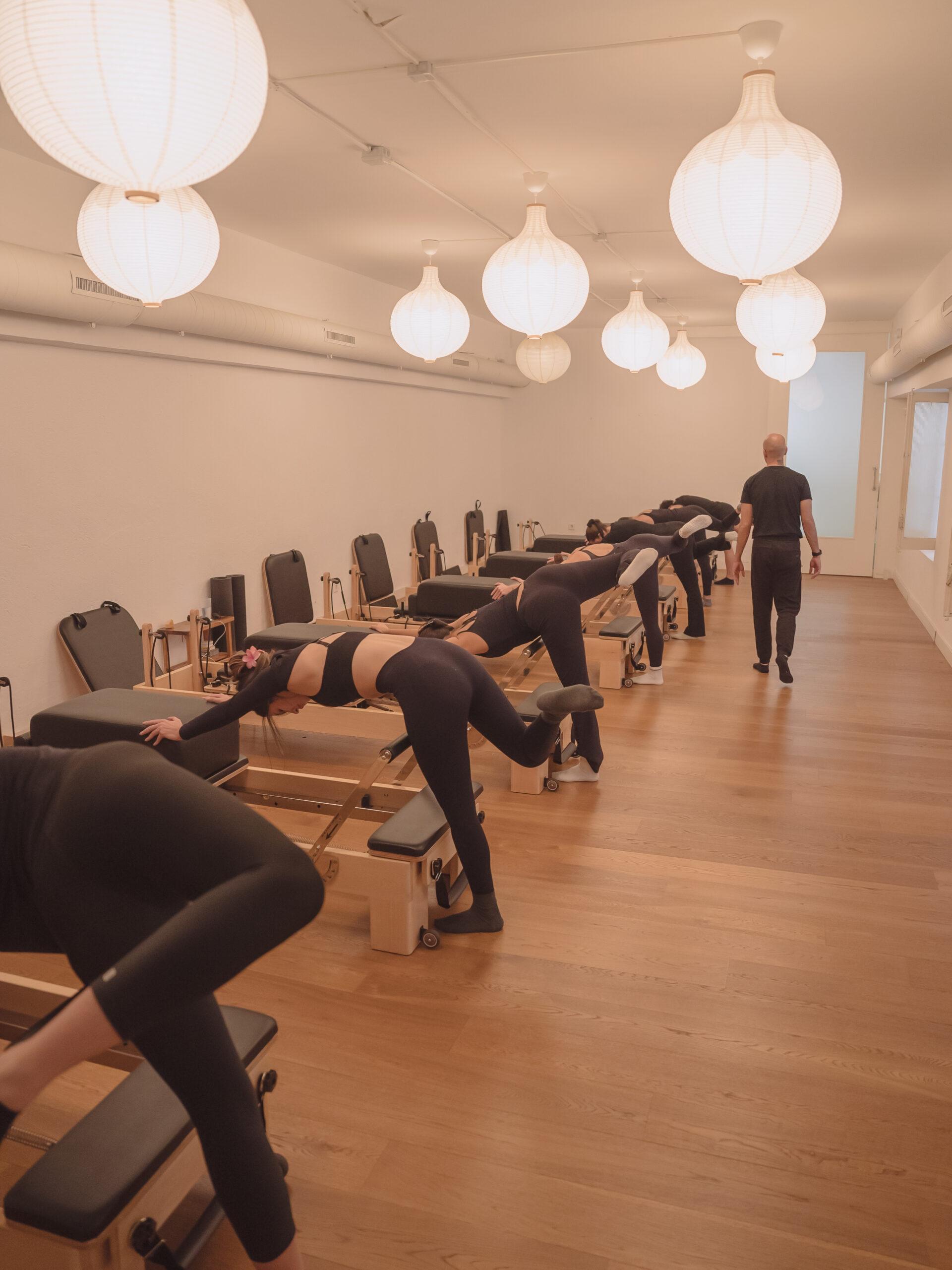
One of the advantages of working in small groups, like those we offer at Pinar Pilates (8 people maximum per class), is that the instructor can watch each student’s execution and correct or modify in real time.
When Pilates Is Not the Answer: Contraindications
Reformer Pilates is a very versatile tool, but there are situations in which it should be postponed or ruled out:
- Acute rotator cuff tear: if there is a recent partial or complete tear, the tissue needs absolute protection. Active exercise can enlarge the injury.
- Post-surgery without medical clearance: after an arthroscopy, a cuff repair or a shoulder replacement, the return to exercise must follow the surgeon’s and physiotherapist’s protocol, never the patient’s eagerness.
- Intense acute inflammation: if the shoulder is hot, swollen and painful at rest, exercise is contraindicated. The inflammation must be controlled first.
- Unhealed fracture: any humeral or clavicular fracture still healing rules out active shoulder work.
For a full review of the situations in which Reformer Pilates is not appropriate, see our article on the contraindications of Reformer Pilates.
Scientific Evidence on Pilates and Shoulder Rehabilitation
The scientific support for Pilates in musculoskeletal rehabilitation has grown considerably in recent years.
Lopes et al. (2017), in a clinical trial published in Archives of Physical Medicine and Rehabilitation, showed that an eight-week Pilates programme notably reduced pain and improved shoulder function in patients with subacromial syndrome, with results superior to the control group on every variable measured.
A study by Elphinston and Pook (2016), published in Physical Therapy in Sport, analysed the role of scapular control in shoulder pain and concluded that exercise programmes that prioritise scapular stabilisation, a pillar of Pilates, produce clinically significant improvements in pain and function.
A systematic review by Cruz-Ferreira et al. (2011), published in Archives of Physical Medicine and Rehabilitation, found strong evidence that Pilates improves flexibility and dynamic balance, and moderate evidence on muscular endurance, in healthy people.
The mechanism by which Pilates acts on shoulder pain is not only muscular: it also influences proprioception (the nervous system’s ability to detect joint position), which is often impaired in patients with chronic shoulder pain. Several studies have documented improvements in body awareness and motor control after supervised Pilates programmes.
Shoulder Pilates in the Context of Overall Posture
The shoulder is not an isolated joint. Its function depends on the position of the cervical spine, the mobility of the thoracic spine and the stability of the core. A chronically painful shoulder is rarely only a shoulder problem: it is usually the visible consequence of an altered overall postural pattern.
That is why, at Pinar Pilates, we address the shoulder within comprehensive postural work. A student with rotator cuff tendinitis can benefit as much from the specific shoulder exercises as from work to improve thoracic mobility, strengthen the core or correct the associated pattern of neck pain.
If you would like to understand how Reformer Pilates acts on posture as a whole, read our article on how to improve your posture with Reformer Pilates.
What to Expect in Your First Class with Shoulder Pain
If you arrive at Pinar Pilates with shoulder discomfort, the first thing the instructor does is a short initial assessment: they ask about your diagnosis, how long you have had the pain, which movements trigger it and your usual activity level. With that information, they adapt the class exercises to your situation.
No two shoulders are the same. Two people with the same diagnosis of supraspinatus tendinitis can have completely different muscle profiles, ranges of movement and pain thresholds. That is why the small-group format, with a maximum of 8 students per class and more than 40 classes a week to choose from, allows a level of attention that is not possible in centres with crowded classes.
To find out more about how the experience is structured from the start, read our guide to the first Reformer Pilates class in Madrid. And if you are curious about the different exercises done on the Reformer beyond the shoulder, our article on Reformer Pilates exercises gives a broader view of the method.
More than 490 people have rated their experience at Pinar Pilates on Google, with an average of 4.9 out of 5.
We help you choose a class
Have shoulder pain and not sure which class to choose?
Start with a Basic level class if you have never done reformer Pilates, or Multilevel if you have tried it before. Groups are 8 people max and the teacher adapts every exercise to your body and your level, so let them know what is going on before you start. Your first class is 50% off.
Would you rather we advised you? Message us on WhatsApp at +34 611 994 729 or email hola@pinarpilates.com, tell us what is going on and we will recommend the class that suits you best.
If you have an injury or pain that has not been assessed yet, check with your doctor or physiotherapist first and always follow their advice: our recommendation is only about which class to choose and does not replace their judgement.
Frequently Asked Questions
1. I have been diagnosed with rotator cuff tendinitis. Can I do Reformer Pilates?
Yes, as long as there is no acute tear and the inflammation is not intense. Reformer Pilates is especially useful for rotator cuff tendinitis because it strengthens the external rotators and the scapular stabilisers that are usually weakened, and does so in positions that avoid the painful arc. It is essential to tell the instructor about your diagnosis before the first class so they can adapt the exercises.
2. I have a frozen shoulder. Can Pilates help me?
It depends on the phase you are in. In the freezing phase, when the pain is very intense, active exercise can be counterproductive. In the frozen and thawing phases, gentle, controlled work on the Reformer can help recover range of movement progressively. Check with your doctor or physiotherapist about when it is appropriate to start.
3. How long does it take to notice improvement in shoulder pain with Pilates?
The studies with the best results use programmes of 8 to 12 weeks, with two or three sessions a week. In clinical practice, many students report a subjective improvement in pain and ease of movement from four to six weeks. Consistency is decisive: one session a week produces slower results than two or three.
4. Can I do Pilates while I am still having physiotherapy for my shoulder?
In general yes, and in fact the combination is usually synergistic: physiotherapy addresses the most acute phase (ultrasound, mobilisations, manual techniques) and Pilates consolidates the results through strengthening and postural awareness. Ideally the physiotherapist and the Pilates instructor should be in contact to coordinate the work. If in doubt, ask your physiotherapist.
5. What is the difference between doing Reformer Pilates for the shoulder and conventional physiotherapy exercises?
Conventional physiotherapy works in a very specific way, targeted at the injured tissue, which is ideal in acute phases. Reformer Pilates works the shoulder within a context of global movement: scapular stabilisation, core control, postural awareness and coordination of complete kinetic chains. The two approaches are complementary, not mutually exclusive.
Shoulder pain does not have to be chronic or limit your life. With the right approach, recovery is possible, and Reformer Pilates can be an important part of that process.
At Pinar Pilates we work with instructors specialised in therapeutic work: Giuliana Di Giovanni, Gabriela Seminara, Camila T, Montserrat Sierra and Abel Gomez. Our classes at Calle del Pinar 8, 28006 Madrid (Salamanca district), with a maximum of 8 students per session, allow the individual attention that makes the difference when the body needs something more than exercise.
You can call us on +34 611 994 729 or book directly online.
Book your first class at 50% off
Pinar Pilates · Salamanca district, Madrid
Your first reformer class, €15
Groups of 8 people maximum, specialist instructors and more than 40 classes a week. Your first class is half price.
Book my first classCalle del Pinar 8, Madrid · Questions? Message us on WhatsApp