Important medical notice: this article is for information only and does not replace diagnosis or treatment by your doctor or physiotherapist. Hip pain can have very different causes, some of them serious, that require medical assessment before starting any exercise programme. The exercises described here are a guide and must be adapted to each case under the supervision of a qualified instructor who knows your diagnosis. If you have sudden-onset hip pain, fever, an inability to bear weight on the leg or a recent trauma, see your doctor before exercising.
The hip is one of the most complex joints in the body and, at the same time, one of the most exposed to chronic pain. Trochanteric bursitis, osteoarthritis, impingement, gluteus medius tendinopathy: different names for a problem many people know well. Pain on the outside of the hip when walking, climbing stairs or simply lying on one side can considerably limit daily life.
At Pinar Pilates we often see students arriving with one of these diagnoses and asking whether the Reformer can help them. The answer, in most cases and with medical clearance, is yes. This article explains why the hip joint responds well to Reformer work, which exercises are appropriate, when it is not the time to practise and what the science says.
The Most Common Hip Conditions
Trochanteric Bursitis
Trochanteric bursitis is inflammation of the bursa that covers the greater trochanter of the femur, the bony prominence you can feel on the outside of the hip. The pain is located exactly there: on the side of the hip, often radiating down the thigh. It gets worse when bearing weight on the leg, climbing stairs and, characteristically, when lying on the affected side.
The most recent literature has refined this diagnosis. In many cases, the real cause is not inflammation of the bursa but a tendinopathy of the glutes (mainly the gluteus medius and gluteus minimus) at their insertion on the trochanter. The more precise term is greater trochanteric pain syndrome or gluteal tendinopathy. Treatment in both cases includes progressive strengthening of the hip stabilisers, precisely what the Reformer aims to do.
Hip Osteoarthritis
Hip osteoarthritis is the degeneration of the joint cartilage that covers the acetabulum and the femoral head. Over time, the joint space narrows, bone spurs appear and hip mobility decreases. The pain is usually felt in the groin, the front of the thigh or directly in the hip. It is more common from the age of 50 and affects around 25% of people over 85, according to data from the Global Burden of Disease Study.
Fear of movement is one of the factors that most worsens hip osteoarthritis. Cartilage is nourished through joint movement: without movement, its deterioration speeds up. Controlled exercise, with appropriate load and a range of movement that respects pain limits, is today the conservative intervention with the most scientific support for hip osteoarthritis.
Piriformis Syndrome
The piriformis is a deep gluteal muscle that runs from the sacrum to the greater trochanter, crossing the area where the sciatic nerve passes. When the piriformis tightens or becomes enlarged, it can compress the sciatic nerve, producing deep buttock pain radiating down the back of the thigh that is easily confused with sciatica of lumbar origin.
The key difference is that in piriformis syndrome the pain gets specifically worse with internal hip rotation, prolonged sitting and direct pressure on the buttock. The Reformer lets you work hip rotation mobility and piriformis stretching with a control that is hard to achieve with floor exercises.
Gluteus Medius Tendinopathy
The gluteus medius is the main abductor and lateral stabiliser of the hip. When its tendon fibres, especially at the insertion on the greater trochanter, degenerate through repetitive load or hormonal changes (it is especially common in perimenopausal women), tendinopathy appears. The pain is lateral, similar to trochanteric bursitis, and gets worse with single-leg loading activities: walking uphill, running, climbing stairs or standing on one leg.
The treatment of choice, backed by robust evidence, is progressive, controlled strengthening of the gluteus medius. Exactly what the Reformer allows with unrivalled precision.
Femoroacetabular Impingement (FAI)
Femoroacetabular impingement occurs when there is abnormal contact between the head of the femur and the acetabulum during hip movement. It can be CAM type (excess bone on the femoral head), PINCER type (excess acetabular coverage) or mixed. The pain is usually felt in the groin and appears with deep hip flexion: squatting, sitting, bringing the knee to the chest.
On the Reformer, precise control of range of movement is key for students with FAI. Work is done within the pain-free range, strengthening the muscles around the joint without provoking the bony contact that causes the symptom.
Why the Hip Responds Well to Reformer Work
Control of Range of Movement
Unlike floor exercises or conventional weight machines, the Reformer lets you adjust the joint range very precisely. The spring resistance can be changed in seconds, and the instructor can limit the travel of the carriage or the straps to keep the movement within a pain-free range. For conditions such as femoroacetabular impingement or osteoarthritis, this feature is not a secondary advantage: it is the factor that makes exercise possible.
Joint Decompression
Most Reformer exercises are performed horizontally or semi-reclined, which removes the gravitational load on the hip joint. A hip with osteoarthritis or active inflammation tolerates unloaded movement far better than standing. The Reformer lets you work strength and joint mobility in a low-compression environment, making it easier to progress gradually towards weight-bearing activities.
Strengthening the Stabilisers
Pelvic instability and weakness of the abductor muscles are present in practically every hip condition. The gluteus medius, gluteus minimus, piriformis, deep external rotators and tensor fasciae latae form a stabilisation system that the Reformer works specifically and progressively. When these muscles are strong and coordinated, they reduce the load on the joint, improve biomechanical alignment and protect the joint and surrounding structures.
Proprioceptive and Neuromuscular Work
Hip pain creates postural compensations that, over time, become dysfunctional movement patterns. The person protecting a painful hip changes the way they walk, sit and climb stairs. The Reformer, by working in a controlled environment with constant feedback from the instructor, helps re-educate these patterns and recover more efficient joint mechanics.
What the Scientific Evidence Says
Research on therapeutic exercise for hip conditions has advanced considerably in the past decade.
Fransen et al. (2014), in a Cochrane review of 10 randomised controlled trials (549 participants), concluded that therapeutic exercise produces significant reductions in pain and improvements in physical function in patients with hip osteoarthritis, with a favourable safety profile. The effect was superior to no intervention and comparable to painkilling medication in the short term.
Mellor et al. (2018), in the LEAP trial published in the British Medical Journal, compared a progressive loading exercise programme for the gluteus medius with a cortisone injection in 204 patients with gluteal tendinopathy. At 52 weeks, the exercise group achieved notably better results in pain, function and quality of life. The authors concluded that progressive exercise is the first-line intervention for this condition.
Haik et al. (2021), in a systematic review published in the Journal of Orthopaedic and Sports Physical Therapy, analysed the effect of therapeutic exercise on greater trochanteric pain syndrome. Programmes that combined gluteus medius strengthening, controlled stretching and education on progressive loading showed the best results in pain reduction and functional improvement.
On Pilates specifically, Wells et al. (2014) published in PLOS ONE a systematic review of 16 trials confirming that Pilates produces significant improvements in pain, function and quality of life across various musculoskeletal populations. The effect on lumbopelvic stability and neuromuscular control is especially relevant for hip conditions, since the pelvis is the connection point between the spine and the hip joint.
Finally, Fernández-Rodríguez et al. (2021), in a clinical trial published in Applied Sciences, showed that a 12-week Pilates programme notably reduced pain and improved balance and mobility in women with mild to moderate hip osteoarthritis, compared with a usual-activity control group.
6 Reformer Exercises for Hip Pain
These exercises are part of the repertoire our instructors (Giuliana Di Giovanni, Gabriela Seminara, Camila T, Montserrat Sierra and Abel Gomez) adapt for students with hip pain at Pinar Pilates. In groups of 8 people maximum, it is possible to personalise the resistance, range and sequence of each exercise according to the diagnosis and individual tolerance.
1. Footwork with External Rotation (Pilates V Position)
Position: lying on your back on the carriage, heels together and toes apart forming a V, feet on the bar. Spine neutral, ribcage resting on the carriage.
Execution: push the bar, extending the legs with control and keeping external hip rotation throughout. Return, controlling the movement against the spring resistance. 10 to 15 repetitions with 2 to 3 medium springs.
Why it works for the hip: it activates the deep external rotators of the hip (piriformis, obturators, gemelli) with the spine fully unloaded. It is the ideal opening exercise for re-establishing neuromuscular activation of the hip without joint compression. In cases of trochanteric bursitis or gluteal tendinopathy, the heels version (without forced external rotation) is the safe alternative when rotation causes discomfort.
2. Side Lying Hip Abduction (Side Series)
Position: lying on your side on the carriage, the body perfectly aligned (hip over hip, shoulder over shoulder). The foot of the top leg in the strap. Head resting on the extended arm or on a pad.
Execution: lift the top leg in abduction against the resistance of the strap, without lifting the pelvis. Lower with control. Variations: small hip circles forwards and backwards, pulses at the midpoint of abduction. 10 to 12 repetitions per side, with a light spring or no spring depending on tolerance.
Why it works for the hip: this is the most specific exercise for strengthening the gluteus medius and gluteus minimus on the Reformer. Control of the strap lets you grade the load minutely, which is key in cases of active gluteal tendinopathy or greater trochanteric pain syndrome. The unloaded position removes the compression on the glute created by standing abduction exercises.
3. Hip Circles with Straps
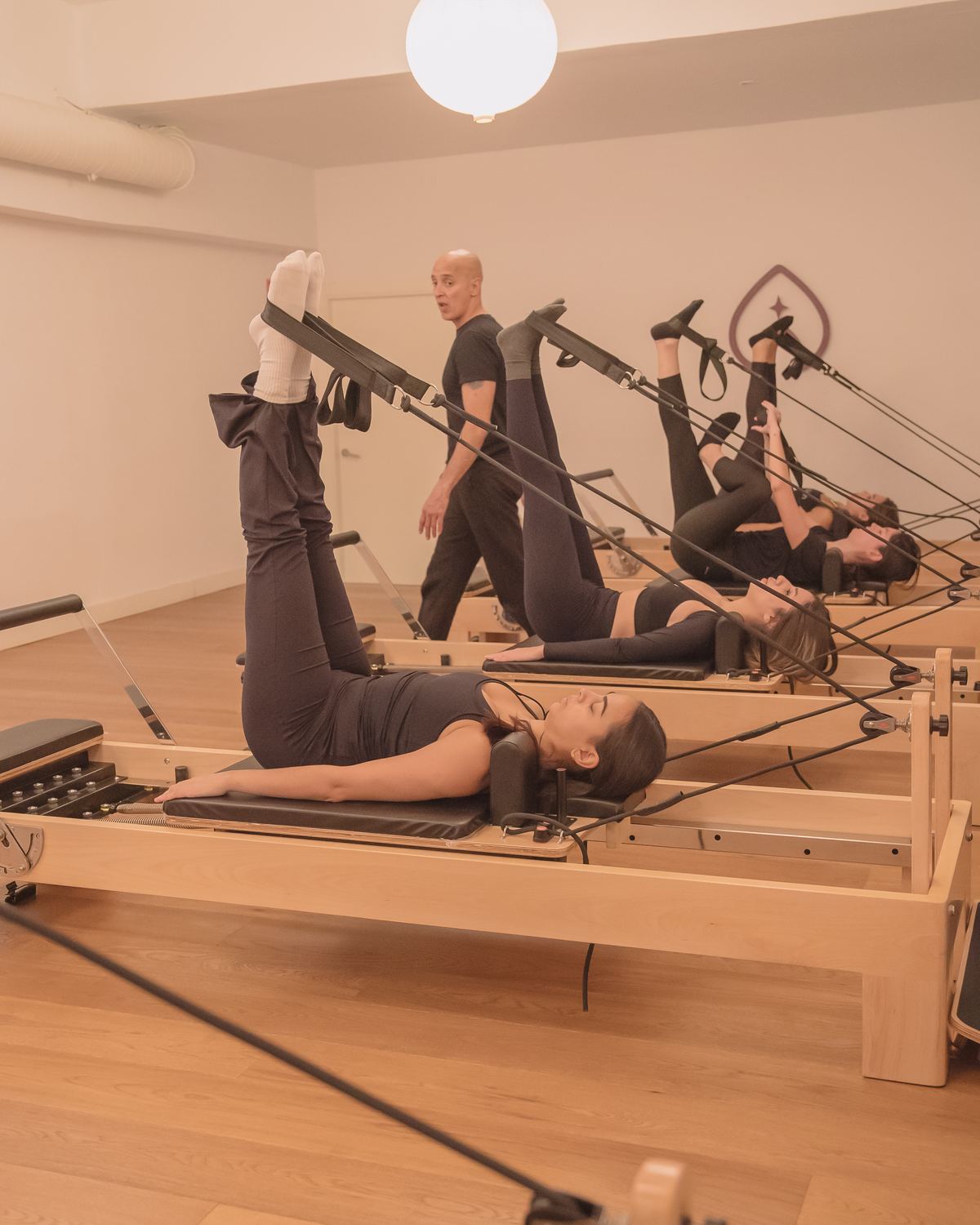
Position: lying on your back, both feet in the straps, hips flexed to roughly 90 degrees, knees slightly bent. Light spring.
Execution: from the starting position, draw circles with the legs, keeping pelvic control throughout. Start with small circles (10-15 cm in diameter) and increase the radius progressively if there is no pain. 5 to 8 repetitions in each direction per leg, or with both legs at once if symmetrical.
Why it works for the hip: hip circles work the joint mobility of the hip in every plane of movement (sagittal, frontal and transverse) at the same time. The straps let you explore the pain-free range without gravitational load on the joint. It is especially useful for students with mild or moderate osteoarthritis who need to keep the joint lubricated, and for piriformis syndrome when working circles in internal and external rotation.
4. Bridging with Single-Leg Progression
Position: lying on your back, feet on the bar or on the carriage, knees bent to 90 degrees. Spine neutral.
Execution: peel the pelvis off the carriage vertebra by vertebra until you reach a full bridge. Hold for 2 to 3 seconds at the top with the pelvis level. Lower, articulating from the thoracic spine down to the sacrum. Progression: once the two-leg version is mastered, lift one leg into table top (hip and knee at 90 degrees) and hold the bridge on one leg for 3 to 5 seconds. 8 to 10 repetitions.
Why it works for the hip: the bridge activates the gluteus maximus, the gluteus medius and the hamstrings in coordination. The single-leg version adds the demand of lateral pelvic stabilisation, replicating the requirement of single-leg support in walking. For students with trochanteric bursitis or gluteal tendinopathy, this exercise strengthens the tendon insertion progressively and with control, which is exactly the stimulus the tendon needs to regenerate.
5. Piriformis Stretch with Straps
Position: lying on your back, one foot in the strap, the other leg resting with the foot supported. The foot in the strap is positioned with the hip flexed and slightly externally rotated.
Execution: bring the knee of the strap leg towards the opposite shoulder, gently adding external hip rotation. The spring assists the movement, letting you deepen the stretch progressively and with control. Hold the position of greatest tolerable stretch for 20 to 30 seconds. 2 to 3 repetitions per side.
Why it works for the hip: this specific stretch of the piriformis and the deep external rotators is hard to perform with proper control on the floor. The assistance of the spring lets you dose the intensity of the stretch and avoid the sharp pull that could irritate the sciatic nerve if there is a component of nerve compression. It is the exercise most valued by students with piriformis syndrome, who often report immediate relief after holding the position.
6. Single-Leg Footwork for Balanced Loading
Position: lying on your back, one foot on the bar, the other leg in table top (hip and knee at 90 degrees). Spine neutral, pelvis stable.
Execution: push the bar with the supporting foot, extending the leg fully and controlling the return without letting the carriage drop. The pelvis must stay absolutely still: no rotation, no lateral tilt, no compensation from the free side. 2 medium springs. 10 repetitions per leg.
Why it works for the hip: single-leg footwork detects and corrects strength asymmetries between the two hips. In people with one-sided hip pain, the healthy leg usually takes over the load of the affected one, creating imbalances that perpetuate the problem. This exercise forces each hip to work independently, revealing differences in strength, stability and control that the instructor can address progressively.
When NOT to Practise Pilates with Hip Pain
Reformer Pilates is an effective tool for chronic or subacute hip pain, but there are situations in which exercise is not the immediate answer.
Active Acute Inflammation
In the acute phase of trochanteric bursitis or bursitis (intense pain, local heat, swelling), the inflamed tissue needs relative rest before taking load. Starting exercise in this phase can perpetuate the irritation. The usual course is to wait until the doctor or physiotherapist confirms the inflammation is sufficiently under control.
Recent Surgery
If you have had a hip replacement, an arthroscopy or any other surgery on the hip joint, you need to follow the specific rehabilitation protocol of your surgeon and physiotherapist. The Reformer can be added in the advanced phases of post-surgical rehabilitation, but always on the medical team’s instruction and with the corresponding adaptations.
No Medical Diagnosis
Hip pain can have very different causes: from a mechanical problem to a stress fracture, avascular necrosis of the femoral head or, in exceptional cases, a tumour. Before starting any exercise programme, you need a diagnosis that identifies the cause of the pain. Without a diagnosis, it is not possible to adapt the exercises safely.
Pain That Gets Worse with Movement
If hip pain increases progressively with any kind of movement, if it does not improve with rest or if it comes with general symptoms such as fever, unintentional weight loss or intense fatigue, consult your doctor before exercising. These are signs that require priority medical assessment.
How We Work with Students with Hip Pain at Pinar Pilates
When a student arrives at Pinar Pilates with a diagnosed hip condition, the process is as follows:
First, we ask to know the diagnosis and the doctor’s or physiotherapist’s clearance for exercise. We need to know which structure is affected in order to adapt the exercises safely.
Second, in the first sessions the instructor assesses posture, hip mobility, the movements that cause or relieve the pain, the relative strength of the glutes and stabilisers, and the walking pattern. This initial assessment defines which exercises to include, which to avoid and what resistance to start with.
Third, the first classes focus on basic unloaded exercises: Footwork, gentle bridging and strap work. The resistance is light and the pace slow. Lateral work is introduced only when the student tolerates load well in the sagittal and frontal planes.
Fourth, progression is gradual and always guided by the student’s response. If an exercise causes pain during or after the class, it is modified or removed. If the response is positive, resistance, range or complexity is increased.
Groups of 8 people maximum allow the instructor to be present in every movement. This attention is not possible in crowded classes, and it is especially important when working with joint conditions.
If you want to know more about what our classes are like before booking, you can read about the first class or explore the repertoire of Reformer exercises we use regularly.
The Link between the Hip and the Lower Back
The hip and the lumbar spine are anatomically and functionally interdependent structures. When the hip loses mobility or strength, the lower back compensates by taking on a load that is not its own. Conversely, a stiff lumbar spine can limit hip extension and rotation. This phenomenon is known in biomechanics as lumbopelvic rhythm.
That is why many people with low back pain also have an underlying hip dysfunction, and vice versa. At Pinar Pilates we work both areas in an integrated way, not as separate compartments.
We help you choose a class
Have hip pain and not sure which class to choose?
Start with a Basic level class if you have never done reformer Pilates, or Multilevel if you have tried it before. Groups are 8 people max and the teacher adapts every exercise to your body and your level, so let them know what is going on before you start. Your first class is 50% off.
Would you rather we advised you? Message us on WhatsApp at +34 611 994 729 or email hola@pinarpilates.com, tell us what is going on and we will recommend the class that suits you best.
If you have an injury or pain that has not been assessed yet, check with your doctor or physiotherapist first and always follow their advice: our recommendation is only about which class to choose and does not replace their judgement.
Frequently Asked Questions
Can Reformer Pilates make hip pain worse?
In general no, as long as the exercises are adapted to the diagnosis and individual tolerance. The risk of worsening the pain exists if you work with too much load in the acute phase, if you force ranges of movement that create compression (especially relevant in femoroacetabular impingement) or if the instructor does not know the student’s diagnosis. That is why we insist that students share their diagnosis before the first class and report any change in symptoms during and after sessions.
How long does it take to notice improvement?
It depends on the condition, its severity and how often you practise. In cases of gluteal tendinopathy and trochanteric bursitis, studies show significant improvements from 8 to 12 weeks with 2 or 3 sessions a week. In osteoarthritis, improvement in pain and function may be more gradual, but sustained over time. The first benefits usually noticed are better postural control, more ease in activating the glute and less morning stiffness.
Can I do Pilates if I have hip osteoarthritis and I am going to have surgery?
Yes, with medical clearance. Preoperative exercise, known as prehabilitation, improves muscle strength and general fitness before surgery, which speeds up post-surgical recovery. A study by Nielsen et al. (2014) published in Acta Orthopaedica showed that patients who did strengthening exercises before hip replacement had a faster functional recovery in the first months after surgery.
Can trochanteric bursitis be cured with Pilates?
Pilates is not the sole treatment for trochanteric bursitis or gluteal tendinopathy, but progressive strengthening of the gluteus medius is today the intervention with the most scientific support for this condition, above even cortisone injections in the long term (Mellor et al., 2018). The Reformer is an excellent way to apply that strengthening in a controlled, progressive way, especially in the early phases when weight-bearing load is still painful.
Can I do Pilates if my hip feels locked?
The feeling of a “locked hip” can have several causes: muscle spasm, inflammation limiting the joint range, a loose body inside the joint or a structural joint problem. Before practising Pilates with this sensation, you need a medical assessment to determine the cause. If the movement limitation is muscular in origin or due to controlled inflammation, the Reformer can help recover mobility progressively. If there is a structural cause that requires intervention, exercise is added after the specific treatment.
Your Next Step
The hip is a joint that responds well to intelligent movement. Not to indefinite rest, not to excessive, uncontrolled load, but to progressive, adapted and supervised exercise. That is exactly what we offer at Pinar Pilates.
Our studio is at Calle del Pinar 8, 28006 Madrid, in the Salamanca district, with groups of 8 people maximum per class and more than 40 sessions a week available. Our instructors have spent years working with students with hip conditions and know how to adapt every exercise to every situation. The more than 490 Google reviews (average 4.9 out of 5) reflect that daily work.
Our prices suit different needs: drop-in class €30, 4-class plan €100, 8 classes €150, 12 classes €200 and unlimited classes €250 a month.
If you are unsure whether the Reformer is right for your specific situation, call us on +34 611 994 729 and we will advise you before you book.
Book your first class at 50% off and feel, in your own body, the difference that working the hip with the control and precision the Reformer allows can make.
You may also be interested in: Pilates for Sciatica, Pilates for Low Back Pain in Madrid and Reformer Pilates Exercises.
Pinar Pilates · Salamanca district, Madrid
Your first reformer class, €15
Groups of 8 people maximum, specialist instructors and more than 40 classes a week. Your first class is half price.
Book my first classCalle del Pinar 8, Madrid · Questions? Message us on WhatsApp