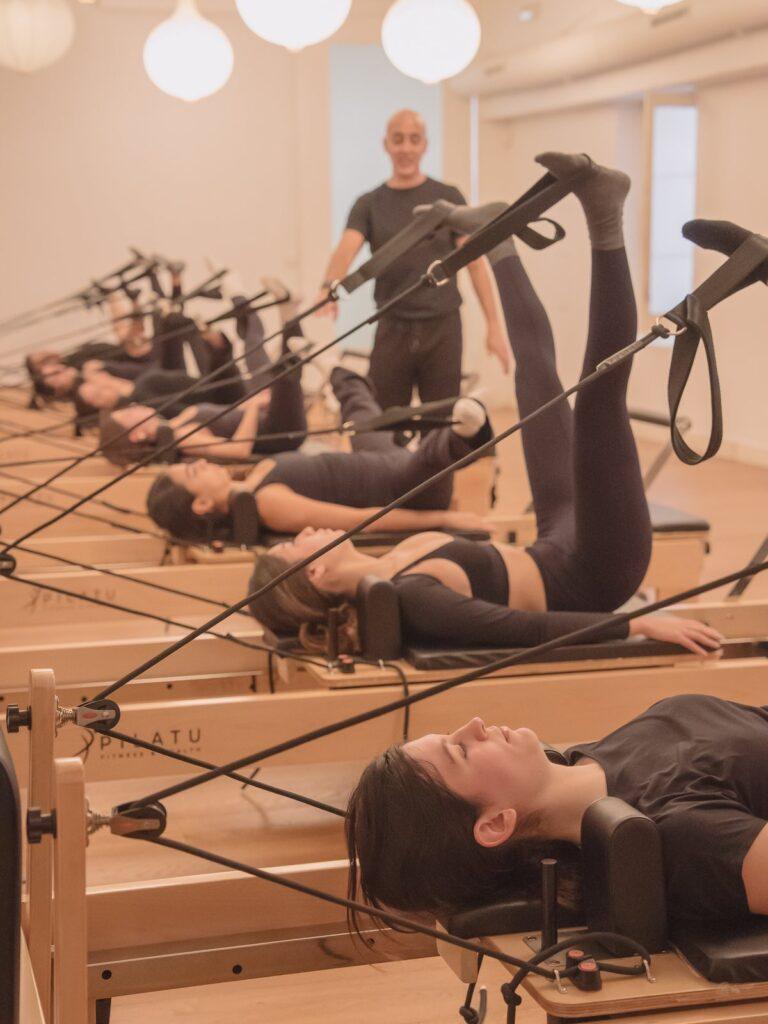
If you want to tone your glutes and legs, you probably already know that squats and lunges on the floor have a limit. There comes a point where the body adapts, progress stalls and the muscle imbalances that existed before you started still go uncorrected.
Reformer Pilates solves exactly that problem. Its spring-resistance system, unilateral work and the ability to control both the push and the return phase make it one of the most effective methods for working the posterior chain, the abductors and the quads. In this article we explain why the glutes matter far beyond appearance, why the Reformer beats bodyweight work, which specific exercises to use and what results you can realistically expect.
Why Strong Glutes Matter Far More Than Appearance
Most people who want to “work their glutes” are thinking about appearance. That is understandable, but there are far more powerful functional reasons to strengthen these muscles.
Knee Stability and Injury Prevention
The gluteus medius is the main lateral stabiliser of the pelvis during walking, running and any single-leg movement. When it fails, the pelvis drops towards the unsupported side (Trendelenburg sign) and the knee collapses inwards into dynamic valgus. That collapse is one of the most common mechanisms of anterior cruciate ligament rupture and patellofemoral syndrome.
A study by Fredericson et al. published in the Clinical Journal of Sport Medicine showed that runners with iliotibial band syndrome had significant weakness of the gluteus medius. After six weeks of specific strengthening, 92% returned to activity pain-free.
Lower Back Health
The gluteus maximus, when it works properly, extends the hip and unloads the lower back. When the glutes are inhibited, the spinal erectors and the hamstrings take over that function. The result is a lower back that is permanently overloaded and prone to pain. If you suffer from chronic lower back discomfort, glute work in Pilates is an essential part of any rehabilitation programme.
Athletic Performance
In sports such as cycling, tennis, skiing or simply walking uphill, the gluteus maximus is the main engine of hip extension. A strong glute means more drive, greater energy efficiency and less joint wear. It is not only a matter of fitness: it is applied biomechanics.
Overall Posture
The glutes are part of the posterior chain along with the hamstrings, the spinal erectors and the neck muscles. Strengthening this chain improves spinal alignment, reduces compensatory lumbar hyperlordosis and contributes directly to a more upright, balanced posture.
The Silent Epidemic: Glutes Switched Off by Sitting
There is a specific term for a problem that affects most adults who work sitting down: gluteal amnesia, also called reciprocal inhibition from a sedentary lifestyle.
When you stay seated for hours, the hip flexors (iliopsoas and rectus femoris) remain continuously shortened. This sustained tension neurologically inhibits the gluteus maximus through the mechanism of reciprocal inhibition: the brain reduces the activation signal to the antagonist muscle so as not to produce a contraction that opposes the intended movement. The problem is that when you stand up and want to use the glute, the nervous system keeps sending a reduced signal. Your glute exists, but it does not fire properly.
The result is that, even if you do squats at the gym, most of the work falls on the quads and the spinal erectors instead of the glute. You are training, but not training what you think you are training.
Reformer Pilates tackles this problem from two angles. First, it activates the glute in positions where the hip flexors are neutral or lengthened, removing the inhibition. Second, it works neuromuscular awareness: learning to activate the glute voluntarily before and during the exercise.
Why the Reformer Beats Bodyweight Work for Glutes and Legs
Body weight has its limits. The Reformer removes them with four specific advantages.
Variable, calibrated resistance. The Reformer springs let you adjust the load precisely, from very light resistance that helps initial activation to a high load that stimulates hypertrophy. You do not depend on your own weight or on adding kilos that compromise technique.
Controlled eccentric load. In exercises such as the leg press, the springs pull the carriage back to the starting position. Resisting that return is an eccentric contraction. Eccentric work is especially effective for muscle development and for preventing tendon and hamstring injuries.
Unilateral work without compensation. On the floor, when you do a single-leg squat, the body looks for postural compensations to keep its balance. The Reformer supports the trunk while isolating the work in a single limb, making it possible to identify and correct left-right imbalances.
Full range of movement. The sliding carriage lets you reach joint ranges the floor does not allow, especially at the hip and ankle. Working through the full range improves functional flexibility at the same time as building strength.
You can see a more detailed comparison in our article on the main Reformer exercises.
7 Reformer Pilates Exercises for Glutes and Legs
1. Footwork Series
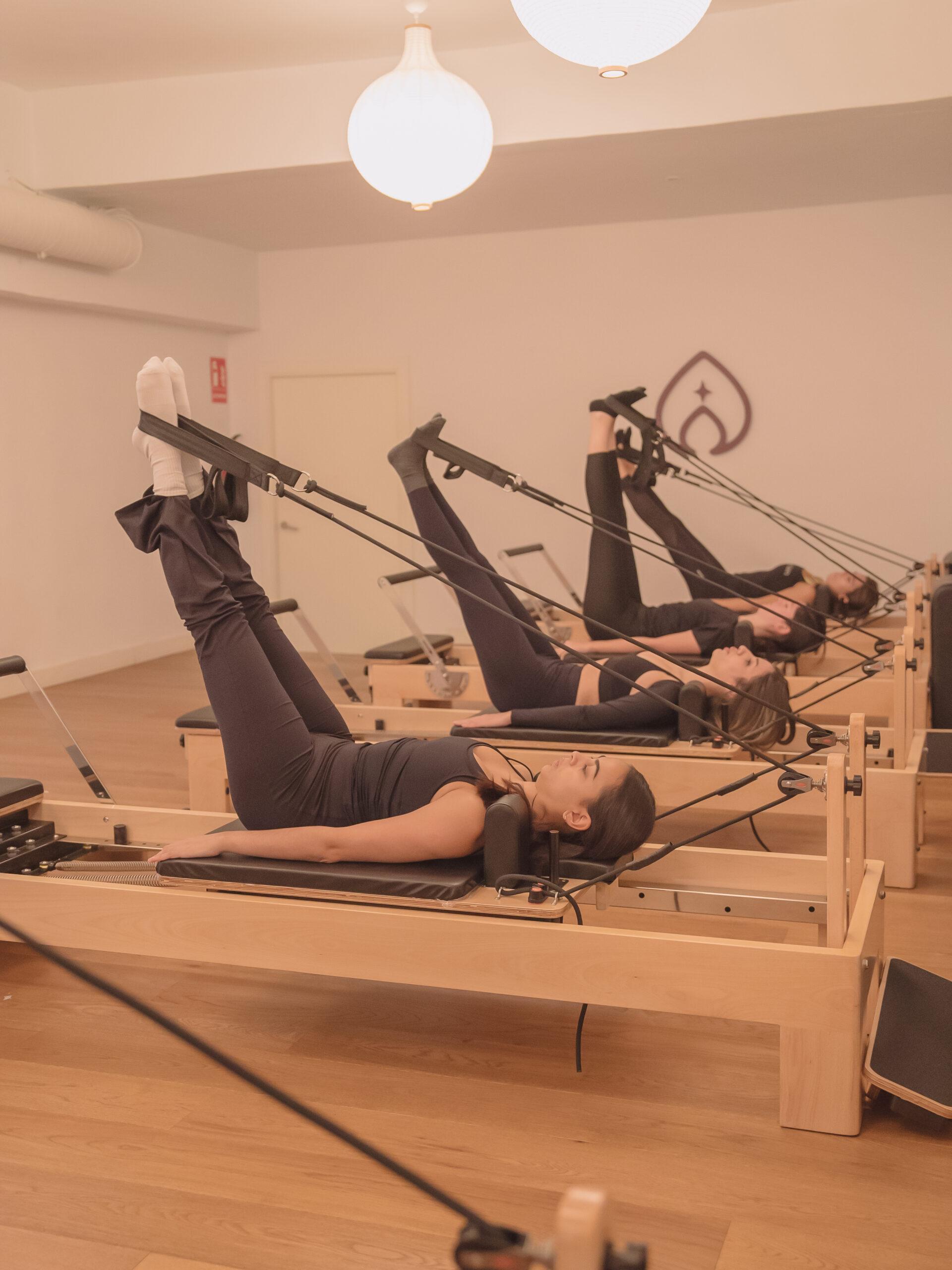
The starting point of any leg-and-glute session. Lying on your back with the feet on the footbar, you push the carriage away and return with control.
Foot position determines the muscular emphasis. With the feet parallel and shoulder-width apart, quads and glutes fire equally. With heels together and toes apart (V position), adductor and gluteus maximus work increases. With the feet on the outer corners of the footbar and the knees apart, the emphasis shifts to the gluteus medius.
The key is to keep the pelvis neutral throughout. If the lower back arches as the legs extend, the resistance is too high or core activation is insufficient.
2. Single Leg Press
The same as footwork, but with only one leg on the footbar. This exercise exposes any imbalance between the right and left sides with a precision no bilateral exercise can match.
It demands active pelvic stabilisation: the glute of the supporting leg works to stop the pelvis from rotating or tilting. It is one of the most effective exercises for activating the gluteus medius and gluteus maximus at the same time.
3. Bridging on the Reformer
With the feet flat on the footbar and the knees bent, you lift the pelvis until you form a straight line from shoulders to knees. The carriage can be fixed or can include a slide to increase the difficulty.
The natural progression is the single-leg bridge, where the free leg extends towards the ceiling while you keep the pelvis level. This variation is very demanding for the gluteus maximus and the hamstrings of the supporting side.
4. Skating
With the knees slightly bent on the carriage and the feet on the platform, you slide the carriage to one side while the supporting leg works in abduction. This lateral push activates the gluteus medius with an intensity that frontal work does not reach.
Alignment is key: the knee of the pushing side must not collapse inwards, and the pelvis must stay level throughout. It is an exercise that requires coordination and concentration, especially in the first sessions.
5. Side Splits (Standing)
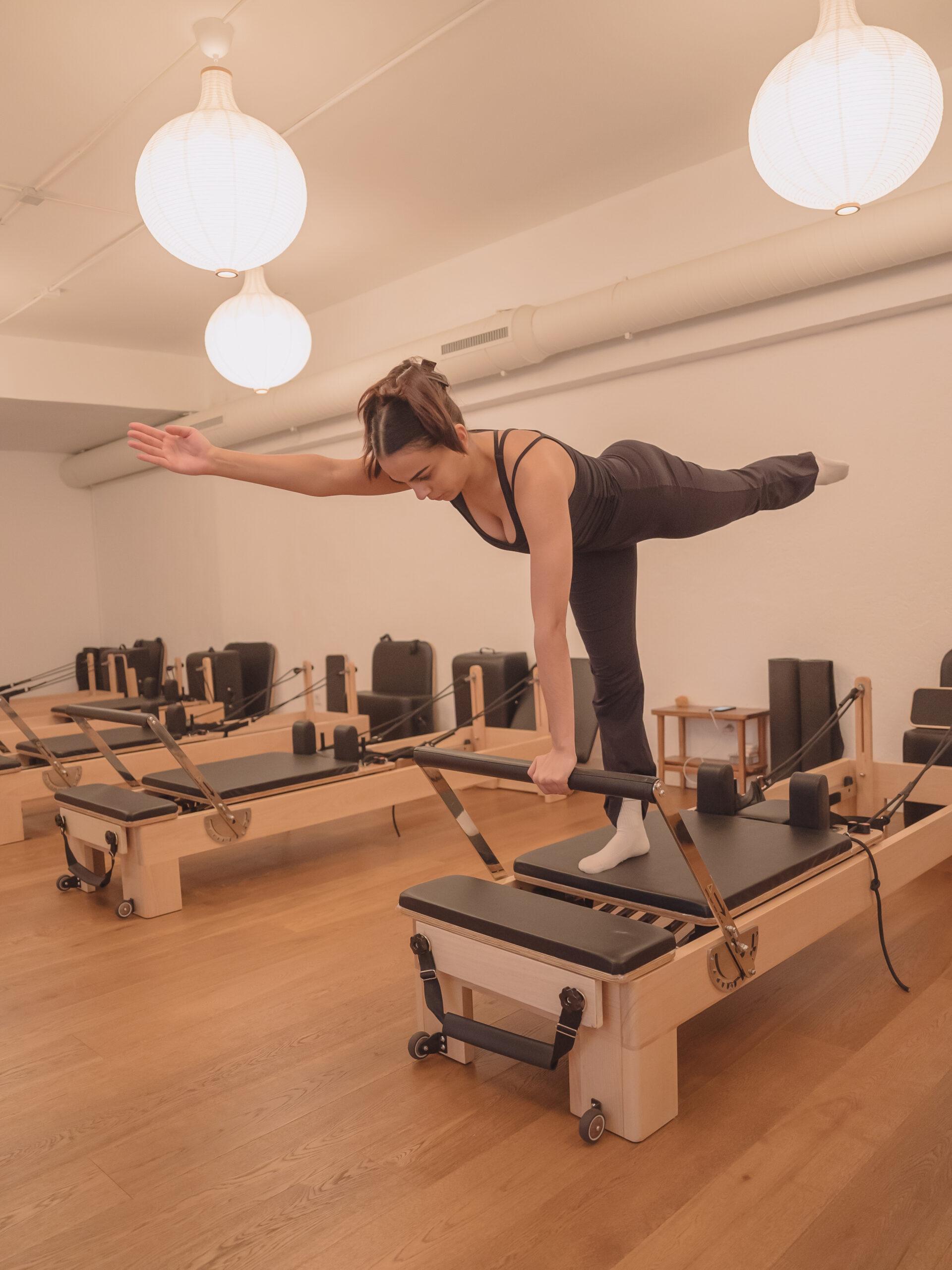
Standing on the Reformer, with one foot on the carriage and the other on the platform, you slide the carriage sideways opening the legs and return by contracting the adductors and the glute of the outer leg. It is an advanced exercise that simultaneously trains glute strength, ankle stability and postural control.
The spring resistance can be adjusted to make the return easier or harder. With a lighter spring, the return demands more effort from the adductors. With a heavier spring, the opening requires more work from the abductors and glutes.
6. Standing Lunges
With one foot on the platform and the other on the carriage, you perform a controlled lunge. Unlike lunges on the floor, the Reformer adds the instability of the sliding carriage, which forces precise eccentric control from the glute and hamstrings to brake the movement.
It is one of the most functional exercises in the session because it replicates the movement pattern of walking and climbing stairs, but with a much higher demand for control.
7. Jump Board
The Jump Board is a padded platform fitted to the footbar that lets you perform jumps lying on your back. The push-off activates the hip extensors (gluteus maximus) and the cushioning of the landing works the calves, hamstrings and glutes eccentrically.
It is the exercise with the biggest cardiovascular component in a Reformer session and, done well, develops posterior-chain power in a way no static exercise can replicate.
Progression on the Reformer: How to Increase Difficulty Correctly
The principle of progressive overload is key to any training method. On the Reformer, progression is applied through four variables.
Spring resistance. Increasing the tension raises the load in the push phase. Reducing it raises the eccentric demand on the return. Both are ways of progressing, not only the first.
Tempo. Performing the eccentric phase more slowly (for example, four counts to return to the start instead of two) noticeably increases the muscular demand without adding load.
Unilateral work. The natural progression of any bilateral exercise on the Reformer is its single-leg version. The single leg press, the single-leg bridge and the lunges are direct examples.
Pelvic control. As strength and neuromuscular control improve, the instructor can remove supports or add simultaneous arm movements, increasing the stabilisation demand on the posterior chain.
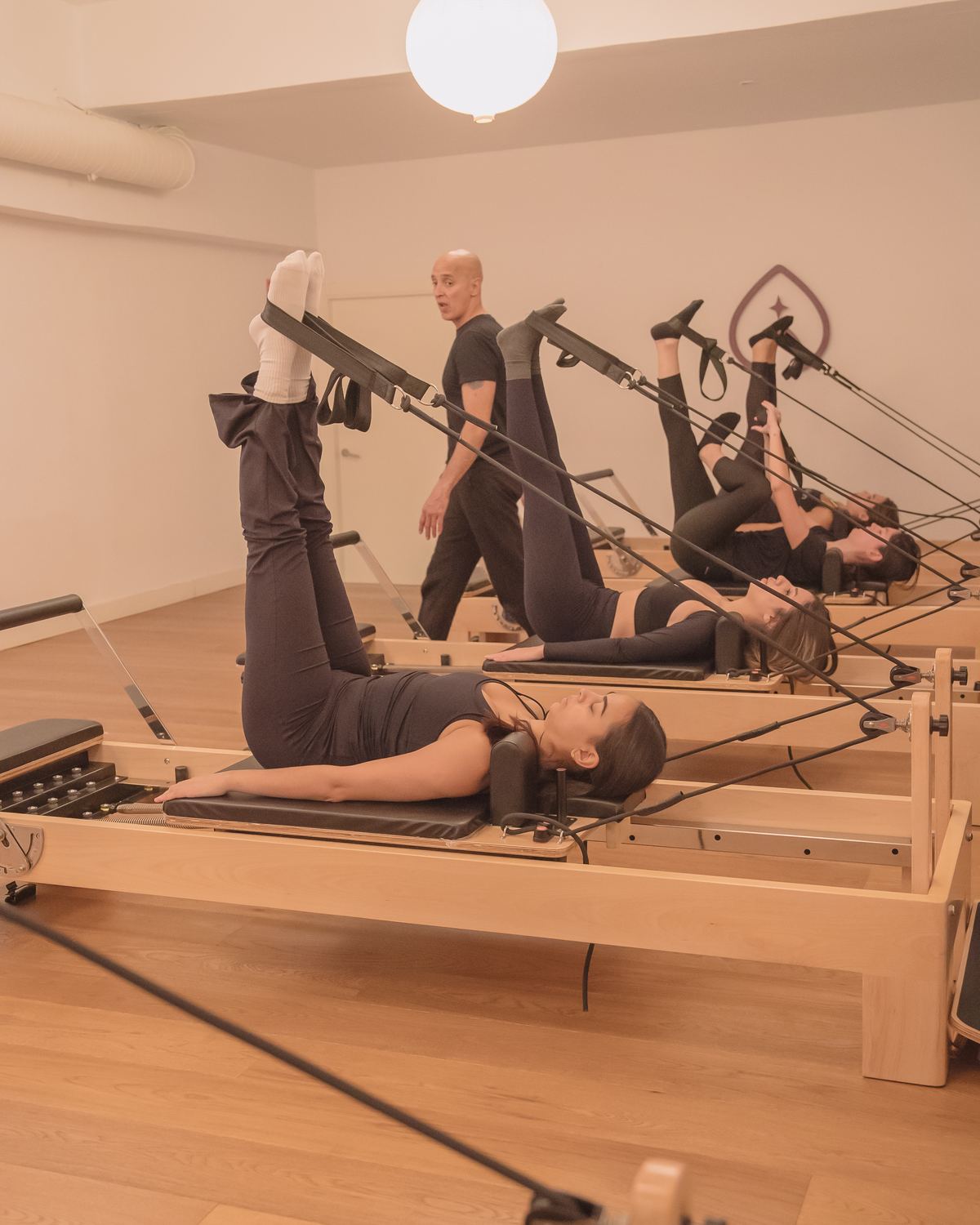
Poorly managed progression creates compensations and injuries. That is why working with a qualified instructor, in small groups where every student gets individual attention, makes a real difference compared with crowded classes. At Pinar Pilates we work with a maximum of 8 people per class to make sure that progression is right for each person.
Realistic Results: What to Expect and How Soon
One of the most frequent questions is when results become noticeable. The honest answer depends on three factors: training frequency, starting point and diet. That said, there are general patterns.
In the first two or three weeks, the changes are mainly neuromuscular. The brain learns to activate the glute more efficiently. You will not see a difference in the mirror, but you will notice that exercises you previously did not feel “in the glute” now produce that sensation of work.
Between the fourth and eighth week, at a frequency of two to three sessions a week, structural changes begin. Muscle mass increases, the area becomes more defined and posture visibly improves. Many students also describe less lower back pain and more hip stability during everyday activities.
From the third month, the changes are evident both in appearance and in function. This is when progress in loads and exercise variations speeds up, because the neuromuscular base is already consolidated.
You can see real transformations in our before and after article and read more about the method’s potential for body composition in our article on Reformer Pilates for weight loss.
Frequently Asked Questions about Reformer Pilates for Glutes and Legs
Can I start even if I have never done Reformer Pilates?
Yes. The Reformer is accessible to beginners because the resistance can be set very low and every exercise can be modified to your level. The first session always includes an introduction to the equipment and the basic principles of movement. You can read exactly what to expect in our article on the first Reformer Pilates class in Madrid.
How often do I need to train to see results in my glutes?
Two sessions a week are the minimum for muscular adaptation. Three sessions speed up results significantly. With a single weekly session you can maintain what you have gained, but progress will be slow. The advantage of the Reformer is that two well-designed sessions can be more effective than four unstructured gym visits.
Can Reformer Pilates help with knee pain linked to weak glutes?
Often yes, especially in cases of patellofemoral syndrome or lateral knee instability caused by a weak gluteus medius. However, if you have a diagnosed injury, it is essential that your doctor or physiotherapist gives the go-ahead before you start. The Reformer lets you work without impact and with very controlled loads, which makes it suitable even during recovery. It can also help if you have knee discomfort; read more in our article on Reformer Pilates for knee pain.
Is Reformer Pilates for glutes and legs suitable for men?
Completely. The muscle imbalances described in this article affect men and women equally. Glute inhibition from sitting, gluteus medius weakness and the associated knee problems do not discriminate by sex. Many of our male students, including athletes, specifically work the posterior chain on the Reformer as part of their training plan.
How is a Reformer Pilates class different from a weights session for glutes?
The main difference lies in the type of contraction, the plane of work and the neuromuscular component. Weights mainly generate concentric work in fixed planes. The Reformer works all three planes, includes significant eccentric load and demands active stabilisation throughout the exercise. It also corrects imbalances that conventional strength training tends to perpetuate. The two methods are complementary; the Reformer does not replace weights, but it adds a dimension of control and correction that weights alone do not offer.
Train Glutes and Legs at Pinar Pilates, Madrid
At Pinar Pilates, in the heart of the Salamanca district (Calle del Pinar 8, 28006 Madrid), we offer more than 40 classes a week in groups of 8 people maximum. Every class is led by qualified instructors who adapt the exercises to your level and goals, whether that is toning legs and glutes, recovering from an injury or improving your sports performance.
With more than 490 Google reviews (average 4.9 out of 5), our students confirm that the method works. The results are no accident: they come from a rigorous methodology, top-quality equipment and personal attention you will not find in a crowded studio.
Our prices are transparent: single class €30, 4-class plan €100, 8-class plan €150, 12-class plan €200 and unlimited membership €250 a month.
For any questions about which class is best for you, call us on +34 611 994 729.
Book your first class at 50% off
Pinar Pilates · Salamanca district, Madrid
Your first reformer class, €15
Groups of 8 people maximum, specialist instructors and more than 40 classes a week. Your first class is half price.
Book my first classCalle del Pinar 8, Madrid · Questions? Message us on WhatsApp