Choosing a Reformer Pilates studio in Madrid is more complicated today than it was three years ago. In 2026, the number of options has multiplied: there are specialist boutique studios, gym chains with Reformer rooms, physiotherapy centres with group classes and international franchises that have landed in the capital. For anyone wanting to start or change studio, the volume of options can create more confusion than clarity.
This guide is not meant to be a definitive ranking or covert advertising. The aim is to give you objective criteria to assess any studio for yourself, offer an honest view of the current landscape in Madrid and mention some of the best-known centres along with their general characteristics. With that information, you can make an informed decision.
The Reformer Pilates Market in Madrid: A Sector in Expansion
Reformer Pilates has stopped being a niche discipline and become one of the fastest-growing fitness activities in Madrid. According to Google searches, terms related to “pilates reformer madrid” have grown steadily over the past four years, with a notable peak from 2023.
The clearest trend is the consolidation of the boutique model: studios specialising exclusively in Reformer Pilates, with small groups, instructors with specific training and a price above that of gym chains. This model has gained ground because the results it offers are different, and more and more people in Madrid recognise it.
At the same time, the big chains have responded by expanding their Reformer rooms and hiring monitors with Pilates certification. The result is a diverse market in which very different offerings coexist under the same name: “Reformer Pilates class”.
That disparity makes comparison necessary and makes the assessment criteria more important than ever.
Criteria for Assessing a Good Reformer Pilates Studio
Before looking at specific studios, it helps to be clear about the factors that set a quality centre apart from one that simply has machines and timetables.
1. Group size
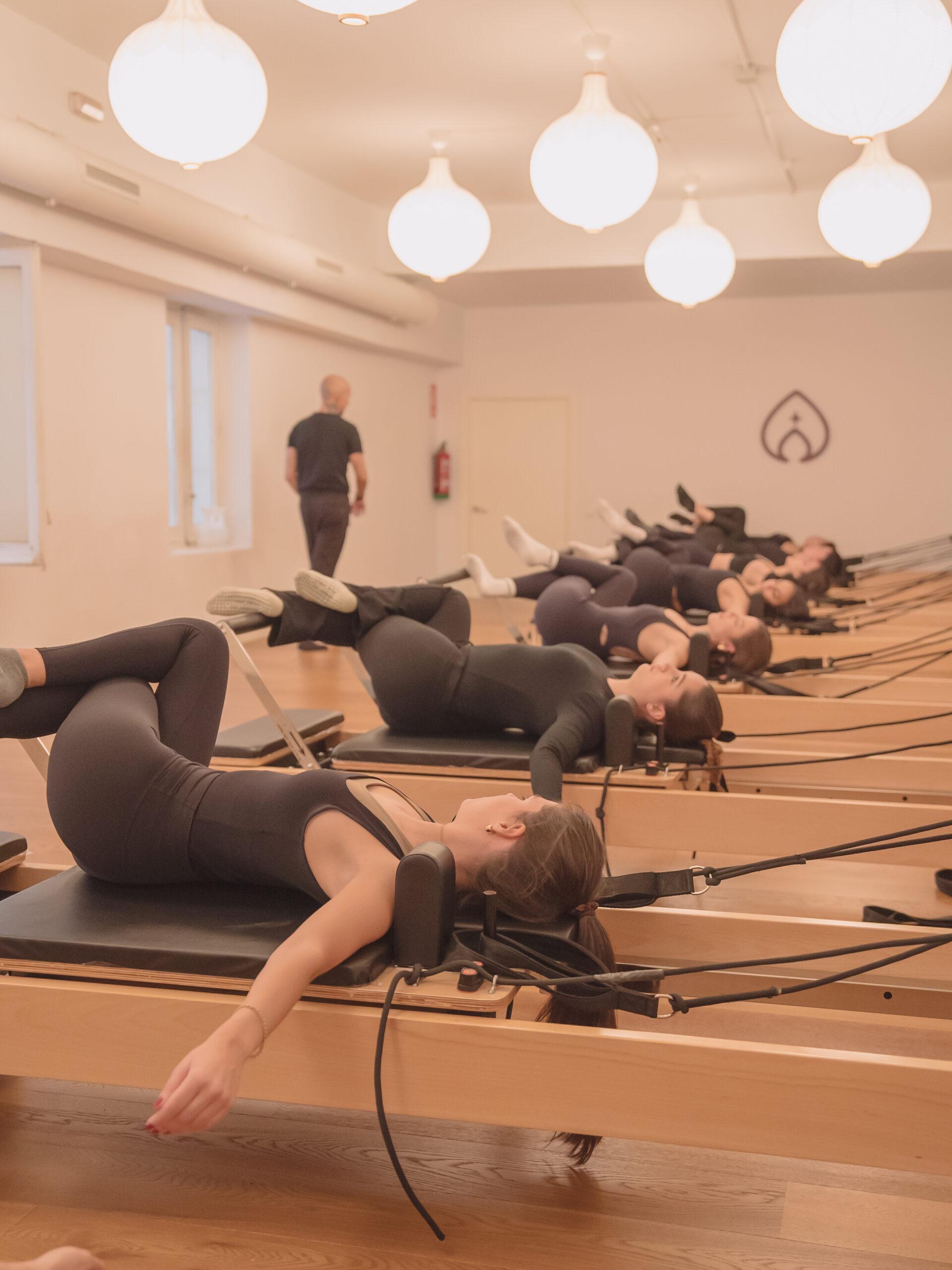
This is the most decisive criterion and the one with the biggest impact on your progress. A Reformer is not a cardio machine you can use on your own: it requires supervision and postural correction. With groups of 15 or 20 people, the instructor cannot attend to each student individually. With groups of 8 or fewer, they can see you, correct you and adapt every exercise to your level.
If a studio does not publish the maximum size of its classes, ask directly. If the answer is vague, it is a warning sign.
2. Instructor qualifications
Reformer Pilates demands specific training. A weekend course is not enough: quality instructors have recognised certifications, years of practice and, in many cases, ongoing training in specific methods (STOTT, Balanced Body, Peak Pilates, among others).
Check whether the studio publishes its instructors’ profiles, training and experience. A studio that hides this information has reasons for doing so.
3. Quality of the equipment
Not all Reformers are the same. The difference between an entry-level machine and a high-end professional Reformer shows in the smoothness of the carriage, the precision of the springs, the stability of the platform and the overall ergonomics. Visit the studio before signing up and look at the condition of the machines.
4. Timetable and availability
A studio with 40 or more classes a week lets you fit Pilates into your routine without forcing your schedule. A studio with 10-15 classes a week depends on your hours matching theirs exactly.
5. Location and accessibility
Location matters more than it seems at first. An excellent studio 45 minutes from home or work will end in dropping out. Consider the metro, the bus and parking options.
6. Reviews and real reputation
Google reviews are a useful source of information if read with judgement. A studio with 400 five-star reviews is more reliable than one with 30. What matters is not only the average score, but the volume, the consistency and the content of the comments. Read what they say about the attention, the quality of the classes and how the team treats people.
7. Price and fee transparency
Compare the price per class, not the price per plan. A 12-class plan at €200 works out at €16.67 per class. An unlimited plan at €250 a month can work out cheaper if you go three times a week. Calculate according to your real rate of use.
Studios that do not publish their prices on their website or require a visit in person to find out the rates usually have reasons for the opacity.
Notable Reformer Pilates Studios in Madrid
Below is a selection of some of the best-known centres in Madrid, with a general description based on their public reputation. Specific third-party data (prices, exact group sizes) that we have not been able to verify directly is not included.
Pinar Pilates (Salamanca district)
Pinar Pilates is a boutique studio at Calle del Pinar 8, in the Salamanca district. It works with a maximum of 8 people per class, which places it among the studios with the smallest groups in Madrid. It has more than 490 Google reviews (average 4.9 out of 5), the largest volume of verified positive ratings among the city’s specialist Reformer Pilates studios.
It offers more than 40 classes a week from Monday to Sunday, with five different formats: Reformer, Legs, Cardio, Upper Body and Stretch. The team of instructors is multilingual (Spanish, English, Italian and Portuguese), which makes it especially accessible to international residents. Its prices are public and range from €30 for a drop-in class to €250 a month for unlimited classes, with a first trial class at 50% off (€15).
For anyone looking for a boutique experience rather than a gym chain, Pinar Pilates represents the most established model in the Salamanca district.
SOLID Pilates
SOLID is one of the most recognised names in Madrid’s boutique Reformer Pilates segment. It is known for its polished aesthetic and its focus on the user experience, with a loyal clientele in several neighbourhoods of the city. It has built a solid social media presence and positioned itself as a reference for the boutique model in Madrid.
Olimpia Pilates
Olimpia is a centre with an established presence in Madrid, known for combining Reformer Pilates classes with other wellness disciplines. It has a consolidated client base and tends to stand out for customer service and the atmosphere of the centre.
Maison Pilates
Maison Pilates is a studio that has gained visibility in Madrid in recent years, with a French aesthetic and premium positioning. It is known for its interior design and for attracting an urban clientele with high purchasing power.
Temple Pilates
Temple Pilates is another of the boutique studios with a presence in the city. It has positioned itself around community and student loyalty, with group Reformer classes and a defined brand identity.
Muelle Pilates
Muelle Pilates is a centre that has built a reputation in its area of Madrid, with Reformer Pilates classes for different levels and an offering aimed at both beginners and experienced practitioners.
Why Reviews and Group Size Matter More Than Marketing
We live in a time when any studio can have an elegant website, professional photos on Instagram and well-written copy about “holistic methodology” and “transformative experience”. Marketing no longer distinguishes a good studio from a mediocre one.
What does distinguish them are two objective facts: the number of real reviews and the maximum group size.
Google reviews are hard to fabricate at scale. A studio with more than 490 Google reviews (average 4.9 out of 5) has hundreds of real people behind it who took the time to rate the experience positively. That cannot be bought or faked. The same applies in reverse: if a studio has few reviews or a low average, that says something about its students’ real experience.
Group size is the second most honest fact. “Personal attention” can be advertised in every communication channel, but if the class has 18 people and a single instructor, personal attention does not exist by pure logistics. An instructor cannot watch, correct and adapt for 18 people at once. With 8, they can.
When you look for small groups in Madrid, do not accept vague answers. Ask for the exact maximum number of places per class and verify it.
Checklist: Questions to Ask Before Signing Up at Any Studio
Before committing to a plan or a pack, ask these questions. A quality studio will answer them without hesitation; one that avoids them is telling you something important.
About the group and the class:
– What is the maximum number of people per class?
– Are there separate classes by level (beginner, intermediate, advanced) or are they mixed?
– What happens if I get injured or need to modify an exercise during the class?
About the instructors:
– What training do the instructors have?
– Does the same instructor always teach the same classes or is there frequent rotation?
– Are there instructors specialised in injuries or specific conditions (low back pain, herniated disc, scoliosis)?
About the equipment:
– Which brand of Reformers do you work with?
– How often is the equipment checked and maintained?
About prices and conditions:
– What are all the rates available?
– Is there a minimum contract or a cancellation penalty?
– What happens to unused classes in a pack?
– Can I try a class before signing up for a plan?
About availability:
– How many classes a week do you offer?
– How far in advance do I need to book a place?
– Is there usually a waiting list?
Pilates centres in Madrid: how they are spread across the city
Pilates centres in Madrid are not evenly distributed, and knowing the map saves quite a lot of search time. There are four fairly clear patterns.
The northern central axis: Salamanca, Chamberí and Chamartín
This is where the highest density of Pilates centres in Madrid is concentrated, and also where the most different models coexist under the same word: boutique group-class studios, one-to-one classical-method centres and physiotherapy clinics with a reformer. Telling the model apart before booking matters more here than anywhere else.
Centro and Chueca-Malasaña
Large-room formats and chains predominate, with lower prices per class and bigger groups. It works well if your priority is timetable flexibility and price, and less well if you are starting from scratch and need correction.
The residential neighbourhoods of the north and west
Chamartín, Tetuán, Moncloa and the residential areas on the outskirts have smaller centres, very neighbourhood-oriented, with timetables concentrated in the morning and the late afternoon-evening.
South and east
Specific reformer provision is scarcer and appears mostly integrated into gyms and multi-purpose sports centres, rather than in dedicated studios.
What this means for your search
If you are looking for Pilates centres in Madrid with an area already decided, what will determine your experience is not the district but the centre’s model: how many people are in each class, whether there are separate levels and who teaches the class. A good studio fifteen minutes away performs better than a mediocre centre five minutes away, but an excellent centre thirty-five minutes away ends in dropping out. The balance lies in finding the best model within a radius you can sustain two or three times a week for months.
How to Choose the Studio That Suits You Best
There is no single best Reformer Pilates studio in Madrid: there is the best studio for your specific situation. To find it, consider these factors in this order:
First, location. Do not choose a studio that requires 30 minutes of travel. Adherence to exercise depends largely on logistical friction. A good studio 10 minutes away is a better option than an excellent studio 40 minutes away.
Second, group size. If you want concrete results and not only to move, group size is the most important criterion. Prioritise studios with 8 people or fewer per class.
Third, reviews. Spend 15 minutes reading the Google reviews carefully. Do not stop at the average: read the recent comments, look for patterns and pay attention to how the studio responds to negative reviews.
Fourth, the first class. Many studios offer a trial class at a reduced price. Use it. A single class is enough to assess the quality of the instructor, the condition of the machines and the atmosphere of the centre.
Reformer Pilates prices in Madrid vary considerably depending on the type of centre, the group size and the location. Always compare the price per class, not the total price of the plan.
FAQ: Frequently Asked Questions about Reformer Pilates Studios in Madrid
How much does a Reformer Pilates class cost on average at a boutique studio in Madrid?
The price per class at specialist boutique studios in Madrid usually ranges from €20 to €35 for a drop-in class, with progressive discounts on packs of 4, 8 or 12 classes and on unlimited monthly plans. At Pinar Pilates, the first class costs €15 (50% off), plans go from €100 (4 classes) to €200 (12 classes) and the unlimited plan is €250 a month.
Do I need previous experience to join a Reformer Pilates studio?
No. Most boutique studios accept absolute beginners. In fact, small groups are especially beneficial for anyone starting out, because the instructor can correct technique from the first class. If it is your first time, read this guide on what to expect in your first Reformer Pilates class before booking.
How much difference is there between doing Reformer Pilates at a gym and at a boutique studio?
The difference is structural, not only aesthetic. At a gym, classes usually have between 12 and 20 people, the instructors are generalists and individual attention is minimal. At a boutique studio with groups of 8 people or fewer, the instructor can see you, correct you and adapt the exercises to your level in every class. The result is different in terms of progress, safety and adherence.
How do I know whether a studio has genuine good reviews or they have been manipulated?
Look at the total volume of reviews, not only the average. It is very hard to sustain more than 400 positive reviews unless most of them are genuine. Also read the content of the comments: real reviews usually mention specific instructors, specific classes or details of the experience. Fabricated reviews tend to be generic and vague.
How often should I go to see results?
Two or three times a week is the rhythm that produces visible changes in the shortest time. At that frequency, most people report postural improvements in 4-6 weeks, less back pain in 3-4 weeks and more strength and flexibility in 6-8 weeks. Once a week maintains your level but slows progress. Less than once a week does not produce sustained adaptations.
Choosing the right Reformer Pilates studio to train at is no small decision. It directly affects your progress, your safety and whether you will still be going in six months or will have given up. Use the criteria in this guide, ask the checklist questions and, above all, try before you commit.
If you are in Madrid and want to see for yourself what a group of 8 people maximum, specialist instructors and more than 490 Google reviews (average 4.9 out of 5) means, the first class at Pinar Pilates is 50% off. Calle del Pinar 8, Salamanca district. Phone: +34 611 994 729.
Book your first class at 50% off
Pinar Pilates · Salamanca district, Madrid
Your first reformer class, €15
Groups of 8 people maximum, specialist instructors and more than 40 classes a week. Your first class is half price.
Book my first classCalle del Pinar 8, Madrid · Questions? Message us on WhatsApp