Important medical notice: this article is for information purposes only and in no case replaces the advice, diagnosis or treatment of your gynaecologist or obstetrician. Before starting Reformer Pilates or any exercise programme during pregnancy, you need express authorisation from your healthcare professional. Every pregnancy is different, and what is suitable for one woman may not be for another. If at any time you experience vaginal bleeding, regular contractions before term, loss of amniotic fluid, chest pain, dizziness, difficulty breathing or reduced foetal movements, stop exercising and go to A&E immediately.
Pregnancy transforms your body week by week. The centre of gravity shifts, the lumbar curve becomes more pronounced, the joints become laxer due to relaxin and the pelvic floor bears a growing load. All of this causes discomfort that many women accept as inevitable: low back pain, sciatica, mild urinary incontinence, fatigue, difficulty sleeping.
The scientific evidence shows that you do not have to put up with it. Reformer Pilates, adapted to pregnancy and supervised by professionals, is one of the most effective tools for staying strong, relieving pain and preparing your body for birth. In this guide we explain everything you need to know to practise it safely in each trimester.
What Science Says about Pilates during Pregnancy
We are not talking about opinions or trends. We are talking about studies published in peer-reviewed scientific journals.
Reduction in low back and pelvic pain. Yıldırım, Basol and Karahan (2022), in a randomised controlled trial published in the Turkish Journal of Physical Medicine and Rehabilitation, showed that a Pilates-based therapeutic exercise programme significantly reduces lumbopelvic pain, functional disability and sleep problems in pregnant women. The improvements were greater than those of the control group, which only received information on postural hygiene.
Less pain during labour. Yilmaz et al. (2023) published in the Revista da Associação Médica Brasileira a systematic review and meta-analysis that examined the effect of Pilates on pain during pregnancy and labour. The results showed that women who practised Pilates for 8 weeks experienced lower pain intensity during labour and lower use of analgesics.
Pelvic floor protection. Feria-Ramírez et al. (2021), in a quasi-experimental study published in the International Journal of Environmental Research and Public Health, investigated the effect of Pilates on pelvic floor injuries during pregnancy and birth. The women in the Pilates group had a lower incidence of perineal tears and better pelvic floor function after birth.
Better birth outcomes. Yousefi Ghandali et al. (2021), in a randomised controlled trial published in BMC Pregnancy and Childbirth, confirmed that a Pilates programme during pregnancy improves birth outcomes, including a shorter duration of labour and greater maternal satisfaction.
Lumbopelvic stability. Sonmezer, Özköslü and Yosmaoğlu (2021), in the Journal of Back and Musculoskeletal Rehabilitation, showed in a randomised controlled trial that clinical Pilates increases lumbopelvic stabilisation, reduces pain and functional disability, and improves physical mobility and sleep quality in pregnant women with low back pain.
The conclusion of these studies is clear: supervised Pilates during pregnancy is not only safe, but offers measurable benefits both for the mother and for the course of labour.
Benefits of Reformer Pilates during Pregnancy
Strengthening the Pelvic Floor
The pelvic floor supports the uterus, the bladder and the rectum. During pregnancy, the growing weight of the baby subjects these muscles to progressive pressure that can weaken them. A weak pelvic floor translates into urinary incontinence (it affects 41% of pregnant women, according to data from the Spanish Society of Gynaecology and Obstetrics), prolapse and difficulty with postnatal recovery.
The Reformer allows you to work the pelvic floor in an integrated way with the rest of the core. Exercises such as footwork with conscious activation of the perineum, pelvic bridges with spring resistance and adduction exercises with the ring strengthen these muscles without overloading them.
Low Back Pain Relief
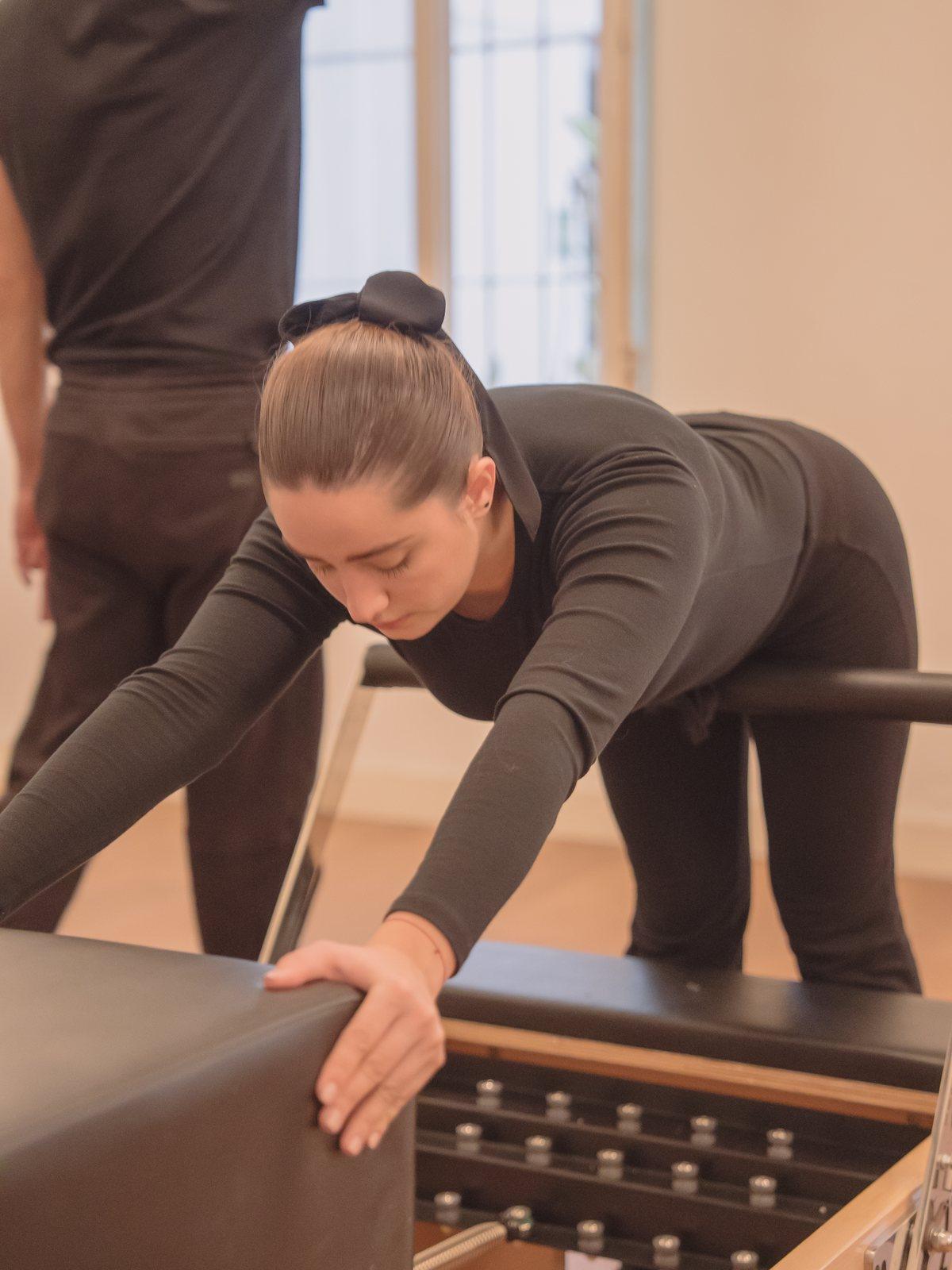
Low back pain affects between 50% and 80% of pregnant women. As the abdomen grows, the lumbar lordosis becomes more pronounced and the muscles of the lower back work at a mechanical disadvantage. The Reformer allows you to strengthen the transversus abdominis and the multifidus (the deep stabilisers of the spine) without compressive loads, working in unloaded positions such as side-lying or on all fours.
If you already had low back pain before pregnancy, we recommend reading our guide on Pilates for low back pain in Madrid, where we explain the mechanisms by which the Reformer acts on the lumbar area in more depth.
Improved Breathing
The lateral costal breathing practised in Pilates has a double benefit during pregnancy. On the one hand, it improves thoracic expansion at a time when the uterus compresses the diaphragm and reduces lung capacity. On the other, it trains a breathing pattern that is useful during labour, where breath control contributes to pain management and a more effective pushing stage.
Preparation for Birth
Reformer Pilates works on pelvic mobility (anteversion, retroversion, tilts, circles), hip opening, perineal flexibility and muscular endurance in the legs. All of these elements are relevant during a vaginal birth. Women who reach labour with a strong but flexible pelvic floor, a mobile pelvis and good body control have, according to the studies cited, shorter births with fewer complications.
Postural Control and Balance
The shift in the centre of gravity during pregnancy alters balance and increases the risk of falls. The Reformer, by working on a stable surface (the carriage moves on rails), allows you to train balance and proprioception safely. Standing exercises with support on the footbar or the platform work on balance with no risk of falling.
Reduced Swelling and Better Circulation
Leg exercises on the Reformer (footwork, leg circles, leg press) activate the muscle pump of the calves and thighs, improving venous return. This helps reduce fluid retention and swelling in the ankles and legs, which is especially common in the third trimester.
Reformer Pilates by Trimester: What to Do and What to Modify
First Trimester (Weeks 1 to 12)
The first trimester is the period of greatest fatigue and nausea for many women. If your gynaecologist has given you the go-ahead, you can practise Reformer Pilates as normal during these weeks, since the physical changes are still minimal.
What you can do:
- Exercises in the supine position (on your back) without restrictions
- Full footwork with all foot variations
- Core exercises (adapted hundred, gentle abdominal curls)
- Arm series with light springs
- Stretches and hip mobility exercises
- Short spine and long spine with caution
Recommended modifications:
- Reduce the intensity if you feel nauseous or markedly fatigued
- Avoid the Valsalva manoeuvre (holding your breath while straining)
- Stay constantly hydrated
- If you have had previous miscarriages or your pregnancy is high risk, consult your gynaecologist before doing exercises that increase intra-abdominal pressure
Important consideration: many women do not reveal their pregnancy during the first trimester. If you attend a group Pilates class, tell your instructor even if you prefer to keep it discreet from the group. She will adapt the exercises without drawing attention. At Pinar Pilates, with groups of a maximum of 8 people, communication with the instructor is direct and easy.
Second Trimester (Weeks 13 to 27)
Many women feel more energetic during the second trimester. Nausea usually subsides and the abdomen does not yet restrict movement too much. It is the period in which you can get the most out of training. However, the hormonal changes (increased relaxin) increase joint laxity, which calls for caution with extreme ranges of motion.
What you can do:
- Footwork with progressive adjustment of resistance
- Hip and pelvis mobility exercises
- Side-lying leg series
- Arm and upper-back work
- Pelvic bridges (with modification from week 20)
- Exercises on all fours (cat-cow, bird-dog)
Necessary modifications:
- From week 16-20, avoid prolonged supine positions. The weight of the uterus can compress the inferior vena cava and reduce blood flow. Use a wedge or raise the headrest of the Reformer to maintain a slight incline
- Reduce the range of motion in stretching exercises. Relaxin makes the joints seem more flexible, but going to extreme ranges increases the risk of injury
- Avoid exercises that generate excessive intra-abdominal pressure (classic hundred, unmodified double leg stretch)
- Replace deep trunk rotations with gentle versions
Third Trimester (Weeks 28 to 40)
The abdomen reaches its maximum size, fatigue returns, the lower back suffers and the pelvic floor bears the greatest load. Reformer Pilates is still beneficial, but the adaptations are more numerous.
What you can do:
- Footwork with moderate resistance and feet in a comfortable position
- Side-lying exercises (leg series, hip opening)
- Seated exercises (adapted mermaid, arm work)
- All fours (cat-cow, pelvic mobility)
- Costal breathing exercises with emphasis on active exhalation
- Gentle stretches for hamstrings, adductors and piriformis
- Specific pelvic floor work (contractions and relaxations)
Necessary modifications:
- Eliminate the supine position completely (work side-lying, seated or on all fours)
- Reduce spring resistance to prioritise control over strength
- Avoid exercises that require unsupported balance
- Eliminate jumps (jump board)
- Do not force the range of motion in any direction
- If you feel pressure in the perineum during an exercise, stop and tell your instructor
Exercises to Avoid during Pregnancy
Regardless of the trimester, there are exercises and movement patterns that must be eliminated or significantly modified:
Classic abdominals with trunk flexion. The classic hundred, full abdominal curls and any exercise that generates direct pressure on the linea alba increase the risk of diastasis recti (separation of the abdominal muscles). From the second trimester, replace these exercises with transversus abdominis activations in neutral positions.
Exercises in the prone position (face down). From the moment the abdomen starts to grow (usually between weeks 12 and 16), lying face down becomes uncomfortable and can compress the abdomen. Eliminate exercises such as swan, prone pulling straps and swimming on the Reformer.
Deep lumbar extension. Hyperextension exercises of the lumbar area (swan dive, back extension at maximum range) are contraindicated. The lumbar lordosis is already accentuated by pregnancy and adding extension increases compression of the facet joints.
Deep trunk twists. Intense trunk rotations compress the abdomen and can generate excessive tension in the uterine ligaments. Replace with gentle, controlled rotations with a limited range.
Jump board with impact. Although the Reformer cushions the impact, jumps generate pressure spikes on the pelvic floor that are not advisable during pregnancy. If your instructor suggests the jump board, the repetitions should be gentle and only in the first trimester with medical clearance.
Ballistic stretches or extreme ranges. Relaxin increases the elasticity of the ligaments, which makes stretches feel easier than they are. Going to extreme ranges can cause joint injuries. Keep stretches within a comfortable range, without forcing.
Warning Signs: When to Stop Exercising
Stop exercising and contact your gynaecologist or go to A&E if you experience:
- Vaginal bleeding
- Loss of fluid from the vagina (possible rupture of membranes)
- Regular, painful contractions before week 37
- Chest pain or difficulty breathing that does not ease when you stop
- Dizziness, feeling faint or blurred vision
- Sudden, intense headache
- Calf pain with swelling (possible thrombosis)
- Noticeable reduction in the baby’s movements
- Intense abdominal pain
- Sudden swelling of the face, hands or feet (possible pre-eclampsia)
These symptoms require immediate medical attention. Do not ignore them or wait for them to pass.
When You Should Not Do Pilates during Pregnancy
The Spanish Society of Gynaecology and Obstetrics and the American College of Obstetricians and Gynecologists (ACOG) establish absolute contraindications to exercise during pregnancy:
- Placenta praevia after week 26
- Premature rupture of membranes
- Pre-eclampsia or uncontrolled gestational hypertension
- Cervical insufficiency or cerclage
- Multiple pregnancy at risk of premature birth
- Persistent vaginal bleeding in the second or third trimester
- Intrauterine growth restriction
- Serious heart or lung disease
If you have any of these conditions, exercise is contraindicated unless explicitly indicated by your doctor. There are also relative contraindications (severe anaemia, unevaluated cardiac arrhythmia, chronic bronchitis, poorly controlled type 1 diabetes, morbid obesity, extreme underweight) that require individual assessment by your doctor.
Your Prenatal Pilates Plan at Pinar Pilates
At Pinar Pilates, located at Calle del Pinar 8, in Madrid’s Salamanca district, we have spent years working with pregnant women in our Reformer classes. This is what we offer:
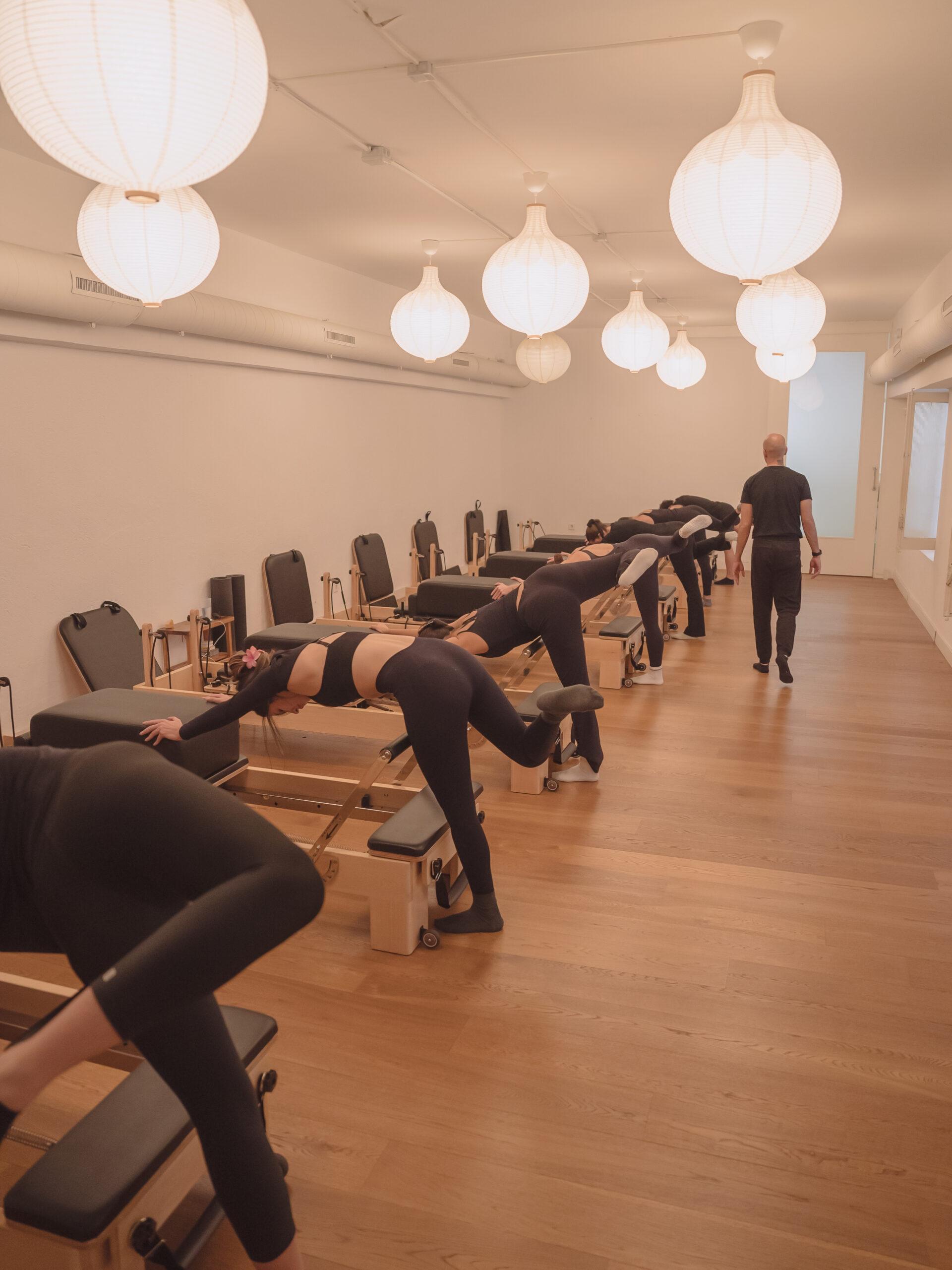
Small groups of a maximum of 8 people. Receiving a generic cue in a class of 20 people is not the same as having an instructor who watches you, corrects you and adapts each exercise to your week of pregnancy. Our small groups allow real attention.
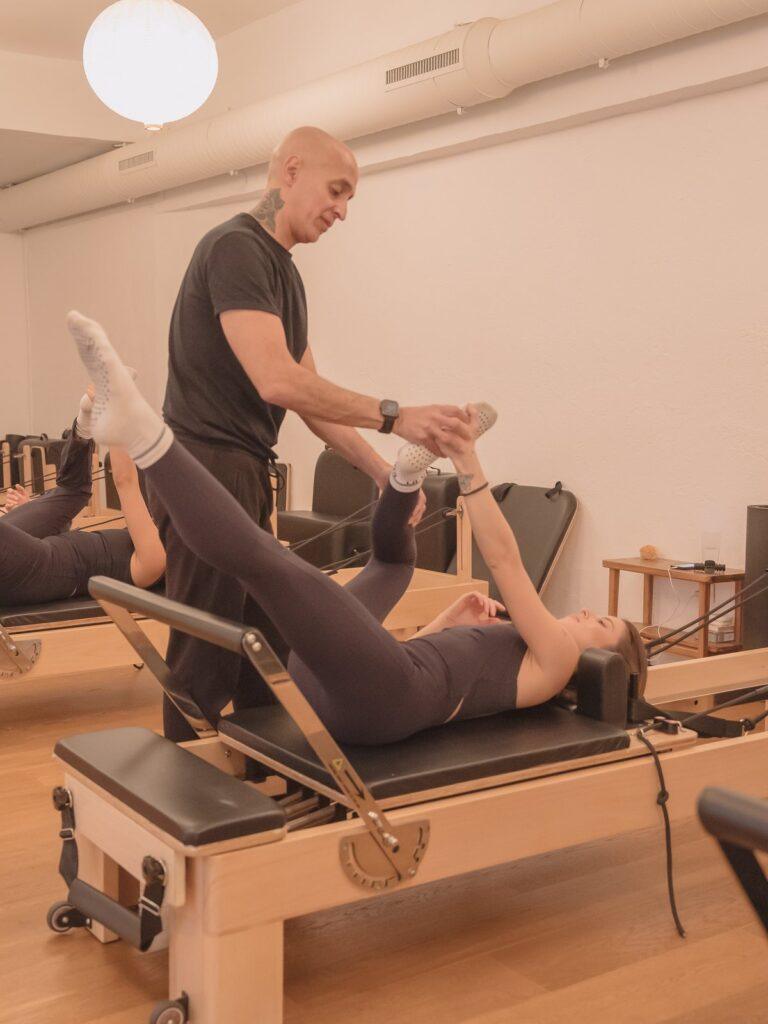
Instructors trained in prenatal Pilates. Our instructors know the contraindications, the adaptations by trimester and the warning signs. They know when to modify an exercise and when to replace it altogether. And they know that every pregnancy is different.
Communication with your medical team. If your gynaecologist or midwife has given you specific instructions (for example, to avoid certain movements because of a placental problem or a history of premature birth), we follow them to the letter. We are open to communicating with your healthcare professional if necessary.
Adapted progression. If you have never done Pilates and you are pregnant, you can start. We recommend reading our guide to your first Reformer Pilates class to know what to expect. You will begin with basic exercises and progress at your own pace.
Recommended frequency. The studies demonstrating the benefits of prenatal Pilates used between 2 and 3 sessions per week. This is the frequency we recommend for results in pelvic floor strengthening, low back pain relief and preparation for birth. If you prefer to start with less, 1 session per week already brings benefits, although more gradually.
Prices. Our monthly rates range from 100 euros per month (4 classes) to 250 euros per month (unlimited plan). For pregnant women looking for a frequency of 2 to 3 times a week, the 12-class pack at 200 euros per month or the unlimited plan at 250 euros per month offer the best value for money. If you want to try first, a single class costs 30 euros.
Our more than 490 Google reviews (average 4.9 out of 5) reflect the experience of students who have come to our studio during pregnancy and returned for their postnatal recovery.
Frequently Asked Questions
Can I start Reformer Pilates if I have never done it and I am pregnant?
Yes, with your gynaecologist’s authorisation. You do not need previous experience. The instructors adapt the exercises to your level and your week of pregnancy from day one. You will start with the fundamentals (breathing, core activation, neutral position) and progress gradually. Read more about what a first Reformer Pilates class is like.
Is it safe to do Reformer Pilates throughout pregnancy?
In low-risk pregnancies and with medical clearance, yes. The necessary adaptations increase as the pregnancy progresses, but the Reformer can be practised safely until the final weeks of pregnancy. What matters is having qualified supervision and respecting your body’s signals.
How many times a week should I do Pilates during pregnancy?
The evidence suggests that 2 to 3 sessions per week is the optimal frequency for significant benefits. The study by Yilmaz et al. (2023) found that 8 weeks of Pilates at this frequency produce measurable improvements in pain and preparation for birth. If you have time or budget limitations, 1 session per week is still better than none.
Does Reformer Pilates help with diastasis recti?
Reformer Pilates, done well, strengthens the transversus abdominis without overloading the rectus abdominis, which helps prevent diastasis during pregnancy. After birth, the Reformer is an excellent tool for recovering from diastasis. What matters during pregnancy is to avoid exercises that generate direct pressure on the linea alba (classic abdominals, full hundred).
Can I keep doing Pilates if I have sciatica during pregnancy?
In most cases, yes, and in fact it can help you. Sciatica during pregnancy is usually caused by compression of the sciatic nerve due to the growth of the uterus and postural changes. The Reformer allows you to work in unloaded positions that relieve compression, strengthen the stabilising muscles and improve hip mobility. Consult your gynaecologist and tell your instructor so she can adapt the exercises.
And after the birth?
Reformer Pilates is one of the best tools for postnatal recovery. It allows you to strengthen the pelvic floor, close diastasis recti, restore lumbopelvic stability and recover strength progressively and safely. Check with your gynaecologist or midwife when you can return to exercise (usually between 6 and 8 weeks after a vaginal birth, and between 8 and 12 weeks after a caesarean).
Are you pregnant and want to look after your body during pregnancy? Book your first class with 50% off at Pinar Pilates. Our instructors will adapt every exercise to your trimester and your needs.
Call us on +34 611 994 729 if you have doubts about whether Reformer Pilates is right for your pregnancy. We will be happy to guide you.
You may also be interested in: Pilates for Low Back Pain in Madrid, Your First Reformer Pilates Class and Small-Group Pilates in Madrid.
Pinar Pilates · Salamanca district, Madrid
Your first reformer class, €15
Groups of 8 people maximum, specialist instructors and more than 40 classes a week. Your first class is half price.
Book my first classCalle del Pinar 8, Madrid · Questions? Message us on WhatsApp